
LSA-451
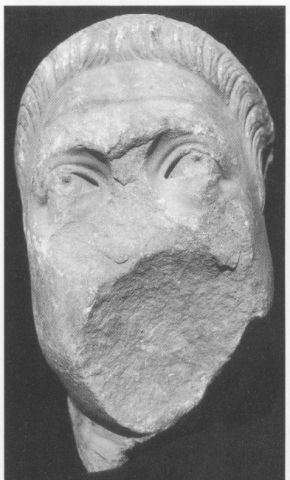
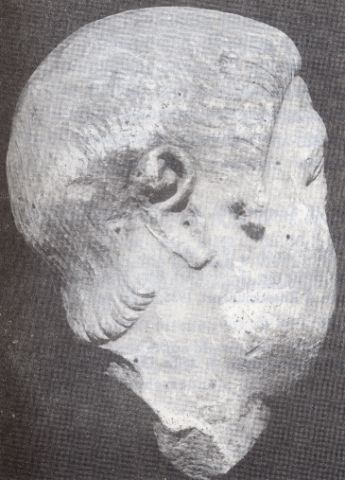
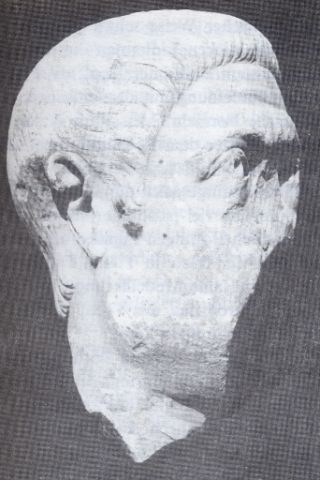
Portrait head of mature man with short hair and no beard. From area of Bodrum. Late fourth century.
Record details
Photographs
Bibliography
- Meischner, J. ‘Ein theodosianisches Porträt’ , Études et Travaux 15 , Warsaw 1990, 258-264, figs. 1-3. (395-410)
Discussion
DESCRIPTION (Object)
Over life-size head. H: 30 cm. Fine-grained white marble, with cream-coloured surface.
The head is broken at the neck. A large area of the lower face, which includes the mouth, chin, and left jaw, and left side of the neck, is missing. The nose is also missing. The rim of the right ear is chipped.
The hair is rendered with a flat chisel, and the pupils are drilled out in a full crescent shape.
PROVENANCE
The head was found in the 1980s in Bodrum (Meischner, JdI 1991, 404).
DESCRIPTION (Subject)
The head depicts a clean-shaven man with a long face and lank hair that is combed forward. A deep furrow across the brow and two vertical creases above the nose suggest that he is of mature age.
The brow is tall and bulges beneath the crease. The eyebrows project and have a high arch. The eyes have straight lower lids and arching upper lids. The lower face is long and broad.
The hair follows the shape of the head and indents at the base of the neck. The locks are slightly wavy. Over the brow the hair is cut in a high arch and their ends curve downwards; this creates almost a part over the nose. On the nape the hair is long, and the ends curl upwards.
DATE
The brushed -forward hairstyle combined with a clean-shaven face is a fashion that appears on all imperial portraits of the fourth-century after Constantine and is attested in private portraits on the Obelisk of Theodosius. LSA-154, LSA-160, LSA-180 and LSA-252 provide private examples of this fashion style.
Here specific details of fashion (the straightness of the hair, the high arc of the fringe over the brow) and the technique (the heavy crescent shape pupils, and the indentation at the base of the skull) suggest a date in the later fourth century.
Discussion references
- Meischner, J., Bildnisse der Spätantike : 193-500 : Problemfelder : die Privatporträts , Berlin 2001, figs. 349-350
- Meischner, J., 'Das Porträt der theodosianischen Epoche II (400 bis 460 n. Chr.),' , Jahrbuch des Deutschen Archäologischen Instituts, 106 (1991), 385-407, 404, pl. 92.4
Cite: Last Statues of Antiquity, LSA-451 (J. Lenaghan).