
LSA-452
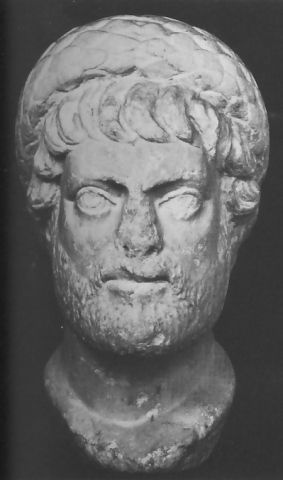
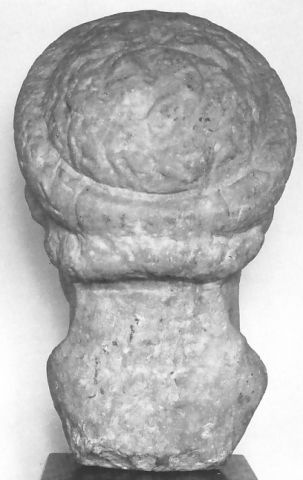
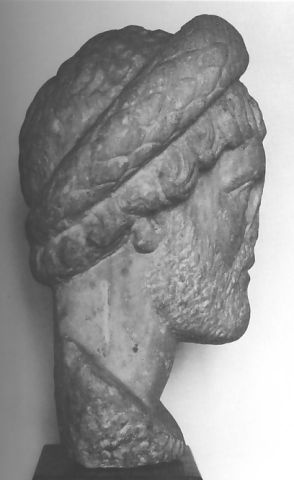
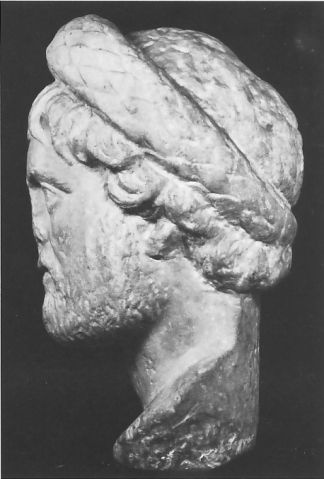
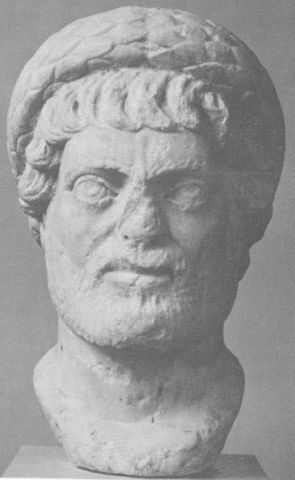
Separately worked portrait head of priest with laurel crown. Probably from Asia Minor. Late third century.
Record details
Photographs
Bibliography
- Inan, J. & E. Alföldi-Rosenbaum, Römische und frühbyzantinische Porträ̈tplastik aus der Türkei : neue Funde, Mainz 1979, 310-11, no. 307, pl. 217
- Stutzinger, D. (ed.), Spätantike und frühes Christentum. Ausstellung im Liebieghaus, Museum alter Plastik, Frankfurt am Main. 16. Dezember bis 11. März 1984, Frankfurt a.M. (1983), 493, no. 97
Discussion
DESCRIPTION (Object)
Over life-size head, separately worked. H: 39, W: 24 cm. H (chin to crown): 29 cm. Fine-grained white marble.
The head is preserved with the neck and a small area of chest. It was worked separately for insertion with a conical plug. Its lower surface is roughly picked (in order to create a gripping join), and the back of the neck has been cut vertically (so as to permit it to be fitted). The nose is missing. The left side of the upper lip is damaged.
The drill has been used sparingly. The iris of the right eye is marked by two concentric rings. The pupils appear to be drill holes. The eyes have pointed inner canthi.
The head has been re-cut. The vertical cut at the back of the neck and the eye markings suggest this. Also the beard is separated from the face by a neat line. The beard itself has been roughly engraved into the face. Finally the ears are awkwardly handled.
PROVENANCE
Asia Minor
DESCRIPTION (Subject)
The head depicts a bearded man with thick hair and a laurel crown. The hair falls across the brow in large C-shaped locks. The beard is short. The physiognomy is regular. The eyes seem unusually large beneath low eyebrows.
DATE
It is difficult to assess this portrait from photographs. The eyes and beard do appear to have been re-worked and the back of the head has been adapted for a fit, probably not the original one. All scholars are unanimous in giving it a late third century date because of the awkward re-cutting, the short beard, and wreath. A laurel wreath, the indicator of a priest, would be an unusual attribute from the later fourth century onwards.
Discussion references
- L'Orange, H. P., Das spätantike Herrscherbild von Diokletian bis zu den Konstantin-Söhnen, 284-361 n. Chr. Das Römische Herrscherbild. III. Abteilung ; Bd. 4 , Berlin 1984, 96 (Diocletian)
Cite: Last Statues of Antiquity, LSA-452 (J. Lenaghan).