
LSA-457
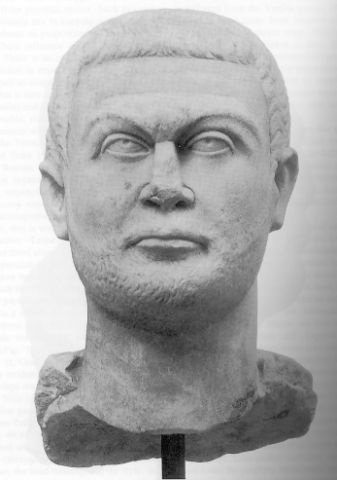
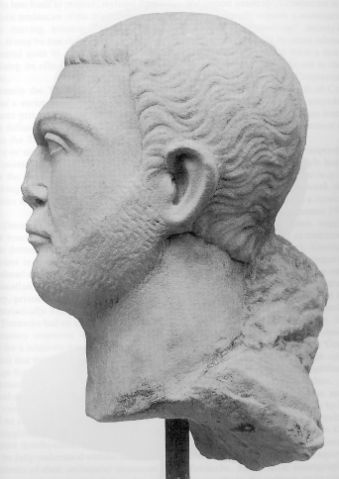
Portrait head of short-bearded man from togate (?) statue. From Asia Minor. Later third century.
Record details
Photographs
Bibliography
- Frel, J. , Roman portraits in the Getty Museum, Tulsa 1981, 112-113, 132, no. 93 (togate Tetrarch)
Discussion
DESCRIPTION (Object)
Over life-size head. H: 35 cm. White marble (according to Frel, Thasian?).
The head was worked together with its statue. It has broken below the neck and around the clavicle. Drapery is preserved around the neck. The head is supported by a thick pillar of roughly worked stone at the back of the neck.
The drill has been used sparingly; the pupils are marked by circular holes. The hair and beard are rendered with a flat chisel.
The head has probably been re-cut. The lack of depth at the chin, the engraved beard, the backward sloping forehead, the irregular thickness in the hair at the left ear all suggests this. The ears might provide further evidence of this but they are not clearly visible in the published photographs.
PROVENANCE
Asia Minor
DESCRIPTION (Subject)
The head depicts a mature man with short hair that is brushed forward and a short beard which is engraved into a slightly raised surface. The short hair across the brow has a small part at the centre. The physiognomy is marked by a single deep crease across a backward sloping brow and by the high stiff arch of the eyebrows. The eyebrows converge at a deep indentation at the root of the nose.
A thick fold wraps around the neck. It follows a vertical path very close to the left side of the neck. There is a trace of an undergarment below it. Frel identified this as a togate statue, and the vertical cut channel along the left side of the neck seems most suitable for that interpretation.
DATE
The beard and hairstyle belong to mid- third century or later. Here they are combined with the inorganic stiffness of the re-cut physiognomy; this is a stylistic tendency associated with the portraits of the Tetrarchy.
L’Orange identified this as a portrait of Galerius. Frel called it more generally a Tetrarch. There is, however, no attribute that securely identifies it as the portrait of an emperor. It might come from a togate statue and it might come from Asia Minor; a large togate statue in Asia Minor in the later third century is more likely to represent a Tetrach than anyone else.
L. Frey in a discussion of LSA-2112 argues that portraits with pupils marked by single drill holes (as also LSA-371and LSA-701) are best dated to the middle of the third century. It is interesting to consider whether this technical tendency might be particularly strong in a geographic area and might be a regional rather than chronological detail; all of these portraits might well come from the same part of Asia Minor.
Discussion references
- L'Orange, H. P., Das spätantike Herrscherbild von Diokletian bis zu den Konstantin-Söhnen, 284-361 n. Chr. Das Römische Herrscherbild. III. Abteilung ; Bd. 4 , Berlin 1984, 108, pl. 21c-d (probably Galerius)
Cite: Last Statues of Antiquity, LSA-457 (J. Lenaghan).