
LSA-458
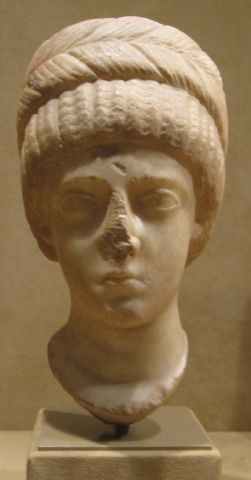
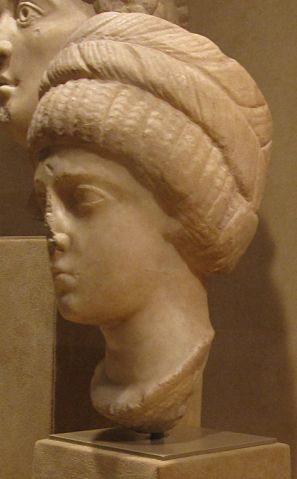
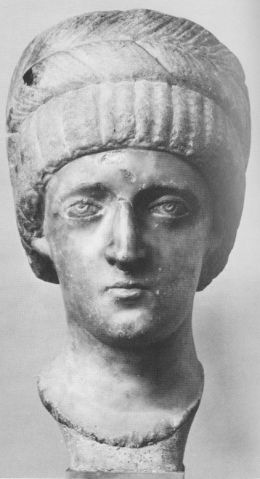
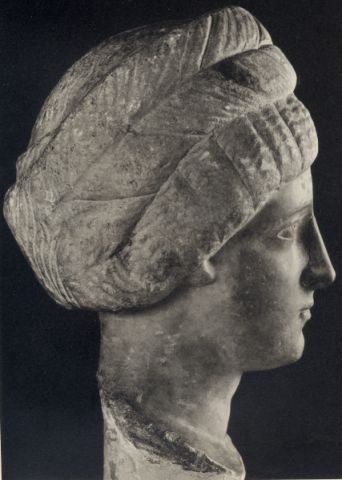
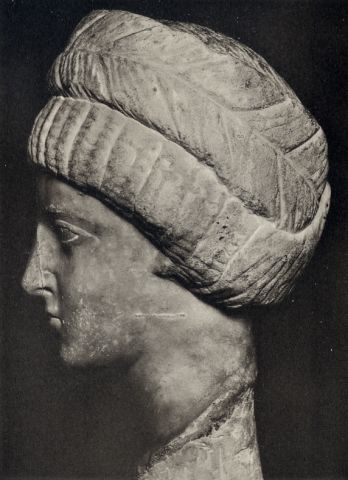
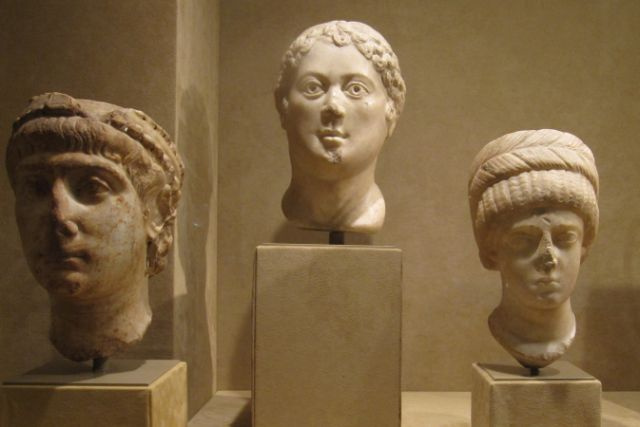
Under life-size head of young woman with crimped hair and encircling braids. Unknown provenance. Mid to late fourth century.
Record details
Photographs
Bibliography
- Delbrueck, R., Spätantike Kaiserporträts. Von Constantinus Magnus bis zum Ende des Westreichs , Leipzig 1933, 202-3, pls. 99-101(Aelia Flaccilla)
- Langlotz, E., Die Kunstsammlungen Baron Heyl, Darmstadt. Zweiter Teil
, Munich 1930, 4, no. 29, pl. 11
Discussion
DESCRI PTION (Object)
Under life-size head, worked separately. H: 26.7, W: 11.1 cm. White marble.
The head has been worked separately. It has a roughly worked tenon at the underside of the neck. The tip of the nose is missing.
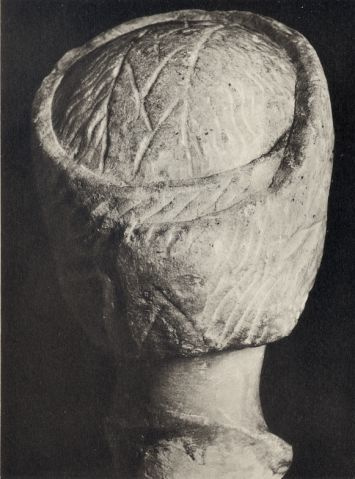
The hair is rendered entirely with a flat chisel; it is only schematically indicated at the back. The pupils and irises are indicated by two parallel U-shaped engravings. The portrait may have been worked out of another head. There is a deep depression at the base of the neck, and the bare chest area is higher than the neck; the bare chest area, therefore, behaves as if it were clothing. The ear lobes are also crudely indicated.
PROVENANCE
From collection of Baron Max von Heyl (Darmstadt), then Calmann collection, then Museum fur Kunst und Gewerbe Hamburg.
DESCRIPTION (Subject)
The head portrays a woman with a tall crown of ‘encircling braids’. The area of the hair over the brow is crimped into short wavy horizontal sections and is without a part. Above it are two twisted braids of hair that are wrapped like a crown or turban above. Engraved in the hair above the twisted braids is a vertical band that looks to be a central braid. In general the hair sits, as if it were a large over-size hat, over a sweet face.
The face is oval with full softly-modelled flesh. The brow is low; the eyebrows slope downwards; and the bow-shaped mouth is short from side to side. The small round chin is defined.
DATE
The hairstyle belongs no earlier than the fourth century. The same is true for the rendering of the eyes. Neither however can be more tightly defined with confidence. Delbrueck identified the honorand as Aelia Flacilla; there is however no imperial iconography in the extant portrait. Von Heintze then placed it in the mid-fourth century; Schade placed it in the early Theodosian period.
LSA-409 and LSA-575 wear similar hairstyles.
Discussion references
- Schade, K., Frauen in der Spätantike--Status und Repräsentation, Mainz 2003, 190-91, no. I 31, pl. 41.3-4 (early Theodosian)
- von Heintze, H. ‘Ein spätantikes Mädchenportät in Bonn. Zur stilitischen Entwicklung des Frauenbildnisses im 4. und 5. Jahrhundert’, Jahrbuch für Antike und Christentum 14, Münster 1971, 73, no. III 4 (mid fourth century)
Cite: Last Statues of Antiquity, LSA-458 (J. Lenaghan).