
LSA-459
Epigram for governor under central niche at Nymphaeum Traiani: building dedication, or for statue. Ephesus (Asia). Fourth or fifth century.
Record details
Photographs
Inscription
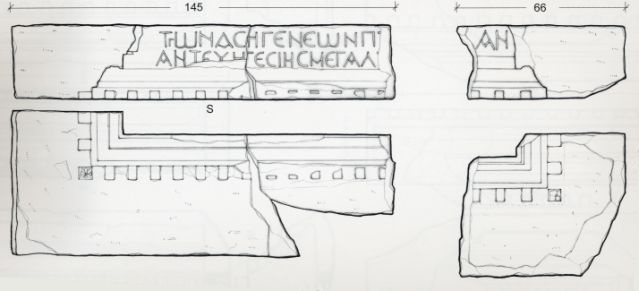
τῶν ἀσιηγηνέων π[......]αν / ἀντ’ εὐηγεσίης μεγαλ[...]
Inscription translation
...of those coming from Asia...on account of his great good government
Bibliography
- Quatember, U., Das Nymphaeum Traiani in Ephesos. Forschungen in Ephesos, XI,2, Vienna 2011, 25-6 nos. 6-9 and 6-10, 86 no. 9.3, 106-109, pl.63
- Wankel, H. et al. (eds.), Die Inschriften von Ephesos III. Inschriften griechischer Städte aus Kleinasien, vol. 13, Bonn 1980, 1, no. 600 A
Discussion
INSCRIPTION
In two lines.
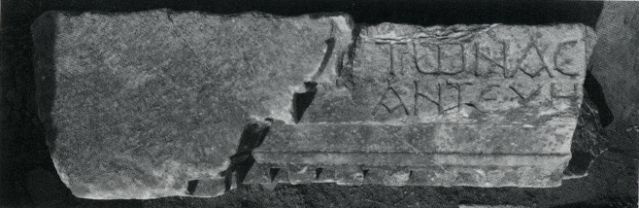
τῶν ἀσιηγηνέων π[......]αν
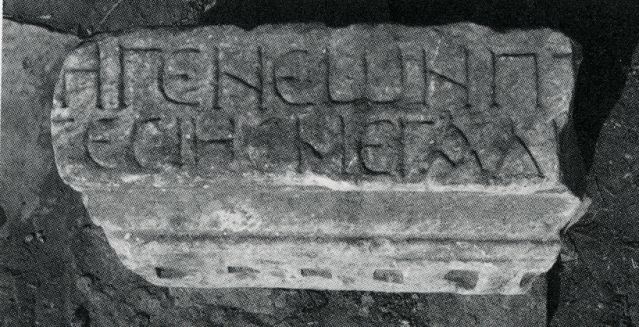
ἀντ’ εὐηγεσίης μεγαλ[...]
‘...of those coming from Asia...on account of his great good government’
PROVENANCE
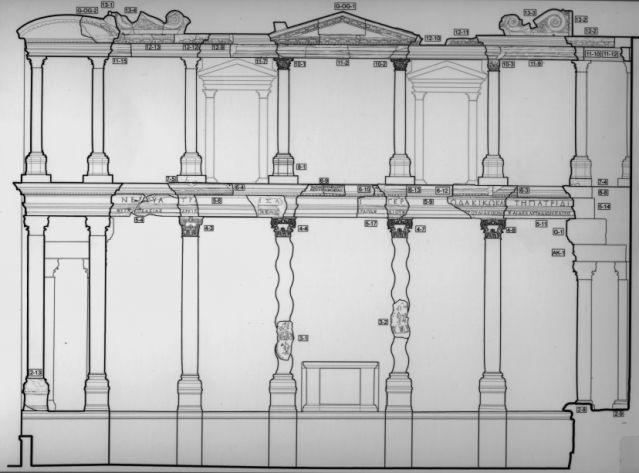
From the facade of the Nymphaeum Traiani.
DESCRIPTION.
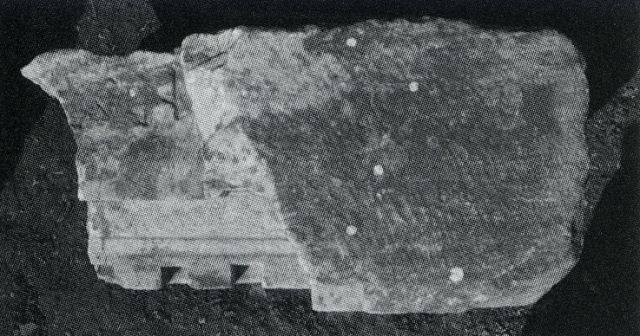
Two, adjacent blocks of recessed cornice. (1) H: 28, W: 145, D: 54.5 cm. (2) H: 28, W: 66, D: 63 cm. White marble.
Both blocks are broken, and no longer join. A significant portion of the second is missing. On both the profiles have been altered so as to receive the inscription. On the upper side of block (2) there is a deep, roughly picked area at the back.
CONTEXT
The early second-century Nymphaeum Traiani had adjustments made to it probably in the fourth cenury or fifth century. The evidence for this is minor repair work, the late-antique inscription for a proconsul, and a re-organization of the statue program; see, for example, the re-worked statue of a woman LSA-684 found there. In the late period, considerable refurbishing was done at Ephesus in various water works (for example, Nymphaeum in Upper Agora, Nymphaeum at Library of Celsus, in terrace houses), and by the sixth century this Nymphaeum seems to have been defunct.
The late-antique inscription was added to and confined within the cornice of the central niche of the second storey. It did not run across the entire facade and seems to label a particular area.
DATE, HONORAND, HONOUR
The lettering is late, and its position clearly indicates that it was added at a second moment. The honorand should probably be associated with a proconsul because of the reference to his good government.
Whether there was a statue placed above this cornice block or whether it was simply a building inscription remains unclear. It presents the same problem as a contemporary inscription on the Library of Celsus LSA-487 and one from the Theatre at Perge LSA-283. An inscribed lintel, LSA-234, from Aphrodisias almost certainly carried the statue of its builder.
In this case, the statue presumably would have been placed near the middle where the blocks are broken. One also wonders why an inscription honouring the building would not run the full width of the cornice, especially as the original inscription runs across the entire architrave below.
Cite: Last Statues of Antiquity, LSA-459 (J. Lenaghan).