
LSA-46
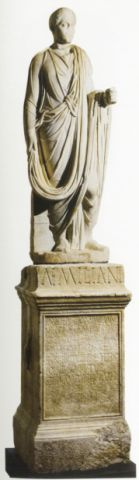
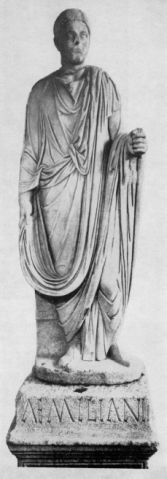
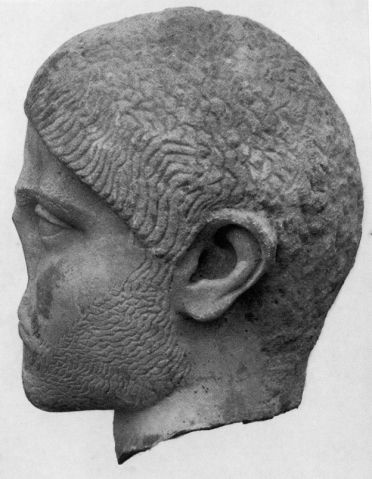
Toga statue of Virius Audentius Aemilianus, governor of Campania (with base LSA-41). Puteoli (Campania). 365-379.
Record details
Photographs
Bibliography
- Camodeca, G., 'Ricerche su Puteoli tardoromana (fine II-IV secolo)', Puteoli, IV (1981) 59-128, 90, 106-107
- Gehn, U., Ehrenstatuen in der Spätantike. Chlamydati und Togati, Wiesbaden 2012, 504-13 cat. no. W 4
- Napoli, M. , 'Statua ritratto di Virio Audenzio Emiliano consolare della Campania', Bollettino d'Arte 44, Milan 1959, 107-113, figs. 1-7
- Zevi, F. [et al.]., Museo Archeologico dei Campi Flegrei: Castello di Baia. II. Catalogo generale. Pozzuoli., Naples 2008, 151 (F. Demma)
Discussion
DESCRIPTION (Object)
Life-size statue. H: 180, W: 62.5, D: 40 cm. H (of head): 25, H (of plinth): 8 cm.
The statue was worked in one piece from the head to the plinth. The head broke off the statue but was found next to it and has been reattached. The nose, which was restored in antiquity, is missing. The surface has been evenly prepared, and an iron pin once in that surface has now been removed.
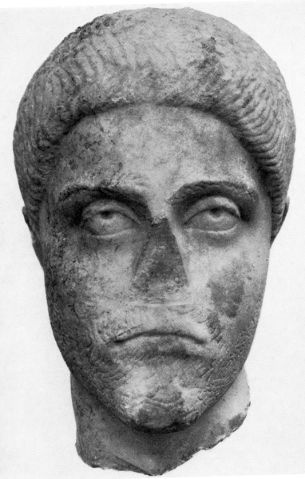
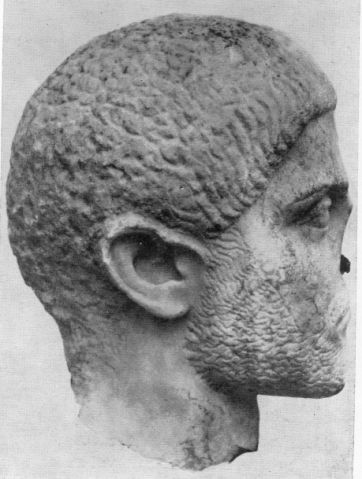
The hair, both on the head and face, has been completely rendered with chisel work. The fringe consists of regularly engraved slightly curving, parallel lines. Behind this short unruly locks are more coarsely worked and and then behind the ears the locks are not even defined. The irises are not engraved, and the pupils are large holes.
The portrait head has been re-cut (despite Napoli’s assertions to the contrary).The hair of the original portrait was fuller, fell long on the nape of the neck, and probably covered the tops of the ears which now have an abbreviated and awkward upper edge. Part of an original lock, running from the right ear into the cheek, is still preserved. The eyebrows have been engraved into the original orbital ridge. The pupils have been enlarged. The beard has been engraved into the surface of the face. The downturned mouth, which lacks an upper lip, suggests that the original portrait had a moustache. Even the elongated shape of the face and chin may depend on the fact that the original portrait had a full beard.
The statue body may also have been adjusted. The right hand is extremely awkward. On the bottom edge of the toga at the right heel are two letters which appear to read, V F. Possibly the V is elided with an L and the F with a T. This suggests that V... fecit. To this author this seems probably belong to the sculptor who re-cut the statue.
PROVENANCE
Found in Via Rosini in 1955 during building works on the ‘Educandato femminile’. This corresponds to a monumental forum area of Rione Terra that dates back to the Neronian area. The Educandato femminile was removed in the 1990s and extensive study of the area was undertaken.
DESCRIPTION (Object)
The statue shows a bearded man dressed in a traditional toga, tunic, and leather shoes with straps. It was found with its base (LSA-41)which identifies it as a statue of Virius Audentius Aemilianus.
He stands with his weight over his right leg. The right arm, covered almost entirely by the sleeve of the tunic, rests at the side of the body and holds the edge of the sinus. The left arm is bent at a 90 degree angle and supports the end of the toga. In the left hand is a cylindrical object, probably a scroll. A box, held together by a strap, rests against the right leg. The feet rest on an unmoulded oval plinth.
The head turns to its left. The face is long with a deep chin. The tall brow is framed by straight hair which is brushed forward. The large eyes have heavy eyelids but relatively low eyebrows. A moustache and beard are engraved into the surface. There are no specific signs of age.
IDENTIFICATION
Virius Audentius Aemilianus (PLRE I, 22, Aemilianus 4) is attested both in Campania and in Africa. Several of the attestations involve the setting up of statues (see LSA-1921, LSA-1958, LSA-1959, LSA-2340, LSA-2341). He was the proconsul of Africa as a vir clarissimus and eminentissimus during the period that Gratian was senior Emperor, 379-383, and was the proconsul of Campania and vir clarissimus between 364 and 378 at a point when two emperors reigned (see LSA-1929). For a full discussion, see LSA-41.
IMPORTANCE
This is one of the most closely dated portrait statues of the fourth century. It is an example both of the fashion of the 360s-370s and of the constraints of re-use. Aemilianus wears the old-fashioned toga because that is what was available, and his physiognomy is dictated by the extant portrait. Both of these details, however, must have been entirely acceptable and satisfactory to the fourth-century viewer and demonstrate a great continuity with the past.
Cite: Last Statues of Antiquity, LSA-46 (J. Lenaghan).