
LSA-460
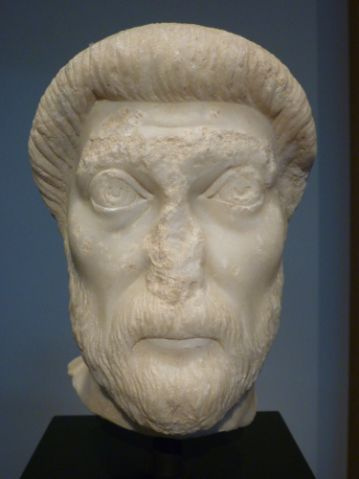
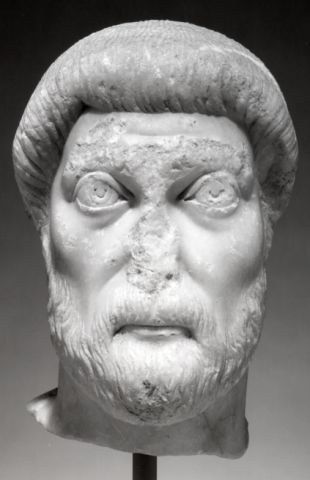
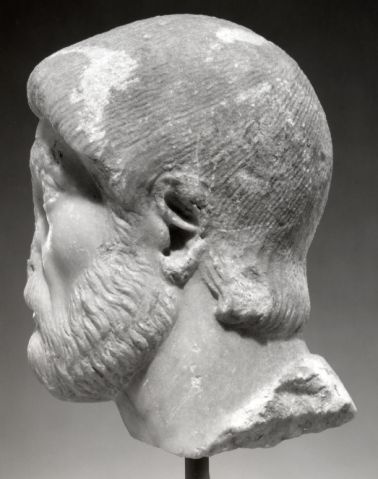
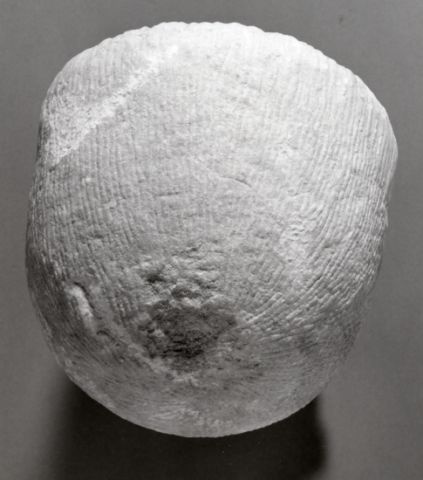
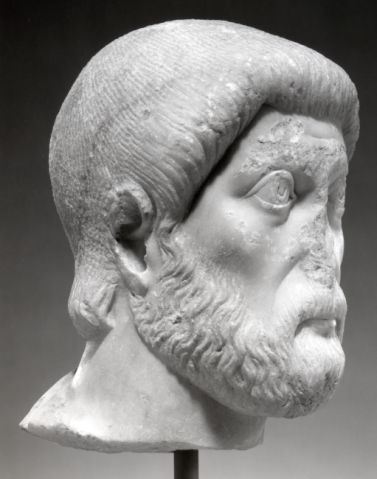
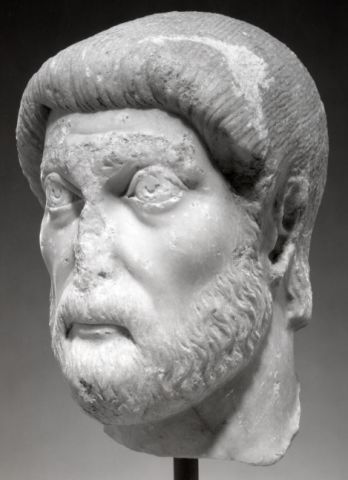
Portrait head of bearded man from statue wearing chlamys. From Asia Minor? First half of fifth century.
Record details
Photographs
Bibliography
- Jucker, H. and D. Willers (eds.) , Gesichter : griechische und römische Bildnisse aus Schweizer Besitz: Ausstellung im Bernischen Historischen Museum vom 6. November 1982 bis 6. Februar 1983, Bern 1983, 224-5, no. 95A (late Theodosian)
- Stutzinger, D. (ed.), Spätantike und frühes Christentum. Ausstellung im Liebieghaus, Museum alter Plastik, Frankfurt am Main. 16. Dezember bis 11. März 1984, Frankfurt a.M. (1983), 460-61, no. 67
Discussion
DESCRIPTION (Object)
Life-size head with neck. H: 29 cm. Fine-grained white marble.
The head is broken at the base of the neck. The nose is missing, and the brow and centre of the chin are chipped.
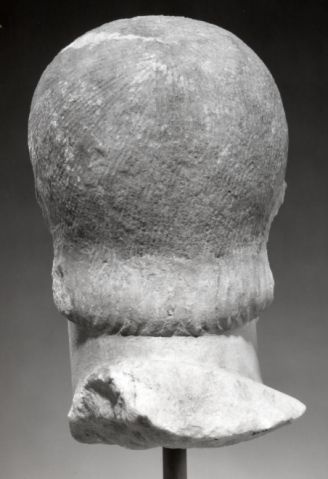
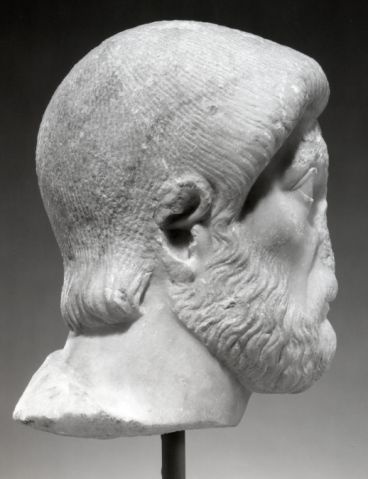
The head was worked together with its statue. The hair (facial and on head) as well as the irises are finely engraved with a flat chisel. The pupils have a U-shape which was made with a narrow bull-nosed chisel.
PROVENANCE
The marble and manufacture suggest that the head comes from Asia Minor; see the comparanda listed under DATE.
DESCRIPTION (Subject)
The preserved head and neck show a mature bearded man with hair brushed forward. A chlamys covers the lowest part of his neck. The portrait belonged originally to a statue.
The hair is thick around the face and curves inward at the base of the skull, at the back of the head. The locks of the fringe all turn to the proper left and create a small fork motif above the outer corner of the right eye.
The brow is marked by one extant crease. The cheekbones protrude, and the naso-labial folds are deep. Only the lower lip is visible. The eyes are large with pointed inner canthi and high-arching upper lids.
DATE
The fashion style of the honorand belongs to the late fourth or early fifth century; see the base of the Obelisk of Theodosius. The shape of the hair around the brow is similar to that of a Theodosian prince, LSA-163, which is securely dated between 388 and 392. The finely engraved strands of the top and sides of the head find close parallels in the portraits of a Theodosian Emperor from Beyazit, LSA-337, and a man from Side, LSA-252. The rendering of the eyes are extremely close to some of the tondi portraits from Aphrodisias and suggest a date in the early fifth rather than the late fourth century. The inner canthi and the markings of pupil and iris are almost identical to those of the ‘Old Philosopher, LSA-207. It is worth noting that a lost head from Aphrodisias, LSA-178 shows a similarly-styled man who is technically rendered in an analogous manner.
Cite: Last Statues of Antiquity, LSA-460 (J. Lenaghan).