
LSA-464
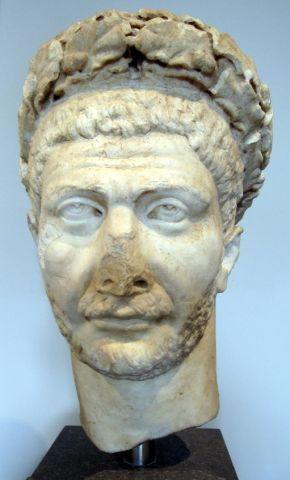
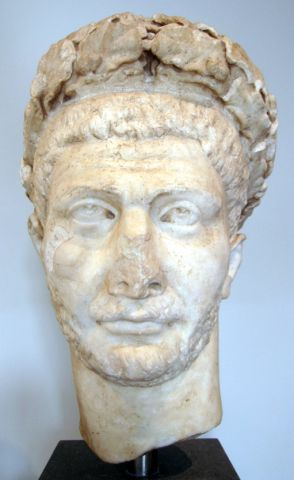
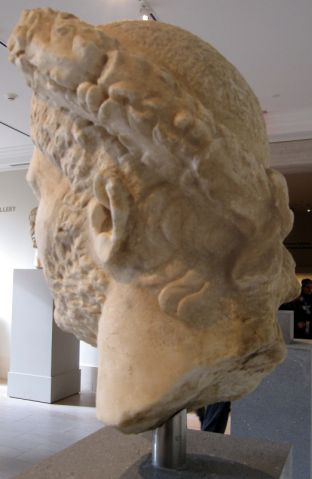
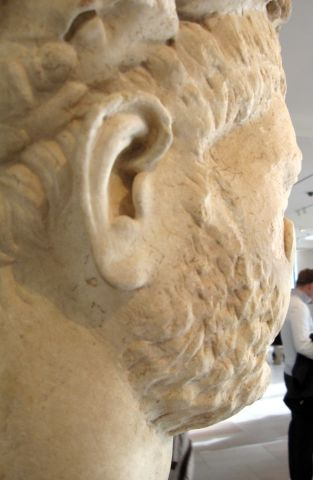
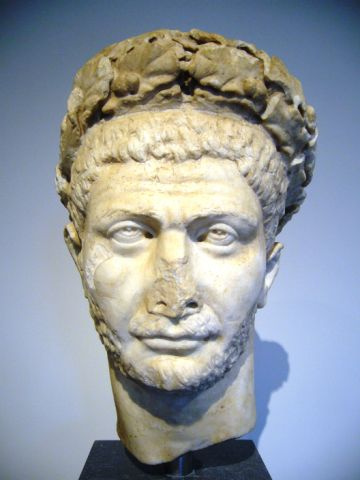
Re-cut portrait of Emperor wearing corona civica. From Asia Minor? Late third century.
Record details
Photographs
Bibliography
- von Bothmer, D. (ed.), Glories of the past : ancient art from the Shelby White and Leon Levy collection, New York 1990, 224, no. 165
Discussion
DESCRIPTION (Object)
Over life-size head. H: 40.7, W: 27.6, D: 22.5 cm. White marble.
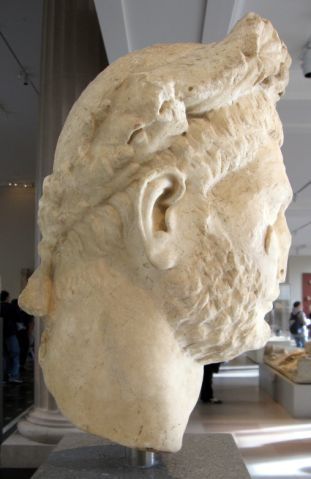
The head has broken off a statue (indicated by size of portrait and small area of neck pillar) at the base of the neck. The lower part of the nose is missing. There is a chip in the right cheek.
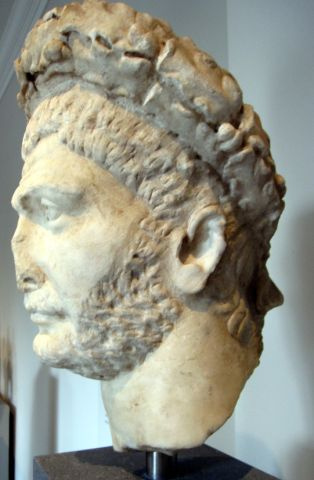
The head has been re-cut from an earlier portrait. The hair beneath the corona civica has been turned into short straight locks that fall forward. They are now marked with a flat chisel. The longer hair of the original portrait is visible behind ears, especially the left one. The beard has been rendered in the same way as the new hair on a raised surface (the surface of the original portrait). The mouth and moustache are awkwardly handled.
Each pupil has been marked by a U-shaped drilled out area. There are deep drill holes in the inner canthi. The irises are engraved semi-circles.
PROVENANCE
Probably Asia Minor. Possibly Perge (see below).
DESCRIPTION (Subject)
The head shows an emperor who wears the corona civica and who turns to his left. He has short-cropped hair and a short-cropped beard. Two creases cross the brow, and vertical lines of contraction are visible above the nose. The root of the nose is deeply indented. The ties of the fillet of the crown are visible at the back of the neck.
DATE AND HONORAND
The head represents an Emperor of the later third century; his portrait has been re-cut from that of an earlier emperor. The corona civica, which was not worn after the early fourth century, provides a terminus ante quem.
The head technically, stylistically, and iconographically almost identical to LSA-2354 and LSA-2542, the latter of which was excavated at the Theatre of Perge. Another portrait from the same context in Perge, LSA-2543, repeats the same technique and iconography with a slightly longer beard. It is conceivable that these four portraits represented the Tetrarchs.
Cite: Last Statues of Antiquity, LSA-464 (J. Lenaghan).