
LSA-466
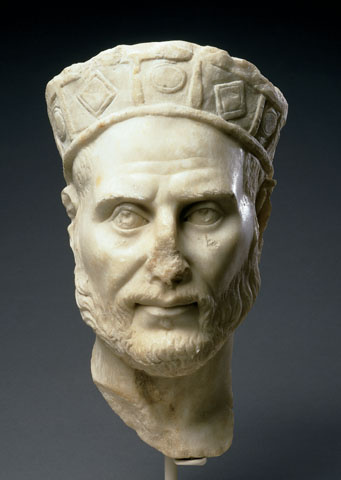
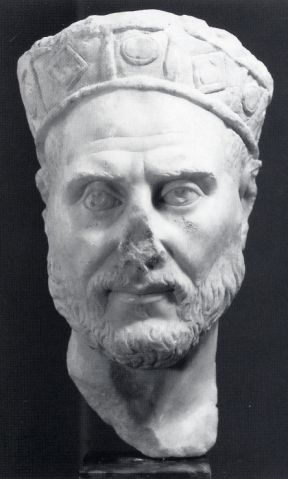
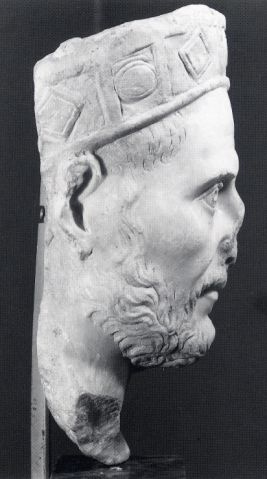
Portrait head of man wearing crown decorated with geometric designs. From Asia Minor? Late third century to fourth century.
Record details
Photographs
Bibliography
- Rumscheid, J., Kranz und Krone : zu Insignien, Siegespreisen und Ehrenzeichen der römischen Kaiserzeit, Tübingen 2000, 87, 186, no. 153, pl. 59.3-4 (post-Gallienic to pre-Tetrarchic)
- Vermeule, C.C., Greek and Roman sculpture in America : masterpieces in public collections in the United States and Canada , Berkeley 1981, 369, no. 320
Discussion
DESCRIPTION (Object)
Life-size head, separately worked. H: 37, W: 22.2, D: 18 cm. Marble.
The head was worked with its neck for insertion into another element. There is a chip on the bottom right side of the neck, in the nose, and in the shells of the ears. The bottom surface of the neck is flat and slants from the base of the neck at the front upwards to the base of the skull. The back of the neck seems to have been cut vertically. The back of the head is apparently not preserved.
The flat chisel has been used to render the short hair of the head, the longer hair of the beard, and the hair of the eyebrows. The pupils are drilled out in deep heart shapes. The irises and inner canthi are indicated with engraved lines.
PROVENANCE
From Greece or Asia Minor.
DESCRIPTION (Subject)
The preserved head and neck shows a mature man with a full beard, short hair that recedes significantly over the centre of the brow, and a tall crown. The tall crown is divided into rectangular sections in each of which has a jewel in a bezel; the jewels alternate in oval and diamond shapes.
The face features two fine lines across the brow, some lines of contraction over the root of the nose, broadly spaced projecting cheekbones, and large eyes.
DATE
The general fashion style of short hair and longer beard belongs in the later third century. Thus, Vermeule dates the portrait to 260-280, and Rumscheid gives a just slightly later range, post-Gallienic (AD 268) to pre-Tetrarchic (AD 284). Rumscheid compares the head to portrait from a sarcophagus lid in Rome (Bergmann, Studien, pl. 36.4).
The Annona sarcophagus (in the Museo Nazionale Romano) features a man with a similar mode of representation and a depiction of a goddess with a diadem articulated with a similar series of jewels. This sarcophagus is generally dated to the 270s because of the hairstyles.
A similar crown also appears on a mosaic in Tunis (Bardo inv. 3650); two centaurs crown Aphrodite. That mosaic is loosely dated to the late third or early fourth century because of the inscription and technique.
The Cincinnati portrait has two details that lead this author to give it a broader chronological range, perhaps 270 until even the early fourth century. The unusual shape of the plug at the base of the neck (and possibly the vertical, if ancient, cut at the back) indicate that the head was probably adapted for a second use. The eyes are especially large and heavily marked.
Cite: Last Statues of Antiquity, LSA-466 (J. Lenaghan).