
LSA-483
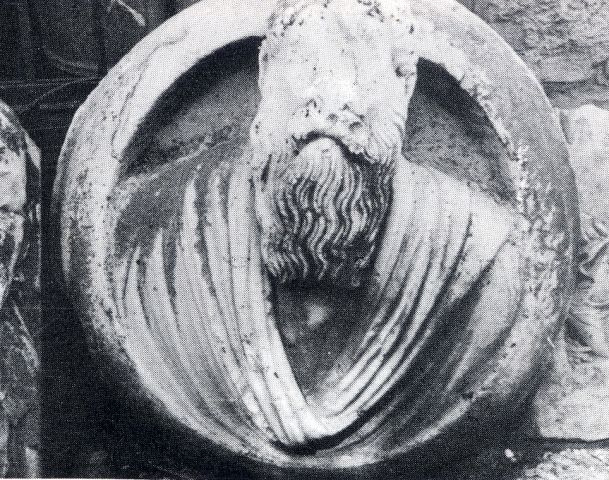
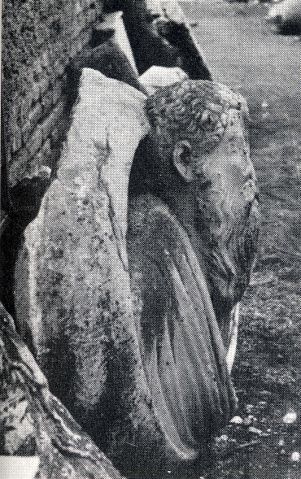
Tondo portrait of long-bearded philosopher (?) in himation. From Athens (?). Fourth to fifth century.
Record details
Photographs
Textual evidence
Bibliography
- Winkes, R., Clipeata imago: Studien zu einer römischen Bildnisform, Bonn 1969, 64, 138, pl. 5a anc 5c (5th c.)
Discussion
DESCRIPTION (Object)
Over life-size shield portrait. Diam: c. 80 cm. White marble.
The portrait head is missing the upper part of the face and nose. The upper rim of the shield is chipped.
PROVENANCE
The portrait was once in the National Museum in Athens. It presumably came from Athens.
DESCRIPTION (Subject)
Within a thick shield is a portrait of man with an exceptionally long beard and moustache. His hair is brushed forward onto the brow. It recedes slightly at the temples and is cut around the ears.
He wears a heavy himation and a chiton under it. The himation is draped over both shoulders and makes a deep V neck line.
DATE AND HONORAND
It is difficult to date this shield both because of the preservation and now loss of the object and because of the subject—a philosopher or intellectual whose personal mode depends on classical models. The shield has been placed in the fifth century by Winkes who noted the rendering of the hair, the elongated proportions, and polish of the face. The repetitive and linear style of the hair, beard, and drapery does seem to be late; see, for example, LSA-2297 and LSA-2363. Moreover, shield portraits of cultural figures are well attested in the fourth and fifth centuries; see, for example, the group from the ‘Atrium House’ at Aphrodisias ( LSA-206 and following) or a group from Rome (LSA-2440 and related images).
Cite: Last Statues of Antiquity, LSA-483 (J. Lenaghan).