
LSA-487
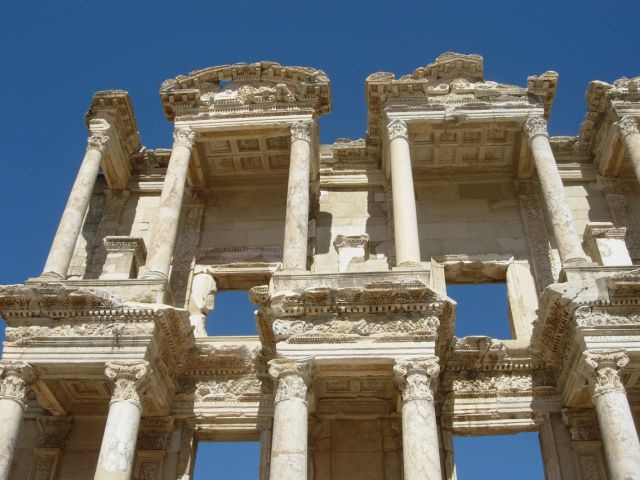
Epigram for governor Stephanus above window of Library of Celsus. Ephesus (Asia). Late fourth to fifth century.
Record details
Photographs
Inscription
Cross δέρκε[ο πῶς] κόσμησε τόσοις χρυσαυγέσιν ἔργοις / καὶ Στέφαν]ς Πτελέην καὶ Πτελέη Στέφανον
Inscription translation
{Cross} See how he decorated with such gold-gleaming works. And so Stephanus for Ptelea (Ephesus) and Ptelea for Stephanus.
Textual evidence
Bibliography
- Meriç, R., R. Merkelbach, J. Nollé, and S. Şahin (eds.), Die Inschriften von Ephesos VII,2. Inschriften griechischer Städte aus Kleinasien, vol. 17,2, Bonn 1981, 527, no. 5115
- Merkelbach, R. and J. Stauber (eds.), Steinepigramme aus dem griechischen Osten. Bd. 1. Die Westküste Kleinasiens von Knidos bis Ilion , Stuttgart 1998
- Wilberg, W. et al., Forschungen in Ephesos, Bd. V, t. 1. Die Bibliothek, Vienna 1953, 34-5, fig. 70; 79-80, no. 15 (Keil: c. AD 400)
Discussion
INSCRIPTION
In two lines. Ltr H: 13 cm, red paint preserved in letters. The end of the first line is written over an erasure.
Cross δέρκε[ο πῶς] κόσμησε τόσοις χρυσαυγέσιν ἔργοις
καὶ Στέφαν]ς Πτελέην καὶ Πτελέη Στέφανον
line 1 originally read
Cross δέρκε[ο πῶς] κόσμησε τόσῳ χρυσαυγέι μόχθῳ
{Cross} See how he decorated with such gold-gleaming works {with such a gold-gleaming toil}. And so Stephanus for Ptelea (=Ephesus) and Ptelea (=Ephesus) for Stephanus.
PROVENANCE
From the facade of the Library of Celsus. The blocks in the current anastylosis stand over the southernmost window of the second storey. Wilberg and Keil in 1953 thought that they were once above the middle window.
DESCRIPTION.
Three wall blocks. Each block, H: 59, W: 116, D: 65 cm. White marble.
The outer blocks preserve areas of the adjacent wall pilaster. The middle block was cut to fit agains the window. The viewer’s right side of the block one is broken. The middle block has lacunae in the upper line.
CONTEXT
The second-century Library of Celsus was refurbished between the fourth and sixth centuries, at which point the facade was turned into the back wall of a large Nymphaeum. This inscription on the facade and a base, again on the facade, which honours a Philip, LSA-1595, seem best understood in conjunction with this renovation of the Library.
This inscription, above a void, refers to decoration which Stephanus made and which must have been visible to the reader. This is what Stephanus did for Ephesus. What Ephesus did for Stephanus was assuredly a statue. The location of this statue is less clear. Keil understood it as a statue for Stephanus below in the area of the new fountain; Feissel saw it as a reference to LSA-732 which stood on the embolos. It seems to this author that a statue might plausibly have been on the facade, perhaps even in directly below this inscription.
HONORAND AND DATE
The honorand should probably be associated with the proconsul Stephanus who is honoured on two other bases from Ephesus LSA-732 and LSA-747. LSA-732 has been dated to the early fifth century on the basis of its text. Here too a cross at the beginning of the text suggests a date in the early fifth century.
Discussion references
- Feissel, D. 'Vicaires et proconsuls d’Asie du IVe au VIe siècle. Remarques sur l’administration du diocèse asianique au Bas-Empire', Antiquité tardive. Revue internationale d’histoire et d’archéologie, 6, 91-104, Paris 1998, 99
Cite: Last Statues of Antiquity, LSA-487 (J. Lenaghan).