
LSA-51
Base for statue of Diogenes, probably local notable. Corinth (Achaea). Third to fourth century.
Record details
Photographs
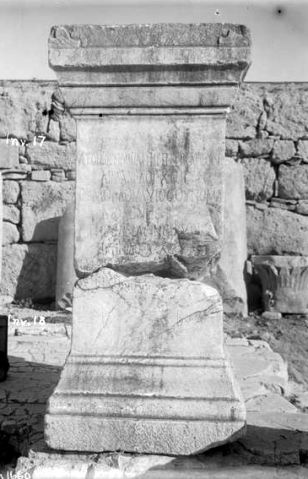
Inscription
Ἀτθίδος εἰμὶ πάτρης Περικλήϊον / αἷμα λελόνγχως /
Ἑρμολάου δ’υἱὸς / οὔνομα Διογένης. /
(5) στῆσε δὲ μ’εἰν Ἐφύρ[ῃ] / Πιρηνίδος ἀγχ[όθι πηγῆς] /
τῇδε Σεκουν̣[δεινος] / εἰκόνι λαμ̣π̣ο̣μ̣έ̣ν̣[ῃ]
Ψ(ηφίσματι) Β(ουλῆς).
Inscription translation
Attica is my fatherland, Pericleian blood is my destiny, the son of Hermolaus am I, by name Diogenes. Secundinus set me up in Ephyra (= Corinth), close [to the spring] of Peirene, in this shining statue. By decree of the council.
Bibliography
- Inscriptiones Graecae, IV, 1602, 1604
- Meritt , B. D., Greek inscriptions, 1896-1927: Corinth VIII. 1, Princeton 1931, 65-6 no. 88
Discussion
INSCRIPTION
Two elegiac distichs, carved in eight lines, with a ninth line after a space:
Ἀτθίδος εἰμὶ πάτρης Περικλήϊον / αἷμα λελόνγχως /
Ἑρμολάου δ’υἱὸς / οὔνομα Διογένης. /
(5) στῆσε δὲ μ’εἰν Ἐφύρ[ῃ] / Πιρηνίδος ἀγχ[όθι πηγῆς] /
τῇδε Σεκουν̣[δεινος] / εἰκόνι λαμ̣π̣ο̣μ̣έ̣ν̣[ῃ]
Ψ(ηφίσματι) Β(ουλῆς).
'Attica is my fatherland, Pericleian blood is my destiny, the son of Hermolaus am I, by name Diogenes. Secundinus set me up in Ephyra (= Corinth), close [to the spring] of Peirene, in this shining statue. By decree of the council.'
Our reconstruction of the text follows Kent 1932, who in line 5 proposed ἀγχόθι (instead of ἀγχοῦ offered in Corinth VIII.1), to avoid a spondaic end of the verse. In line eight, Corinth VIII. 1 reads λαϊ[νέῃ] ('stone'), which is paralleled in other inscriptions of this type and would match what seems to have stood on top of this base (see 'Description'). However, the surviving traces suggest a longer word than this, perhaps λαμ̣π̣ο̣μ̣έ̣ν̣[ῃ] ('shining').
DESCRIPTION (from A. Brown, ascsa.net/id/corinth/object/i 17, and the published photo)
Tall rectangular base of bluish marble, broken into two pieces across the centre, and re-joined in modern times: H 160, W 70, D 65 cm. Mouldings at top and bottom on three sides. Three surfaces are finely worked with a claw, the back is flat and only roughly worked with a punch. On the front face, an earlier inscription has been erased, leaving only its last line: 'Ψ(ηφίσματι) Β(ουλῆς), By decree of the council'.
The top is roughly picked and has two sets of cuttings. First, there are two cuttings for the feet of a bronze statue of at least life-size, with two dowel holes in each foot. Second, there is a sequence of three smaller holes forming an arch towards the back, and one such hole in the front, with iron dowels still broken off inside them; along with a cutting in the upper moulding of the right side of the base. The latter set of holes indicates that in the second use a marble statue was set on top, with a plinth measuring about 55 x 40 cm held down at the sides with iron tangs.
The two pieces of the base were recorded as two different inscriptions by IG IV (nos. 1602, 1604).
PROVENANCE AND LOCATION
Both fragments were found in 1901 on the marble stair which connects the Forum of Corinth with the road leading northwards to Lechaion (one of the harbours of Corinth, in the Corinthian gulf). Today the base stands, the fragments joined together, on the East side of the Lechaion road.
HONORAND, AWARDER, AND DATE
The honorand, Diogenes son of Hermolaus, is not known from other sources. Our inscription provides neither information about his role in Corinth nor the reasons for this honour (for the person see Traill 1996; no entry in PLRE). The lack of allusions to the conventional virtues of officials strongly suggests that he was citizen of Corinth honoured for local reasons, and not a high-ranking imperial official.
The name of the awarder, Secundinus (completed thus for metrical reasons from the surviving letters 'Σεκουν...') possibly reoccurs in the fragmentary inscription Corinth I-1989-1 (ascsa.net/id/corinth/image/1989_st_044_015). However, no further information, as to the date or role of Secundinus, is provided by that fragment.
The date of the inscription can not be ascertained with confidence: the general form in verse matches the practice of late antique honorific inscriptions, that become common for high ranking state officials by the end of the 3rd century (Robert 1948); however, this practice was in use for local and provincial notables also in the 3rd and possibly even late 2nd century. The inscription lacks some key features of the late antique texts, notably allusions to virtues held and benefits bestowed.
Discussion references
- Robert, L., Epigrammes du Bas-Empire (Hellenica IV), Paris 1948
- Traill, J. S., Persons of Ancient Athens, Volume 5, D- to Dionysios, Toronto 1996, 333 no. 326095
Cite: Last Statues of Antiquity, LSA-51 (Ulrich Gehn/ Amelia Brown).