
LSA-512
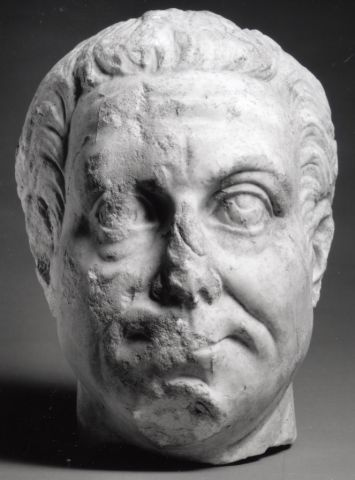
Portrait head in the Vienna-Izmir type, probably of Licinius. From Asia Minor? Early fourth century.
Record details
Photographs
Bibliography
- Smith, R.R.R.,'The public image of Licinius I: Portrait sculpture and imperial ideology in the early fourth century', JRS 87, 1997, 189-90, pl. 6.2
- Sothebys London, Sothebys London Antiquities Monday 18 May 1987, London 1987, no. 206, pl.18
Discussion
DESCRIPTION (Object)
Under life-size head. H: 22.9 cm. White marble.
The head is broken through the neck. The brow, nose, mouth, and chin are battered.
The hair is rendered with a flat chisel The irises and pupils are indicated by two parallel U-shaped engraved lines.
PROVENANCE
The head was sold in London in 1987. The date of sale and the fact that all other versions of this portrait type have been found in Asia Minor (see below) make it tempting to suggest a provenance of Asia Minor.
DESCRIPTION (Subject)
The head depicts a full-faced, elderly man with short hair. The hair is brushed forward onto the brow; at the sides of the brow it curves downwards and across the front of the brow the locks converge to a meeting point over the inner corner of the right eye.
The brow is tall and marked by horizontal creases and a vertical fold over the root of the nose. The eyes are large with a loose flap of skin preserved over the upper left eyelid. Sunken and loose skin is indicated under both eyes. The naso-labial folds are deep. The thin-lipped mouth appears to smile; there are folds at the corners. The rounded chin was defined by a curved line below the lower lip.
DATE AND HONORAND
The head seems to correspond in salient details (mouth and hair) to a type (Vienna-Izmir) best known in two colossal versions from Smyrna and Ephesus LSA-325 and LSA-687. A third version, purchased in Istanbul, also comes from Asia Minor, LSA-373 . Smith has identified the model for this replicated type as Licinius. This should probably be the identification for this portrait head as well notwithstanding the fact that here the man lacks a stubble-beard.
Cite: Last Statues of Antiquity, LSA-512 (J. Lenaghan).