
LSA-513
Statue base, or milestone, with dedication to Diocletian, Maximian, Constantius I, Galerius, and (later) Constantine I. Mylasa (Caria). 293-337
Record details
Photographs
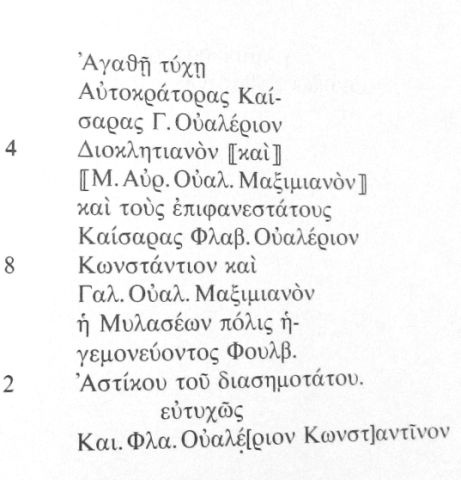
Inscription
Ἀγαθῇ τύχῃ / Αὐτοκράτορας Καί/σαρας Γ(αίον) Οὐαλέριον / Διοκλητιανὸν [καὶ] /(5) [ Μ(άρκον) Αὐρ(ήλιον) Οὐαλ(έριον) Μαξιμιανὸν] / καὶ τοὺς ἐπιφανεστάτους / Καίσαρας Φλάβ(ιον) Οὐλέριον / Κωνστάντιον καὶ / Γαλ(ήριον) Οὐαλ(έριον) Μαξιμιανὸν /(10) ἡ Μυλασέων πόλις ἡ/γεμονεύοντος Φουλβ(ίου) / Ἀστίκου τοῦ διασημοτάτου. / εὐτυχῶς / Καὶ Φλά(βιον) Οὐαλέ[ριον Κωνστ]αντῖνον
Inscription translation
To Good Fortune. The city of the Mylaseans [honours] the Augusti Caesars Caius Valerius Diocletianus and Marcus Aurelius Valerius Maximinianus and the most noble Caesars Flavius Valerius Constantius and Galerius Valerius Maximianus, in the governorship of Fulvius Asticus, of perfectissimus rank. With good fortune. And Flavius Valerius Constantinus.
Bibliography
- Blümel, W. (ed.), Die Inschriften von Mylasa. Inschriften griechischer Städte aus Kleinasien, bd. 34 , Bonn 1987, 19-20, no. 36
- French, D. H., Milestones of Pontus, Galatia, Phrygia and Lycia, Zeitschrift für Papyrologie und Epigraphik 43, 1981, 149-74, pp. 173-4 n. 16
Discussion
INSCRIPTION
In 14 lines:
Ἀγαθῇ τύχῃ / Αὐτοκράτορας Καί/σαρας Γ(αίον) Οὐαλέριον / Διοκλητιανὸν [καὶ] /(5) [ Μ(άρκον) Αὐρ(ήλιον) Οὐαλ(έριον) Μαξιμιανὸν] / καὶ τοὺς ἐπιφανεστάτους / Καίσαρας Φλάβ(ιον) Οὐλέριον / Κωνστάντιον καὶ / Γαλ(ήριον) Οὐαλ(έριον) Μαξιμιανὸν /(10) ἡ Μυλασέων πόλις ἡ/γεμονεύοντος Φουλβ(ίου) / Ἀστίκου τοῦ διασημοτάτου. / εὐτυχῶς / Καὶ Φλά(βιον) Οὐαλέ[ριον Κωνστ]αντῖνον.
'To Good Fortune. The city of the Mylaseans [honours] the Augusti Caesars Caius Valerius Diocletianus and Marcus Aurelius Valerius Maximinianus and the most noble Caesars Flavius Valerius Constantius and Galerius Valerius Maximianus, in the governorship of Fulvius Asticus, of perfectissimus rank. With good fortune. And Flavius Valerius Constantinus.'
Letter height not recorded.
The epigraphic formula with the honorands in the Greek accusative and an awarder in the nominative is apt for a statue base, although the block has been classified in the past as milestone.
DESCRIPTION (from French 1981 and Blümel 1987)
The block is merely described as a milestone by French 1981 and Blümel 1987. There are no published mesurements or image.
PROVENANCE AND CURRENT LOCATION
The block was first recorded in Milas (ancient Mylasa) by French 1981. It is today in the garden of the Milas Kültür Merkezi (Culture Centre), without inv. no.
HONORANDS, AWARDER AND DATE
Diocletian, the first honorand, was Augustus 284-305; Maximian, the second, 286-305. Constantius I, was Caesar 293-305, as was the fourth, Galerius. The original dedication therefore dates to the common reign of the four emperors, 293-305. At a later date, the name of Constantine I, Augustus 306-37, was added (line 14).
The inscription was set up by the city of Mylasa (line 10), under the governorship of Fulvius Asticus (see below, 'Further Discussion'). This Asticus is known from two further milestones in Caria (French 1981), and also set up the price edict of Diocletian (of 301) in Aezani in the neighbouring province of Phrygia (PLRE I, 119 Fulvius Asticus, and Martindale 1980, 477-8). He must therefore have been governor of the joint province of Caria and Phrygia before it was split up, probably in 303 (Roueché 1981, 111). Remarkably, in our inscription he is described as holding the equestrian rank of διασημότατος (Latin perfectissimus, line 12), although the province of Phrygia and Caria was under senatorial governors well into the tetrarchic period., normally styled ὑπατικός (Latin, consularis) in the inscriptions (Roueché 1981, 109-11).
FURTHER DISCUSSION
We include this inscription as a possible statue base because the epigraphic formula suits a statue dedication (see above, 'Inscription'), as does its findspot within the city. We are aware, however, that it could a milestone, which is how it is published by its first editor (French 1981, but without any detail of its appearance). Moreover, the addition of an imperial name at a later date (that of Constantine in line 14) is unparalleled on statue bases, but does occur on milestones. If it was for a statue, it is likely to have been accompanied by three others, to make up a group to all four tetrarchs.
Discussion references
- Jones, A. H. M. et al., The Prosopography of the Later Roman Empire. Vol. I 260-395, Cambridge et al. 1971 (1975)
- Martindale, J. R., Prosopography of the Later Roman Empire: addenda et corrigenda to Volume I, Historia. Zeitschrift für alte Geschichte 29, 1980, 474-97, pp. 477-8 Fulvius Asticus
- Roueché, C., Rome, Asia and Aphrodisias in the third century, Journal of Roman Studies 71, 1981, 103-120
Cite: Last Statues of Antiquity, LSA-513 (Ulrich Gehn).