
LSA-514
Base for statue of Julian, emperor. Iasos (Caria). 361-363.
Record details
Photographs
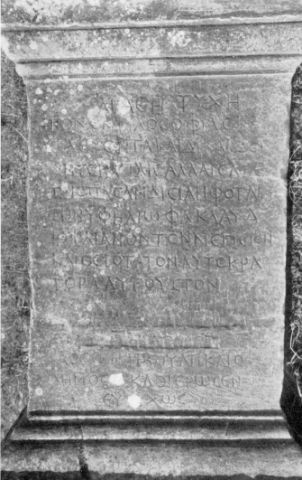
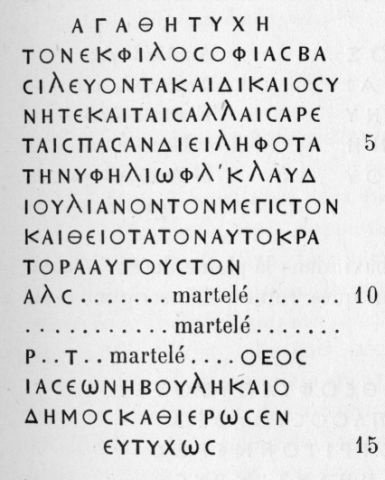
Inscription
Ἀγαθῇ τύχῃ. / τὸν ἐκ φιλοσοφίας βα/σιλεύοντα, καὶ δικαιοσύ/νῃ τε καὶ ταῖς ἄλλαις ἀρε/ταῖς, πᾶσαν διειληφότα / (6) τὴν ὑφ’ ἡλίῳ Φλ(άβιον) Κλαύδ(ιον) / Ἰουλιανὸν, τὸν μέγιστον / καὶ θειότατον Αὐτοκρά/τορα Αὔγουστον, /(10) [[Αλε...]]/ [[...]]/ [[ρ τ...θεο[ῖ]ς]] / (13) Ἰασέων ἡ βουλὴ καὶ ὁ / δῆμος καθιέρωσεν. / εὐτυχῶς.
Inscription translation
To Good Fortune. He who is ruling by [the precepts of] Philosophy, and with justice and [every] other virtue, who has brought everything under the sun into his embrace, Flavius Claudius Iulianus, the greatest and most divine emperor, Augustus; ... (three erased lines) ... the council (boule) and people (demos) of the Iasians dedicated [this to him]. With good fortune.
Bibliography
- Blümel, W. (ed.), Die Inschriften von Iasos. Inschriften griechischer Städte aus Kleinasien, Bd. 28 , Bonn 1985, pp. 33-4 no. 14
Discussion
INSCRIPTION
In 13 lines:
Ἀγαθῇ τύχῃ. / τὸν ἐκ φιλοσοφίας βα/σιλεύοντα, καὶ δικαιοσύ/νῃ τε καὶ ταῖς ἄλλαις ἀρε/ταῖς, πᾶσαν διειληφότα / (6) τὴν ὑφ’ ἡλίῳ Φλ(άβιον) Κλαύδ(ιον) / Ἰουλιανὸν, τὸν μέγιστον / καὶ θειότατον Αὐτοκρά/τορα Αὔγουστον, /(10) [[Αλε...]]/ [[...]]/ [[ρ τ...θεο[ῖ]ς]] / (13) Ἰασέων ἡ βουλὴ καὶ ὁ / δῆμος καθιέρωσεν. / εὐτυχῶς.
'To Good Fortune. He who is ruling by [the precepts of] Philosophy, and with justice and [every] other virtue, who has brought everything under the sun into his embrace, Flavius Claudius Iulianus, the greatest and most divine emperor, Augustus; ... (three erased lines) ... the council (boule) and people (demos) of the Iasians dedicated [this to him]. With good fortune.'
Letter height not recorded.
Towards the end of the inscription, three original lines have been erased (lines 10-12), leaving only the traces of a few letters; below this gap, according to Cousin and Diehl 1889, 35, the final three lines (13-15) display a notable difference of script ('une différence très sensible de gravure') to the main body of the inscription (lines 1-9). Cousin and Diehl therefore hypothesised, probably rightly, that the name of an original dedicator had been removed, and replaced by the dedication by the council and people of the city. Amongst the erased letters they were able to read 'θεο[ῖ]ς, to the gods' in line 12, and they therefore argued that the name of the awarder had been removed by later Christians, because, under the pagan Julian, he had included a dedication to the pagan gods within the wording of his inscription. This hypothesis is supported by the fact that the inscription earlier makes specific reference to Julian's very particular intellectual and spiritual style of emperorship ('ruling by the precepts of Philosophy', in lines 2-3).
DESCRIPTION (from Blümel 1985, and the published photo)
Rectangular marble base with mouldings at top and bottom. There are no published measurements.
PROVENANCE AND CURRENT LOCATION
The inscription was first recorded in 1885 by Demnios in Kıoulouk (Güllük) in the area of Mylasa. Cousin & Diehl 1889, 35 saw it in a field ('dans un champ’) in the area of Iasos, while Levi & Pugliese Carratelli 1963 recorded it 'by the house of Faruk Akargià, about 1 kilometre from Asin Kurin' ('a circa 1 km. da Asin Kurin, presso la casa di Faruk Akargià'). It is not known to us whether the base has been moved since.
HONORAND AND DATE
Julian, the honorand, was Augustus 361-63.
As discussed above (under 'Inscription') it seems that the base originally carried a different closing dedication, subsequently changed to a very simple dedication by the council and people of Iasos. If it was removed by Christians, for religious reasons, it is interesting that they removed only the name and formula of the awarder, and not those of the emperor himself.
Discussion references
- Mouseion kai Bibliotheke tes Euangelikes Scholes V, 1884-1885, Smyrna (Izmir) 1885, p. 61 no. 450 (Xenophon Demnios)
- Cousin, G. & Ch. Diehl, Inscriptions de Iasos et de Bargylia, Bulletin de Correspondance Hellénique 13, 1889, 23-40, pp. 35-6 no. 2
- Levi, D. & G. Pugliese Carratelli, Nuove Iscrizioni di Iasos, Annuario della Scuola Archeologica di Atene e delle Missioni Italiane in Oriente39-40 (nuova serie 23-24) (1961-1962), 573-632, Roma 1963, p. 580 no. 8 bis
Cite: Last Statues of Antiquity, LSA-514 (Ulrich Gehn).