
LSA-515
Base for statue of emperor, name erased. From Iasos (Caria). 286-324
Record details
Photographs
Inscription
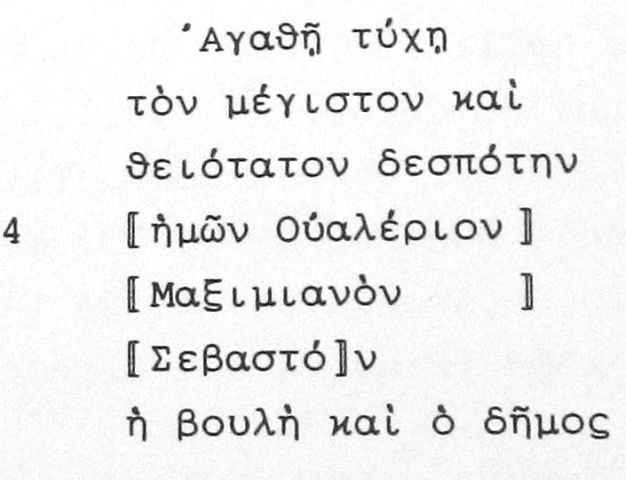
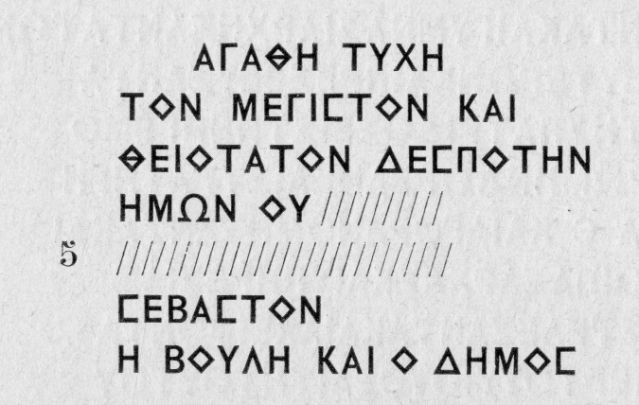
Ἀγαθῇ τύχῃ. / τὸν μέγιστον καὶ / θειότατον δεσπότην / [[ἡμῶν Οὐ[ ... ]] /(5) [[[ ... ]]] / [[Σεβαστό]]ν, / ἡ βουλὴ καὶ ὁ δῆμος.
Inscription translation
To Good Fortune. Our greatest and most divine ruler, Va... (2 lines) ... Augustus; the council (boule) and people (demos) [honour him].
Bibliography
- Blümel, W. (ed.), Die Inschriften von Iasos. Inschriften griechischer Städte aus Kleinasien, Bd. 28 , Bonn 1985, 34, no. 15
- Reinach, T., Un nouveau proconsul d'Achaie, Bulletin de Correspondance hellénique 24, 1900, 324-8
Discussion
INSCRIPTION
In seven lines:
Ἀγαθῇ τύχῃ. / τὸν μέγιστον καὶ / θειότατον δεσπότην / [[ἡμῶν Οὐ[ ... ]] /(5) [[[ ... ]]] / [[Σεβαστό]]ν, / ἡ βουλὴ καὶ ὁ δῆμος.
'To Good Fortune. Our greatest and most divine ruler, Va... (2 lines) ... Augustus; the council (boule) and people (demos) [honour him].'
Letter height not recorded.
The imperial name in lines 4-5 has been deliberately erased, but remains very partially legible.
SUGGESTED TEXT:
The two legible letters of the imperial name in lines 4-5, 'ΟΥ... ', leave more than one possibiliy for completion in the tetrarchic period: Maximian (full name Marcus Aurelius Valerianus Maximianus); Licinius (full name Valerius Licinianus Licinius); Galerius (full name Caius Galerius Valerius Maximianus). Blümel 1985 entirely hypothetically expanded the name to 'Οὐαλέριον Μαξιμιανὸν' and suggested either Maximian or Licinius as the honorand (though in reality his proposed combination of names suits neither of them).
DESCRIPTION (from Reinach 1883, Blümel 1985, and the published photo in Robert 1970)
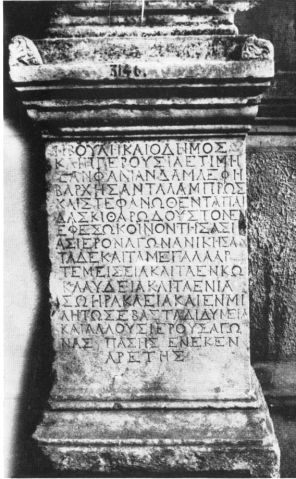
Rectangular marble base, with mouldings on all sides at top and bottom: H 141, W 70, D 91 cm. On top of the top moulding is a plinth, worked from the same block, standing slightly indented, and likewise moulded. The corners of the top moulding are decorated by acroteria. Our inscription is carved on the left side of a first-use inscription to a local notable Phanias Lama from the early imperial period (Blümel 1985 no. 110; Reinach 1883 no. 25).
PROVENANCE AND CURRENT LOCATION
The inscription was first recorded by Reinach 1883 in Iasos. Now in the Istanbul Archaeological Museum, inv. no. 3146.
HONORAND, AWARDER, AND DATE
As discussed under 'Inscription' above, the precise identity of the honorand is uncertain, but he was certainly one of the emperors of the tetrarchic period who suffered damnatio memoriae after his fall from power. All of the possibilities considered above (under 'Inscription') - Maximian, Licinius, Galerius - fit these criteria.
The inscription was set up by the council and people (boule and demos) of Iasos (line 7).
The outer dates for our inscription are the outer dates of the possible honorands, 286-324.
Discussion references
- Reinach, Th., Inscriptions d'Iasos, Revue des études grecques 6, 1893, 153-203, p. 175 no. 8
- Robert, L., Die Epigraphik der klassischen Welt, Bonn 1970, pl. 2
Cite: Last Statues of Antiquity, LSA-515 (Ulrich Gehn).