
LSA-516
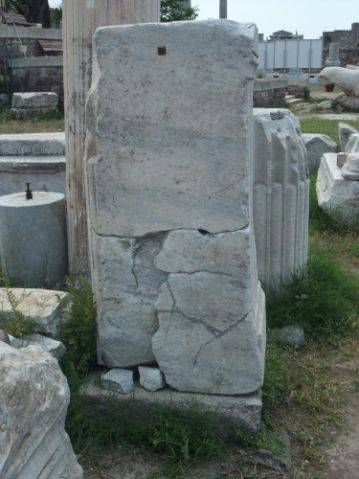
Base for statue of Eustathius, governor of Asia. Smyrna (Asia). Fourth to fifth century.
Record details
Photographs
Inscription
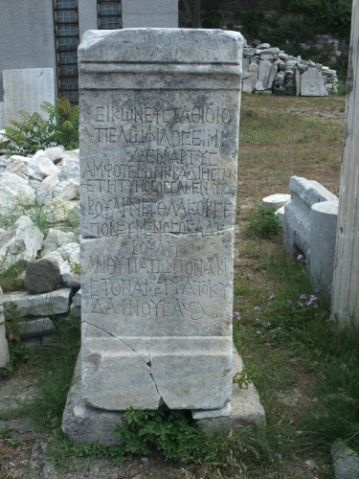
Εἰκὼν Εὐσταθίοιο / πέλω, φίλος··εἰμὶ / δὲ μάρτυς/ (4) ἀμφοτέρων κραδίης πα[ν]/ετήτυμος, ὄσσα μὲν αὐτὸ[ς] / βουλὴν ἐσθλὰ ἔοργε ̣ / πονεύμενος, ὄσα δ ̣ὲ ̣ / (8) βουλὴ / ἀνθυπάτων τὸν ἄρι/στον ἀμείψατο κυ/δαίνουσα. (ivy leaf)
Inscription translation
Friend, I am a statue of Eustathius. I am a true witness of both sides: of the so many noble things which he, toiling away, has done for the council (boule), and of the so many things that the council, holding him in honour as the best of governors (proconsul) has done in exchange.
Bibliography
- Petzl, G. (ed.), Die Inschriften von Smyrna. Inschriften griechischer Städte aus Kleinasien, Bd. 24, 1990, 124-5, no. 636
Discussion
INSCRIPTION
Verse inscription in four hexameters laid out in eleven lines:
Εἰκὼν Εὐσταθίοιο / πέλω, φίλος· εἰμὶ / δὲ μάρτυς /
(4) ἀμφοτέρων κραδίης πα[ν]/ετήτυμος, ὄσσα μὲν αὐτὸ[ς] /
βουλὴν ἐσθλὰ ἔοργε ̣ / πονεύμενος, ὄσα δ ̣ὲ ̣ / (8) βουλὴ /
ἀνθυπάτων τὸν ἄρι/στον ἀμείψατο κυ/δαίνουσα. (ivy leaf)
'Friend, I am a statue of Eustathius. I am a true witness of both sides: of the so many noble things which he, toiling away, has done for the council (boule), and of the so many things that the council, holding him in honour as the best of governors (proconsul) has done in exchange'.
Letter height 4-7 cm.
DESCRIPTION
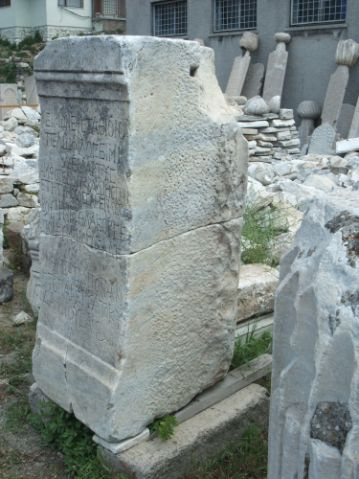
White marble base, at front face with mouldings at top and bottom; H 147, W 59, D 68 cm. The base is horizontally broken at the centre, the two portions jointing. The lower portion of the left side is damaged; the upper rear corners are broken off.
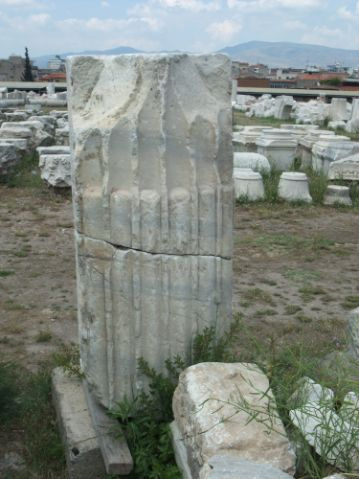
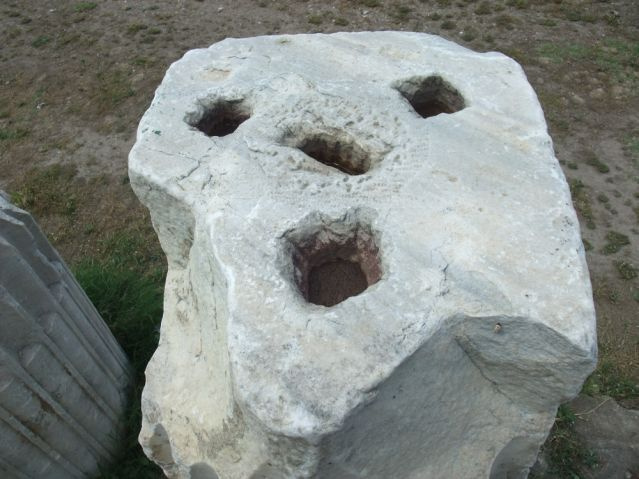
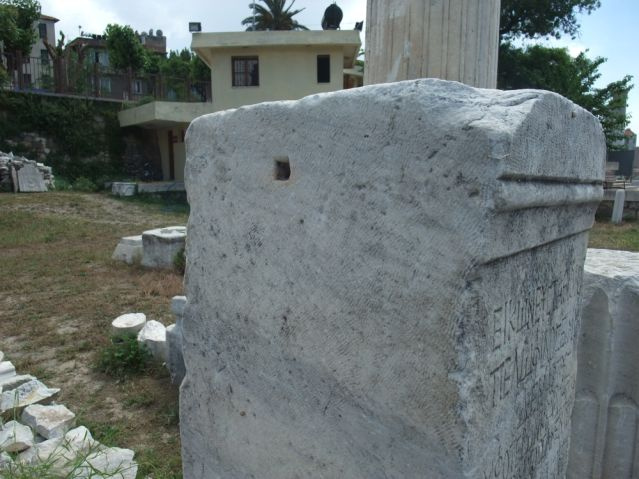
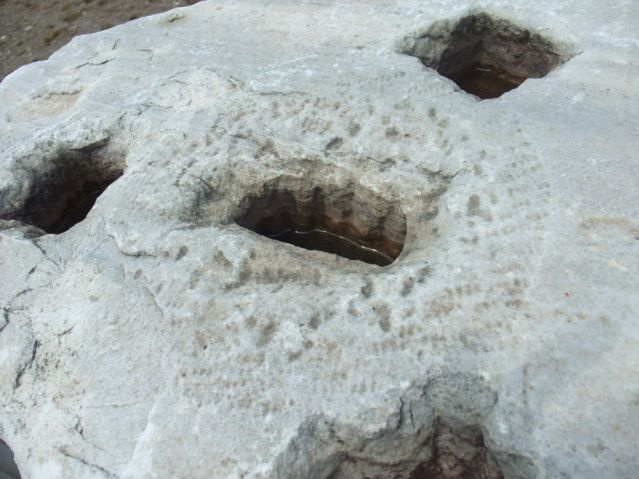
The front face is finished with a claw, the epigraphic field not framed. The right side shows three different surface textures: (i) a stripe at the front margin finished with a claw; (ii) a vertical stripe finished with a fine point; (iii) a stripe along the rear margin only roughly worked back. The back face is semicircular, with six flutings of a ionic (or corinthian) column. The right side is finished with a claw. The top face is smoothly finished with a small anathyrosis at the centre. It has three square shaped dowel holes symmetrically ordered around the central leverage hole ('Wolfsloch'). These holes belong to the original architectural use of the block.
On both the left and right sides, there is a small rectangular hole close to the upper edge, for a clamp to fix a crowning element on which the statue was based.
The base was cut back from a ionian (or corinthian) column or pillar.
PROVENANCE AND MOST RECENTLY RECORDED LOCATION
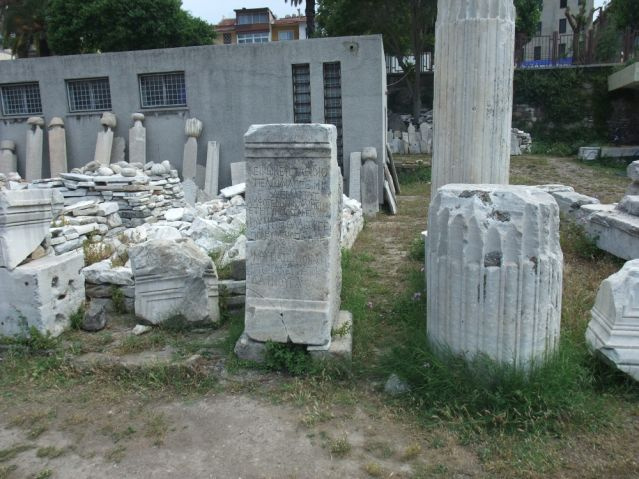
When first recorded, by Robert 1969, the base was in use as a pillar in the modern reconstruction of an arch at the south end of the west portico on the agora in Smyrna (so Petzl 1987; Robert 1969: north end). We recorded it set up on the agora, in front of the excavation store house, in summer 2011.
HONORAND AND DATE
The honorand, Eustathius, was a governor (proconsul) of Asia (line 9). He is recorded neither in Malcus 1967 nor in PLRE I or II. While all persons of this name from PLRE I can be excluded, some of the records in PLRE II can possibly be taken into consideration (p. 434 Eustathius 1, quaestor sacri palatii (east) in 404; p.435 Eustathius 9, quaestor sacri palatii (east) in 494/5; p. 436 Eustathius 11, praetorian prefect, perhaps of the East, in 505-6; p. 436 Fl. Eustathius 12, praetorian prefect of the East in 420-22, and consul in 421). Of these, the praetorian prefect of 420-22 (and consul of 421) appears the most probable.
The inscription was set up by the city council of Smyrna (lines 6. 8).
Honorific verse inscriptions for high ranking imperial officials feature in the Greek East from the 4th through to the 6th century. Without further dating criteria, we cannot assign a closer date to our inscription. It is most likely, however, that the inscription was set up in the 4th or earlier 5th century.
Discussion references
- Jones, A. H. M. et al., The Prosopography of the Later Roman Empire. Vol. I 260-395, Cambridge et al. 1971 (1975)
- Martindale, J. R., The Prosopography of the Later Roman Empire. Vol. II A.D. 395-527, Cambridge 1980
- Robert, L., Les inscriptions, De Gagniers, J., Devambez, P., Kahil, L. & R. Ginouvès, Laodicée du Lycos. Le nymphée. Campagnes 1961-1963, 247-389, Paris 1969, p. 342 pl. 111
Cite: Last Statues of Antiquity, LSA-516 (Ulrich Gehn).