
LSA-517
Base for statue of Julian, emperor. Pergamon (Asia). 361-363.
Record details
Photographs
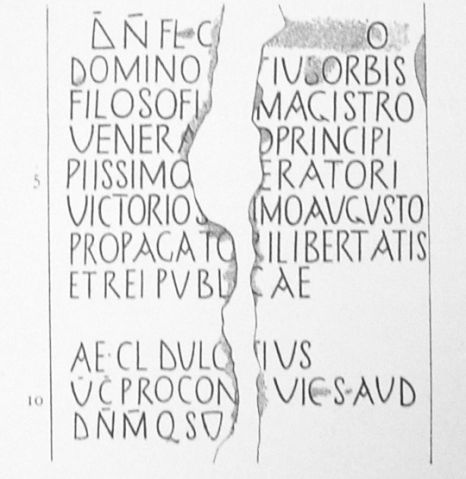
Inscription
D(omino) n(ostro) Fl(avio) C[l(audio) Iulian]o, / domino [tot]ius orbis, / filosofi[ae] magistro, / venera[nd]o principi, /(5) piissimo [imp]eratori, / victor[ioss]imo Augusto, / propagatori libertatis / et rei publ[i]cae, / Ae(lius) Cl(audius) Dulc[it]ius /(10) v(ir) c(larissimus) procon[s(ul)] vic(e) s(acra) aud(iens) / d(evotus) n(umini) m(aiestati)que su(ae).
Inscription translation
To our lord Flavius Claudius Julianus, lord of the entire world, master of philosophy, revered ruler, most pious Augustus, enlarger of freedom and the commonwealth. Aelius Claudius Dulcitius, of clarissimus rank, governor (proconsul), judge representing the emperor, devoted to his divine spirit and majesty, [set this up].
Bibliography
- Fränkel, M., Die Inschriften von Pergamon. 2. Römische Zeit - Inschriften auf Thon, Berlin 1895, p.387 no. 633
- Mommsen, Th., Ephemeris Epigraphica. Corporis Inscriptionum Latinarum Supplementum. Vol. V, Berlin 1884, p. 589 no. 1388
Discussion
INSCRIPTION
In eleven lines:
D(omino) n(ostro) Fl(avio) C[[[l(audio) Iulian]]]o, / domino [tot]ius orbis, / filosofi[ae] magistro, / venera[nd]o principi, /(5) piissimo [imp]eratori, / victor[ioss]imo Augusto, / propagatori libertatis / et rei publ[i]cae, / Ae(lius) Cl(audius) Dulc[it]ius /(10) v(ir) c(larissimus) procon[s(ul)] vic(e) s(acra) aud(iens) / d(evotus) n(umini) m(aiestati)que su(ae).
'To our lord Flavius Claudius Julianus, lord of the entire world, master of philosophy, revered ruler, most pious Augustus, enlarger of freedom and the commonwealth. Aelius Claudius Dulcitius, of clarissimus rank, governor (proconsul), judge representing the emperor, devoted to his divine spirit and majesty, [set this up].'
Letter height 2.7 – 3.5 cm.
The imperial name in line 1 has been erased (see below, 'Honorand, Awarder, and Date’).
DESCRIPTION (from Ephemeris Epigraphica V, Fränkel 1895 and the published image)
White marble base, with mouldings at top and bottom: H 135, W (of shaft alone) 50 cm. The base is broken vertically into two, the crack destroying a portion of the inscription.
PROVENANCE AND CURRENT LOCATION
The inscription was first recorded in 1884 (by Mommsen for Ephemeris Epigraphica V) at the Turkish cemetery by the hot springs of Ilıcı (called Tabbak Ludscha by the late 19th century authors, today Tabak Ilıcası) west of Bergama (Conze 1912, 406 and map 1). By 1895 it had been brought to the residence of the Ottoman administration (Kaymakam) in Bergama ('...in den Hof des Konak gebracht', Fränkel 1895) where it was assigned the inv. no. P 52. Here finds from excavations were collected, with the aim of creating a local museum (Conze 1898). No more recent account of its location is known to us, but if it still exists, it is probably in the Bergama Museum.
HONORAND, AWARDER AND DATE
The imperial name of the honorand has been erased (in line 2), only 'FL C' being still legible. However, the reference to his philosophical achievements (in line 3) leaves no doubt that the honorand was Julian. A similar formula was applied on a statue base for Julian in Iasos set up by the council and the people (LSA-514), and in Ephesus, set up by our same governor Aelius Claudius Dulcitius (LSA-748). Julian was Augustus 360-3, but only recognised in the East in 361, after the death of Constantius II.
Aelius Claudius Dulcitius, the awarder, was governor (proconsul) of Asia (PLRE I, 274, Ael. Claud. Dulcitius 5). He was himself honoured with a statue by the koinon of Asia in Ephesus (LSA-733).
FURTHER DISCUSSION
In line 10, the formula 'vic(e) s(acra) aud(iens)', instead of 'vic(e) s(acra) iud(icans)', is unique and possibly a misreading; likewise unusual is 'd(evotus) n(umini) m(aiestati)que su(ae)', instead of 'd(evotus) n(umini) m(aiestati)que e(ius)', in line 11.
Julian never suffered political damnatio memoriae, so his name was presumably chiseled out by Christians, eager to destroy the memory of a notorious pagan.
ACKNOWLEDGMENT
I am indebted to Dr H. Schwarzer, Universität Münster, for help with this inscription.
Discussion references
- Conze, A., Archäologischer Anzeiger 1898, 221-3, p. 221-3
- Conze, A. et al., Stadt und Landschaft (Altertümer von Pergamon Band I), Berlin 1912, p. 406 and map 1
- Jones, A. H. M. et al., The Prosopography of the Later Roman Empire. Vol. I 260-395, Cambridge et al. 1971 (1975)
Cite: Last Statues of Antiquity, LSA-517 (Ulrich Gehn).