
LSA-518
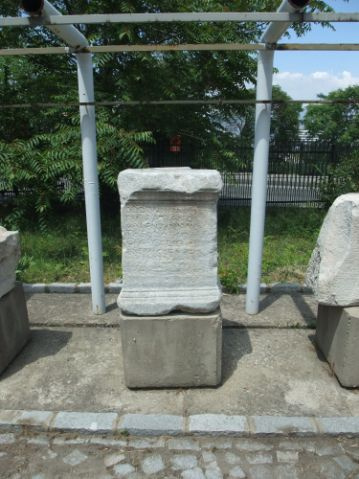
Milestone, or just possibly statue base, with dedication to the emperor Constantine I and family, later re-used for Gratian, Valentinian, Theodosius, and Arcadius. Smyrna (Asia). 317-324 and 383
Record details
Photographs
Inscription
Inscription 2:
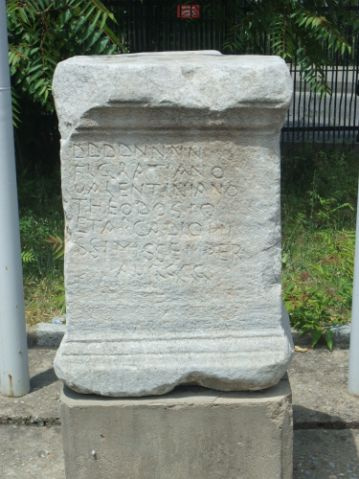
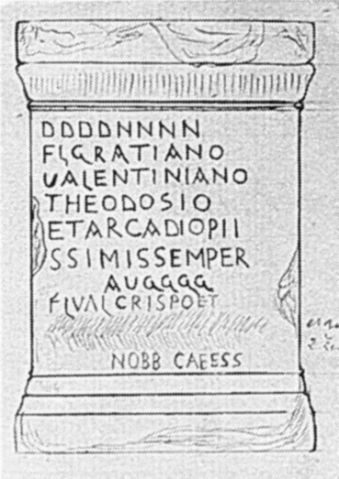
Dddd(ominis) nnnn(ostris) / Fl(avio) Gratiano, / Valentiniano, / Theodosio, /(5) et Arcadio, pii/ssimis semper / Augggg(ustis).
INSCRIPTION I:
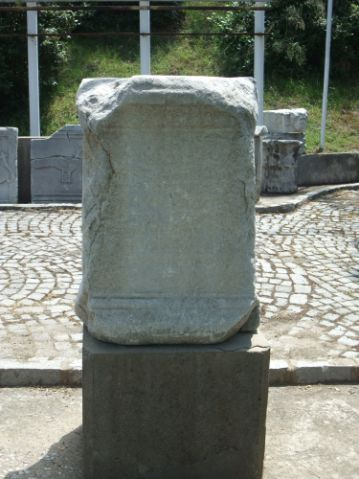
--] Fl(avio) Val(erio) Crispo, et / [Val(erio) Liciniano Licinio, et] / [Fl(avio) Cl(audio) Constan]tino, / nobb(ilissimis) Caess(aribus).
Inscription translation
(II)
To our lords Flavius Gratianus, Valentinianus, Theodosius, and Arcadius, the most pious eternal Augusti
(I)
... to Flavius Valerius Crispus, and Valerius Licinianus Licinius, and Flavius Claudius Constantinus, most noble Caesars.
Bibliography
- Petzl, G. (ed.), Die Inschriften von Smyrna. Inschriften griechischer Städte aus Kleinasien, Bd. 24, 1990, 300-01, no. 820
- Petzl, G. (ed.), Die Inschriften von Smyrna. Inschriften griechischer Städte aus Kleinasien, Bd. 24, 1990, pl. 28 no. 820
Discussion
INSCRIPTION
(2, the upper, but later, inscription) In seven lines at the top of the block and extending about three-quarters of the way down:
Dddd(ominis) nnnn(ostris) / Fl(avio) Gratiano, / Valentiniano, / Theodosio, /(5) et Arcadio pii/ssimis semper / Augggg(ustis).
'To our lords Flavius Gratianus, Valentinianus, Theodosius, and Arcadius, the most pious eternal Augusti.'
(1) In three lines, largely erased, at the bottom of the block:
--] / Fl(avio) Val(erio) Crispo, et / [Val(erio) Liciniano Licinio, et] / [Fl(avio) Cl(audio) Constan]tino, / nobb(ilissimis) Caeess(aribus)
' ... to Flavius Valerius Crispus, and Valerius Licinianus Licinius, and Flavius Claudius Constantinus, most noble Caesars.'
Letter height 3 - 5.5 cm. The letters are markedly irregular and rough.
Both inscriptions name the honorands (in the dative or ablative), but no awarder. The substitution or addition of earlier imperial names on one and the same side of a stone is common with milestones, while bases usually are either tidily and completely erased, or turned around for a new inscription (see below, 'Description'). This suggests that this is a milestone, rather than a statue base, although no mileage is legible. This might have been added on a plinth on which our block stood.
DESCRIPTION
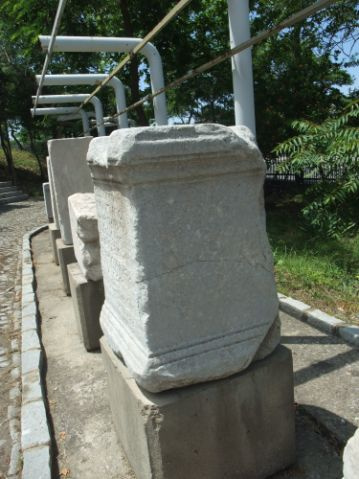
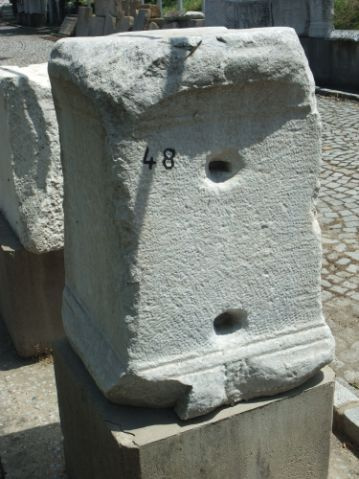
Rectangular block of white marble, with mouldings at top and bottom: H 84, W 63, D 54 cm. All margins and the front mouldings are chipped; the upper left front corner and all four rear corners are broken.
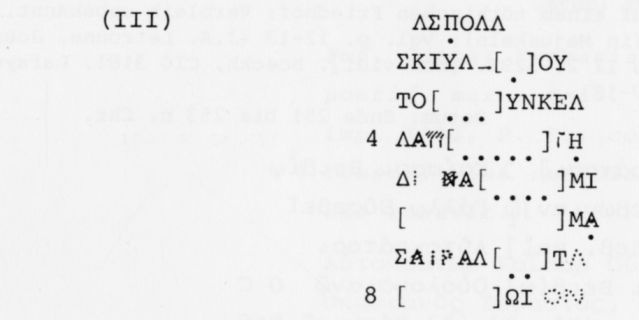
Inscription 2 is carved over the erased top of inscription 1, of which only traces of the last lines remain. Both inscriptions, 1 and 2, are carved on the back side of an earlier inscription, today illegible (Petzl 1987 no. 820, III).
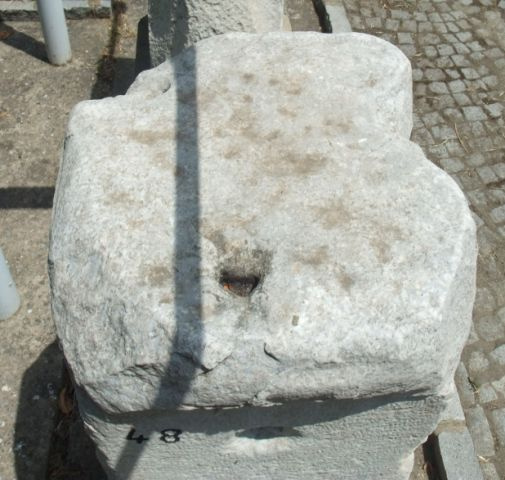
The epigraphic field carrying inscription 2 is finished with a claw, whereas it is smoothly finished if slightly weathered where inscription 1 is extant. The left side is finished with a claw (in the same technique as inscription 2), while both other sides are finished in the same way as inscription 1. The top face is picked and has a small rectangular hole close to the left margin. On the left side, there are two rectangular holes close to the mouldings. Below the lower one, the moulding is worked back, probably to receive a metal clamp.
PROVENANCE AND MOST RECENTLY RECORDED LOCATION
Found in the village of Pınabaşı in the countryside east of Izmir. In summer 2011, we recorded it in the epigraphic collection in the garden of the Archaeological Museum in Izmir, inv. No. 48.
HONORANDS AND DATE
Inscripton 1, now largely erased (to make way for inscription 2), was probably to Constantine I and Licinius the Augusti and their sons Crispus (whose name survives in line 1), Licinius II, and Constantine II (whose names are almost completely erased). Crispus, Constantine II, and Licinius II were elevated to the rank of Caesar in 317, providing a terminus post quem; the terminus ante quem is Licinius's fall from power in 324.
Gratian, the first honorand of inscription 2, was Augustus 367-83; his brother Valentinian II, the second honorand, Augustus 375-92; Theodosius I, the third honorand, 379-95; his son Arcadius, the fourth honorand, 383–408. This allows a closer date for inscription 2, between the elevation of Arcadius on 19 January 383 and Gratian’s death on 25 August of the same year.
FURTHER DISCUSSION
The addition of imperial names to an earlier inscription, rather than the complete erasure of the earlier one, and the absence of an awarder's name, suggest that this was a milestone rather than a statue base (see above, 'Inscription'). Its findspot, outside the city of Smyrna, supports this interpretation. A very similar inscription was found some miles further west, just outside ancient Smyrna (LSA-519). The two may have been milestones along the same road.
However, it is just possible that these two were statue bases, for which the best evidence is their shape. The clamp devices at the left side, moreover, suggest that this block was embedded into a crowning and a supporting element; this was possibly an elaborate composite base. If so, there were probably originally four, one to each of the emperors commemorated.
Cite: Last Statues of Antiquity, LSA-518 (Ulrich Gehn).