
LSA-519
Lost milestone, or just possibly statue base, with dedication to Gratian, Valentinian, Theodosius, and Arcadius. Smyrna (Asia). 383
Record details
Photographs
Inscription
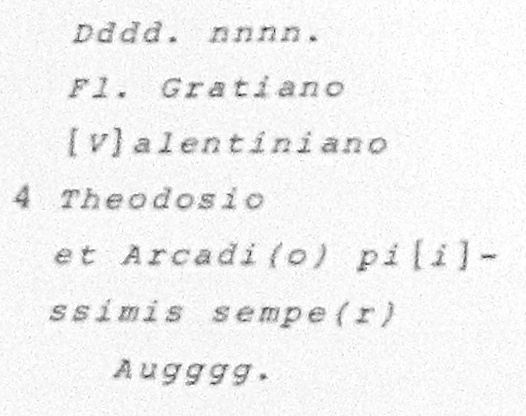
DDDD(ominis) NNNN(ostris) / Fl(avio) Gratiano, / [V]alentiniano, / Theodosio /(4) et Arcadi(o), pi[i]/ssimis sempe(r )/ Augggg(ustis).
Inscription translation
To our lords Flavius Gratianus, Valentinianus, Theodosius and Arcadius, most pious, eternal Augusti.
Bibliography
- Corpus Inscriptionum Latinarum; , III supplement 1 no. 7200
- Petzl, G. (ed.), Die Inschriften von Smyrna. Inschriften griechischer Städte aus Kleinasien, Bd. 24, 1990, 301-2, no. 821
Discussion
INSCRIPTION
In six lines:
DDDD(ominis) NNNN(ostris) / Fl(avio) Gratiano / [V]alentiniano / Theodosio /(4) et Arcadi(o), pi[i]/ssimis, sempe(r )/ Augggg(ustis)
'To our lords Flavius Gratianus, Valentinianus, Theodosius, and Arcadius, most pious eternal Augusti.'
Letter height not recorded.
The honorands are named in the dative or ablative, but no awarder appears (see below, 'Further Discussion').
DESCRIPTION
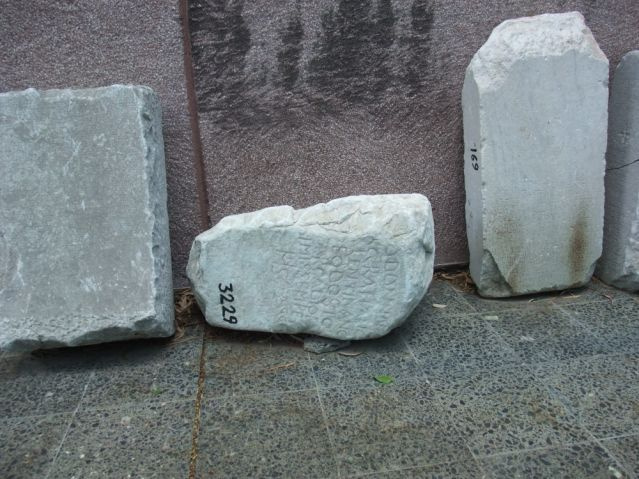
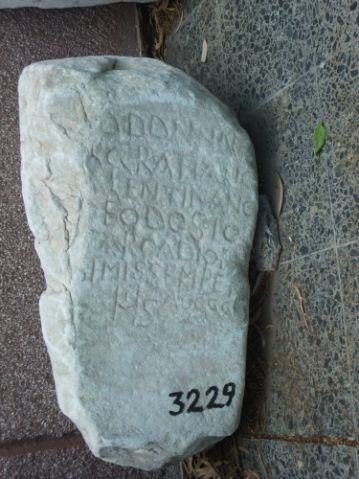
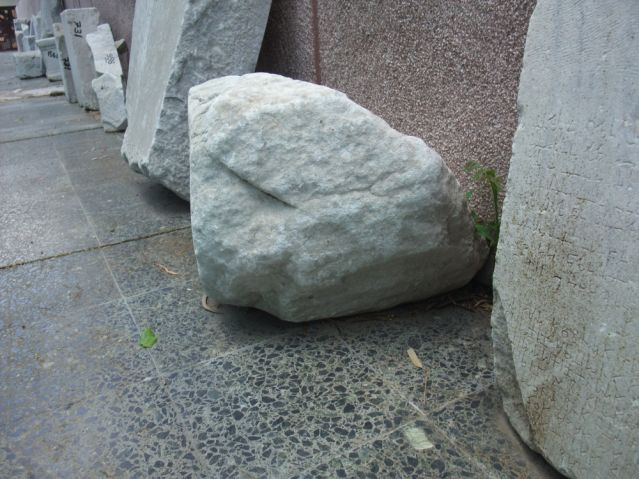
The stone is described as a 'small base with misshapen letters’ by Mommsen for CL III. No measurements are published, and there is no published image. We assume that this is a white marble block which we saw in the Izmir Archaeological museum in summer 2011 (see below, 'Provenance and most recently recorded location'). The inscription of that block, however, displays the letters (?) HS in line 6 (abbreviated form for 'sestertius'), preceding Augggg(ustis); it is possible, therefore, that the block in the Izmir museum carries a further inscription of the same type.
PROVENANCE AND MOST RECENTLY RECORDED LOCATION
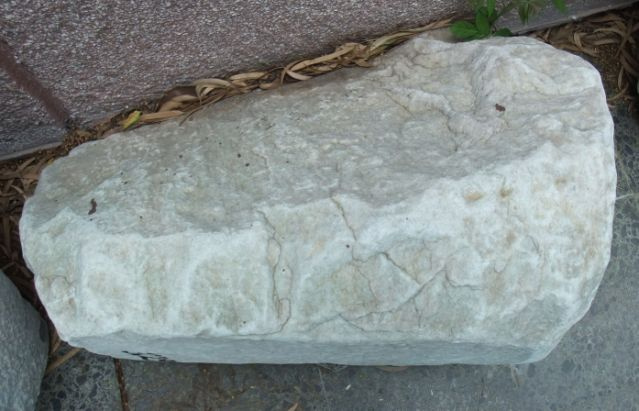
The inscription was recorded built into a fountain in Belkahve within today’s Izmir, just outside the ancient city of Smyrna, by Keil 1914, 8 (though he had not himself seen it). This is where the ancient road from Smyrna to Sardis ran. There is no more recently published record of its location; we believe, however, that this is a block we recorded in the epigraphic collection in the garden of the Izmir Archaeological museum in summer 2011, inv. no. 3229 (see above, 'Description'). This block is broken on all sides; its dimensions are roughly the same as the twin inscription LSA-518.
HONORANDS AND DATE
Gratian, the first honorand, was Augustus 367-83; his brother Valentinian II, the second honorand, Augustus 375-92; Theodosius I, the third honorand, 379-95; his son Arcadius, the fourth honorand, 383-408. This allows a precise date for our inscription, between the elevation of Arcadius on 19 January 383 and Gratian’s death on 25 August; a certain time span has to be allowed for the news of both events to reach Anatolia (see also LSA-518).
FURTHER DISCUSSION
A very similar inscription was found some miles further east on the way to Sardis (LSA-518). The findspot of our inscription, close to a major road (see above, 'Provenance and Location'), and its close similarity to LSA-518 make it probable that this is a milestone rather than a statue base; the mileage must have been legible on a separate element. Moreover, on a statue base one would expect the name of the awarder.
If it was a statue base, then the explanation of the existence of two such similar object (ours, and LSA-518) is that there were origianlly four, one to each of the emperors commemorated.
Discussion references
- Keil, J. & A. von Premerstein, Bericht über eine dritte Reise in Lydien und den Angrenzenden Gebieten Ioniens : Ausgeführt 1911 im Auftrage der Kaiserlichen Akademie der Wissenschaften, Wien 1914, p. 8
Cite: Last Statues of Antiquity, LSA-519 (Ulrich Gehn).