
LSA-52
Fragmentary plaque from base for statues of Theodosius I, Arcadius and Honorius, emperors. Corinth (Achaea). 393-395
Record details
Photographs
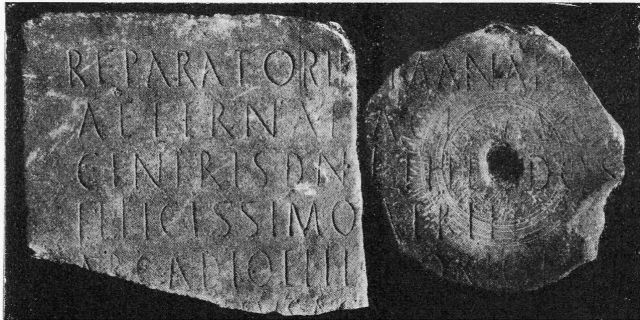
Inscription
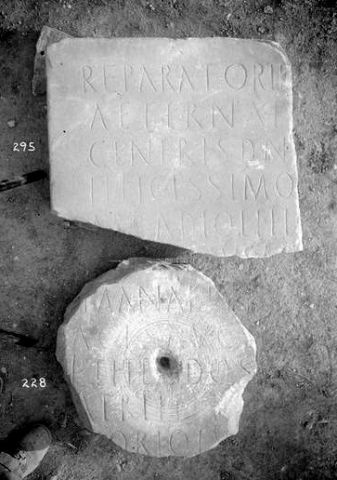
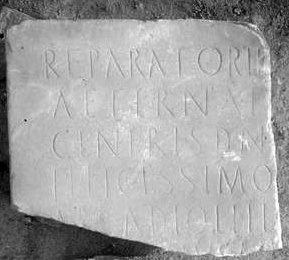
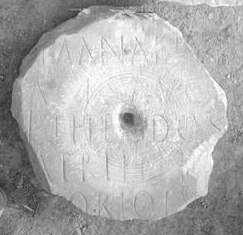
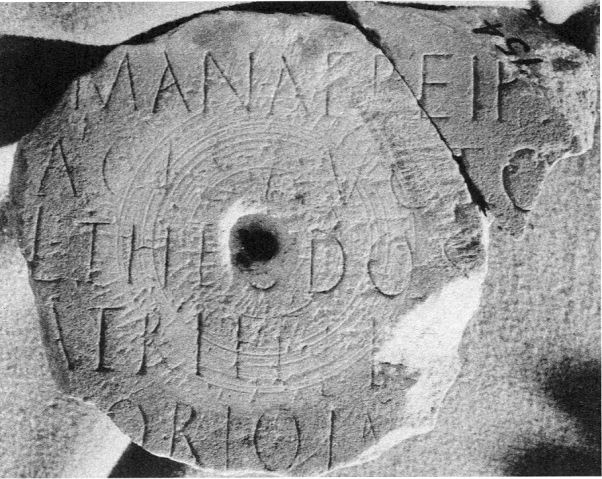
Reparatori R[o]manae rei, [fundatori] / aeternae [p]acis, aucto[ri humani] / generis, d(omino) n(ostro) [F]l(avio) Theodos[io augusto] / felicissimo [p]atri, et fi[liis dd(ominis) nn(ostris) ffll(aviis)] / (5) Arcadio et H[on]orio iṃ[peratoribus] / [---] ṭịụṣ Ạc̣ [---].
Inscription translation
To the restorer of the Roman empire, the founder of eternal peace, and progenitor of mankind, to our lord Flavius Theodosius the most fortunate Augustus, father; and to his sons, our lords the Flavians Arcadius and Honorius the emperors ... ius Ac...
Bibliography
- Brown West, A., Latin inscriptions, 1896-1926: Corinth VIII, 2, Princeton 1931, nr. 26
- Kent, J. H., The inscriptions, 1926-1950: Corinth VIII, 3, Princeton 1966, nr. 506 pl. 41
Discussion
INSCRIPTION
In six surviving lines:
Reparatori R[o]manae rei, [fundatori] / aeternae [p]acis, aucto[ri humani] / generis, d(omino) n(ostro) [F]l(avio) Theodos[io augusto] / felicissimo [p]atri, et fi[liis dd(ominis) nn(ostris) ffll(aviis)] / (5) Arcadio et H[on]orio iṃ[peratoribus] / [---] ṭịụṣ Ạc̣ [---].
'To the restorer of the Roman empire, the founder of eternal peace, and progenitor of mankind, to our lord Flavius Theodosius the most fortunate Augustus, father; and to his sons, our lords the Flavians Arcadius and Honorius the emperors ... ius Ac...'
The wording and the Latin dative for the honorands show that this was a dedication of statues. It is uncertain how many lines of text are missing at the bottom of the inscription.
DESCRIPTION
Three fragments (two perfectly adjoining) of a substantial white marble slab (14 cm thick), with a dedicatory inscription to Theodosius I, Arcadius and Honorius.
Fragment 295, with the beginning of the inscription, is broken and lost on the right and bottom, but preserves its original left and upper edges and parts of the top six lines of the text. Fragment 228, from the top right of the inscription, is broken on all sides. It preserves parts of five lines. Fragment 754 is broken on all sides but preserves a small part of the original upper edge of the slab and parts of the two top lines of the inscription; it adjoins perfectly with Fragment 228.
The original surface is well preserved on fragment 295, and is smoothly finished. Fragment 228 was later used as a millstone, as shown by the hole drilled in the centre and by the concentric lines of wear. Fragment 754 was considered to be part of a Greek inscription by Meritt 1931 and only later joined with the two others (Kent 1966).
This is an unusually long inscription, of at least 125 cm in length. It must have been set into the front of a long base in some other material, supporting statues of all three emperors.
PROVENANCE AND LOCATION
Fragment 295 was found in 1896, in Trench XIII southeast of the village square; fragment 228 in 1902 near the east end of the Northwest Stoa in the centre of ancient Corinth (Brown West 1931). The provenance of fragment 754 is unknown (Meritt 1931).
HONORANDS, AWARDER, AND DATE
Theodosius I was Augustus 379-95; his older son Arcadius in 383-408; his younger son Honorius in 393-423. The terminus post quem is given by Honorius' elevation in 393, the terminus ante quem by the death of Theodosius I in 395. The name of the awarder is possibly partly preserved in the final line ... tius Ac .... (Feissell & Philippidis Braat 1985; Rizakis 2001).
Discussion references
- Feissel, D. & Philippidis-Braat, A., Inventaires en vue d’un recueil des inscriptions historiques de Byzance, 3. Inscriptions du Péloponnèse, (à l’exception de Mistra)., Travaux et mémoires, 9, Paris 1985, 267-395, 275-6 no. 10
- Meritt, B. D., Greek Inscriptions 1896-1927 (Corinth VIII, 1), Cambridge, Mass. 1931, 157 no. 299
- Rizakis, A. D., Roman Peloponnese 1. Roman personal names in their social context (Achaia, Arcadia, Argolis, Korinthia and Eleia), Athens and Paris 2001, 248 no. 4
Cite: Last Statues of Antiquity, LSA-52 (Ulrich Gehn / Amelia Brown).