
LSA-523
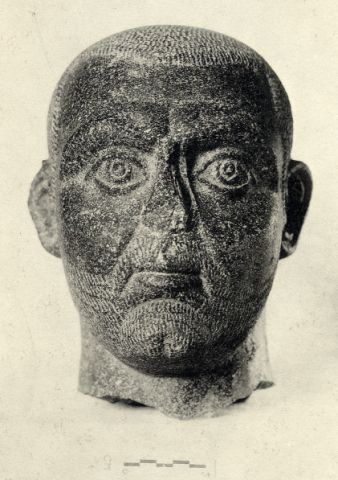
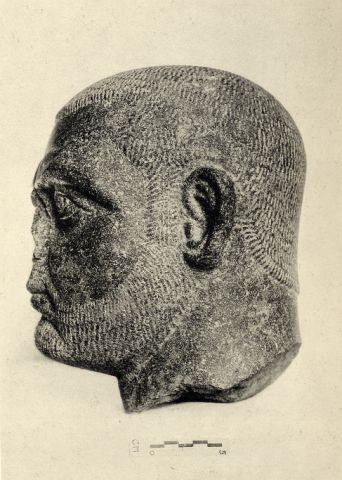
Porphyry head of Tetrarch (lost). From Antioch on the Orontes (Syria). Late third to early fourth century.
Record details
Photographs
Bibliography
- Brinkerhoff, D., A Collection of Sculpture in Classical and Early Christian Antioch, New York 1970, 19-28, figs.1,22, 23
- Calza, R., Iconografia Romana Imperiale. Da Carausio a Giuliano (287-363 d. C.), Rome 1972, 145, no. 56 pl. 38.107-108
- L'Orange, H. P., Das spätantike Herrscherbild von Diokletian bis zu den Konstantin-Söhnen, 284-361 n. Chr. Das Römische Herrscherbild. III. Abteilung ; Bd. 4 , Berlin 1984, 27, 106, figs. 18c-d
- Stillwell, R. (ed.), The Excavations 1933-1936. Antioch on-the-Orontes II, Princeton 1938, 172, no. 136, pl. 6
Discussion
DESCRIPTION (object)
Head. H: 22 cm. Porphyry.
The head is broken at the neck. The nose and the upper rim of the right ear are chipped off. Undoubtedly the surface was polished.
PROVENANCE
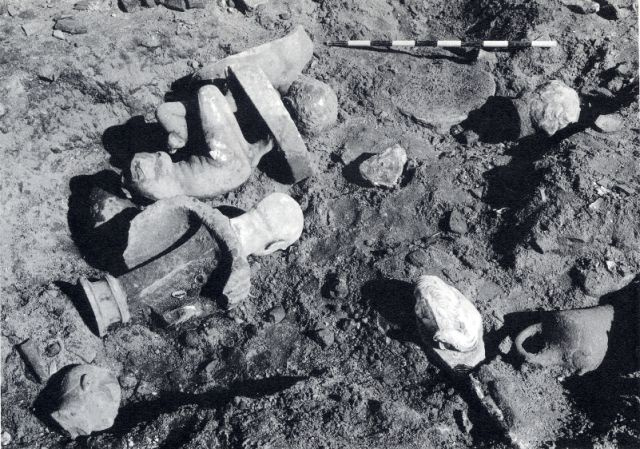
Excavated 1934 at Antioch together with a cache of sculpture comprising 22 pieces buried in a room of a rather poor villa of the late fourth or early fifth century A.D. at Antioch on the Orontes, sector 25–H, that lay just outside of the city wall, near the gate to the road south to Daphne and Laodikeia. See also LSA-254.
DESCRIPTION (subject)
The head has short-cropped hair and beard. The hair is set as a mass against the flesh, and the beard is incised into the skin. The texture of hair and beard is rendered by short strokes arranged in rows just as it is on the portraits of the Tetrarchs now in the Vatican (LSA-840, LSA-841) and from Athribis (LSA-836). The face follows the general iconography of the Tetrarch which includes a contracted forehead and eyebrows as well as lines leading down from the nostrils and the corners of the mouth.
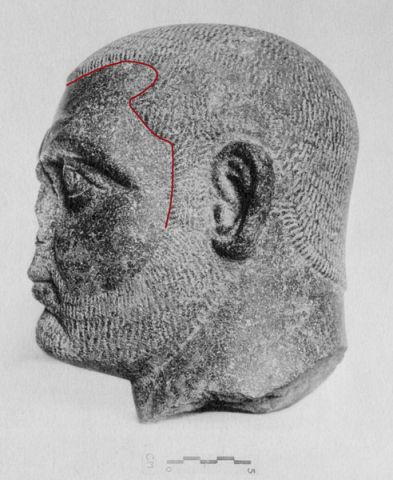
The portrait does differs from the others in certain traits which seem personal. For example, there is only one vertical line above the root of the nose and one horizontal line across the forehead. The chin is pronounced and separated by a strong, upper, defining furrow (the vertical cleft in in the chin seems to be rather a damage than a physiognomic trait). The contour of the hair at the temples, which normally forms an angle or part of a circle, is triangular. It then moves in a three-quarter circle into the front hair, the perimeter line of which has the form of a hanging bow (see drawing)
DATE/INTERPRETATION
The portrait has been thought to represent the same person as the proper right man in the Caesars group in Venice (LSA-4) because of ist single lines on the forehead. It has been identified with Constantius Chlorus because of the chin; it has also been identified as Galerius. The pronounced chin is a feature of the portraits of Constantius Chlorus (see LSA-806, LSA-855), whereas the form of the hair on the temples and corners of the front hair are a specialty of Licinius on the coins of Antioch (Overbeck 1973, 12 fig.12; Smith 1997 pl.5,2) , where the head was found. It is the local form for Licinius’ receding hairline which appears on all his coin portraits, the heads on the arch of Constantine, and one of two colossal heads from Ephesus, which seems to represent Licinius ( LSA-687). This latter portrait shows a fat-faced man, and neither this head from Antioch nor the Licinius on the arch of Constantine (L’Orange 1984 pl.28.29) is heavy-set. As is the case with the porphyry portraits from Tekija (LSA-1042) and Athribis (LSA-836) there is no secure argument which permits the attribution of this portrait to a specific emperor.
Discussion references
- Robertson, A. S., Roman imperial coins in the Hunter Coin Cabinet, University of Glasgow, v. 5. Diocletian (reform) to Zeno. , Oxford 1982
- Smith, R.R.R.,'The public image of Licinius I: Portrait sculpture and imperial ideology in the early fourth century', JRS 87, 1997, 170-202, pls. 1-12
Cite: Last Statues of Antiquity, LSA-523 (Marianne Bergmann).