
LSA-524
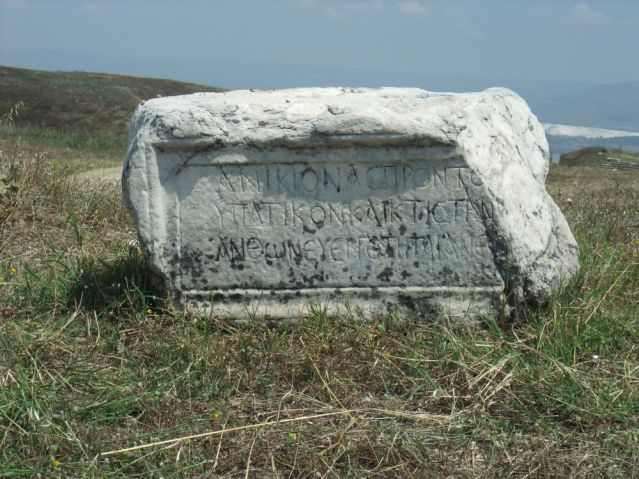
Base for statue of Anicius Asper, governor of Caria et Phrygia. Laodicea ad Lycum (Phrygia Pacatiana). Late third to very early fourth century.
Record details
Photographs
Inscription
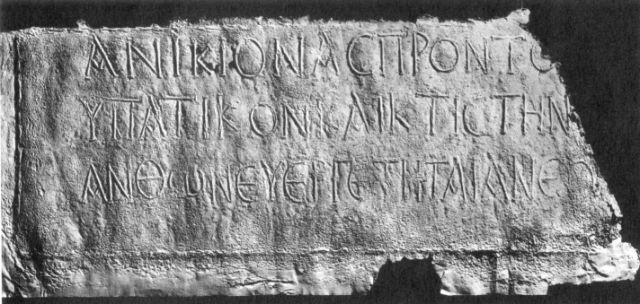
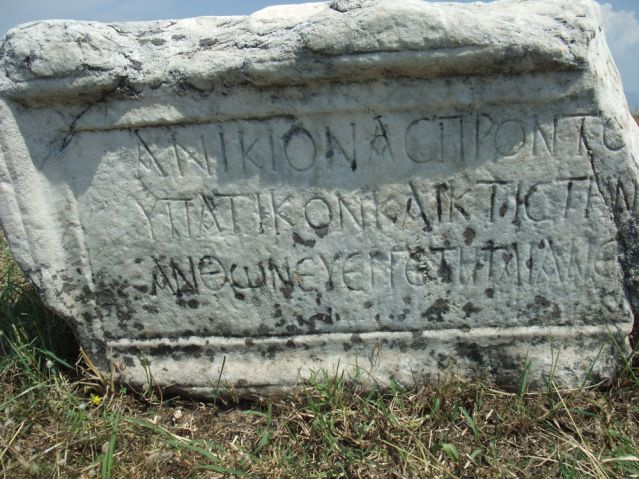
Ἀνίκιον Ἄσπρον, τὸ[ν λαμ(πρότατον)] / ὑπατικὸν καὶ κτίστην [τῆς πόλεως], / ἀνθ’ ὧν εὐεργέτηται ἀνέθ[ηκεν].
Inscription translation
To Anicius Asper, of clarissimus rank, governor (consularis) and founder of the city, on account of the things which he donated.
Bibliography
- Inscriptiones Graecae, IV 852
- Corsten, T., Die Inschriften von Laodikeia am Lykos. Teil I (Inschriften griechischer Städte aus Kleinasien, Bd. 49) , Bonn 1997, 83-5, no. 40
Discussion
INSCRIPTION
In three lines:
Ἀνίκιον Ἄσπρον, τὸ[ν λαμ(πρότατον)] / ὑπατικὸν καὶ κτίστην [τῆς πόλεως], / ἀνθ’ ὧν εὐεργέτηται ἀνέθ[ηκεν].
'[We honour] Anicius Asper, of clarissimus rank, governor (consularis) and founder of the city, on account of the things which he donated.'
Letter height 4.5 - 5.5 cm.
We reproduce the text with the completions suggested by Corsten 1997.
DESCRIPTION (from Robert 1969, Corsten 1997, and the published photo)
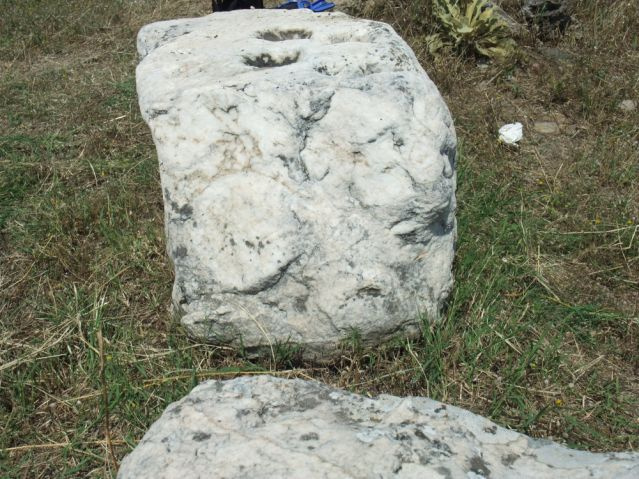
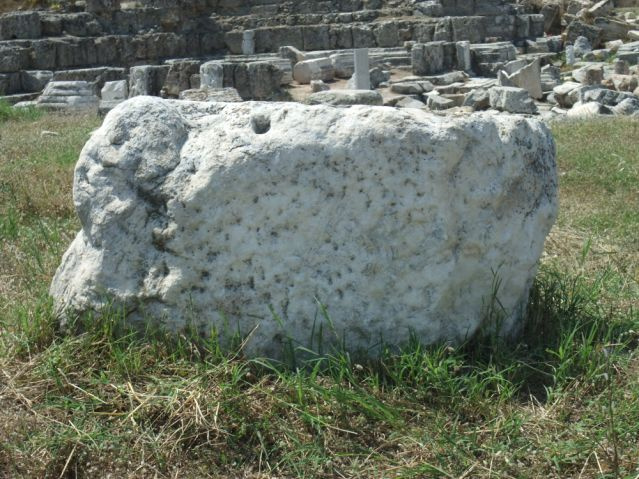
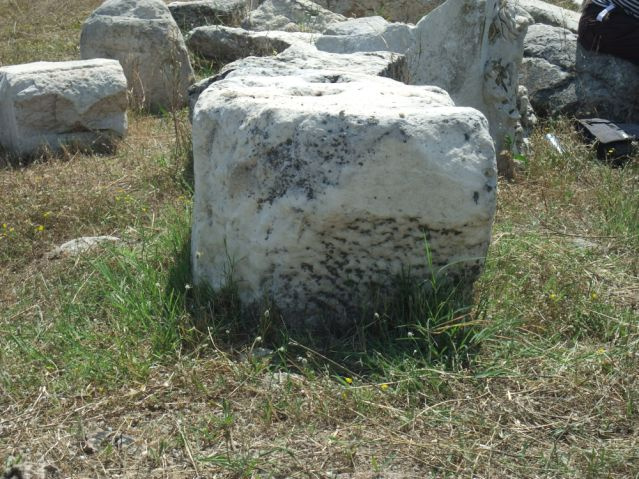
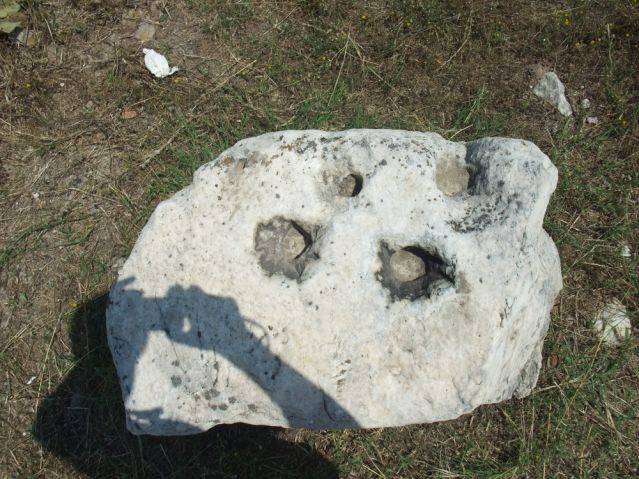
White marble base broken and lost on the right: H 44, W 81, D 56 cm. On the top face there are holes for the insertion of a bronze statue. The inscription is set within a moulded frame.
PROVENANCE AND CURRENT LOCATION
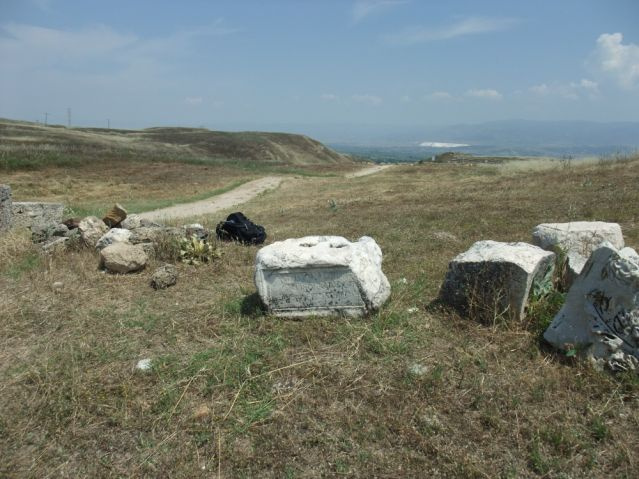
The inscription was first recorded by Weber 1898 on a main street ('...der Stein liegt ... an der großen Straße und gehört ... zu dem Triumphbogen, der hier stand'), but afterwards probably re-buried. It was re-discovered in 1962 by the Canadian excavators of the nymphaeum (Robert 1969). It is still in situ on the right side of the main street of Laodicea (http://www.trismegistos.org/place/5418), opposite the nympheum of Caracalla, excavation inv. no. 1723.
HONORAND, AWARDER AND DATE
The honorand, Anicius Asper, is described as being of senatorial rank, and a governor (ὑπατικός, Latin consularis), but is not otherwise known. The province he ruled and the date of his office are shown by the title 'ὑπατικός' which he bears. This was used by governors of the newly created province of Phrygia and Caria (within which Laodicea lay) from its inception in the mid 3rd century (Roueché 1981,109-11), but not by the earlier governors of Asia (out of which Phrygia and Caria was carved). Around AD 300, Phrygia and Caria was itself divided, and Phrygia Pacatiana (with Laodicea) was placed under governors of lesser (equestrian) rank, with the lesser title of ἡγεμών (Latin praeses); so our inscription must date from before this change (for discussion of the precise date, see Roueché 1981, 111, Seston 1946, Barnes 1982, and Corsten 1997, 84-5).
Robert 1969 dated the script to the late 3rd/ early 4th century.
FURTHER DISCUSSION
Another inscription to a governor of the same rank is known from Laodicea (LSA-606).
Discussion references
- Eck, W., C. Iulius Octavius Volusenna Rogatianus, Statthalter einer kaiserlichen Provinz, Zeitschrift für Papyrologie und Epigraphik 90, 1992, 199-206
- Robert, L., Les inscriptions, De Gagniers, J., Devambez, P., Kahil, L. & R. Ginouvès, Laodicée du Lycos. Le nymphée. Campagnes 1961-1963, 247-389, Paris 1969, pp. 338-9 no. 14
- Roueché, C., Rome, Asia and Aphrodisias in the third century, Journal of Roman Studies 71, 1981, 103-120, pp. 110-11
- Seston, W., Dioclétien et la Tétrarchie I, Paris 1946, p. 337
- Weber, G. Funde aus Laodicea ad Lycum, Mittheilungen des Kaiserlich Deutschen Archaeologischen Instituts, Athenische Abtheilung 23, 1898, 363-5, p. 364 no. 2
Cite: Last Statues of Antiquity, LSA-524 (Ulrich Gehn).