
LSA-525
Base for statue of Flavius Constantinus, consul and praetorian prefect. Laodicea ad Lycum (Phrygia Pacatiana). 457.
Record details
Photographs
Inscription
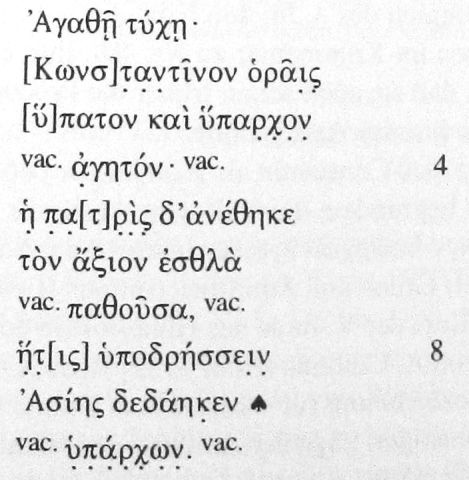
Ἀγαθῇ τύχῃ·/ [Κωνσ]τ̣α̣ν̣τῖνον ὁρᾶι̣ς / [ὕ]πατον καὶ ὕπαρ̣χ̣ο̣ν̣ / ἀ̣γητόν· / (5) ἡ̣ π̣α̣[τ]ρ̣ὶ̣ς̣ δ’ ἀνέθηκε / τὸν ἄξιον ἐσθλὰ / παθοῦσα, / ἣ̣τ̣[ις] ὑποδρήσσει̣ν ̣ / Ἀσίης δεδάηκ̣εν (ivy leaf) / ὑ̣̣π̣ά̣ρ̣̣χ̣ω̣ν̣.
Inscription translation
To Good Fortune. You see Constantinus, consul and admirable prefect. The fatherland, having received noble deeds, set up this worthy man -- the fatherland which has learned to serve the prefects (uparchoi) of Asia.
Bibliography
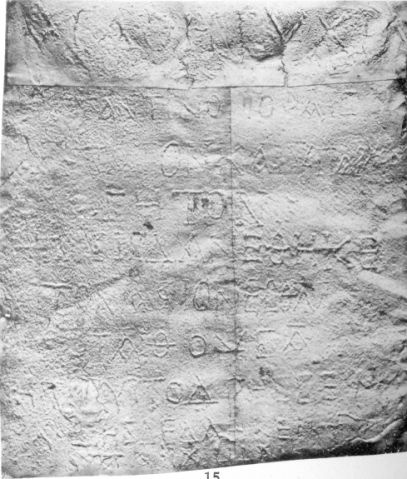
- Buckler, W.H. and W.M. Calder (eds.), Monuments and documents from Phrygia and Caria. Monumenta Asiae Minoris antiqua, v. 6, Manchester 1939, p. 9 no. 15 pl. 4
- Corsten, T., Die Inschriften von Laodikeia am Lykos. Teil I (Inschriften griechischer Städte aus Kleinasien, Bd. 49) , Bonn 1997, pp. 87-89 no. 42
Discussion
INSCRIPTION
Verse inscription in three hexameters, laid out in ten lines:
Ἀγαθῇ τύχῃ·/
[Κωνσ]τ̣α̣ν̣τῖνον ὁρᾶι̣ς / [ὕ]πατον καὶ ὕπαρ̣χ̣ο̣ν̣ / ἀ̣γητόν· /
(5) ἡ̣ π̣α̣[τ]ρ̣ὶ̣ς̣ δ’ ἀνέθηκε / τὸν ἄξιον ἐσθλὰ / παθοῦσα, /
ἣ̣τ̣[ις] ὑποδρήσσει̣ν ̣ / Ἀσίης δεδάηκ̣εν (ivy leaf) / ὑ̣̣π̣ά̣ρ̣̣χ̣ω̣ν̣.
'To Good Fortune. You see Constantinus, consul and admirable prefect. The fatherland, having received noble deeds, set up this worthy man -- the fatherland which has learned to serve the prefects (uparchoi) of Asia'.
Letter height 3-7 cm (7 cm in line 1, 3 cm line 9, otherwise 4-5cm).
The precise meaning of 'ὑ̣πάρχων' in line 10, which we have translated as 'prefects', is open to debate (see below, 'Further Discussion')
DESCRIPTION (from Buckler & Calder 1939, Corsten 1997, and the published image)
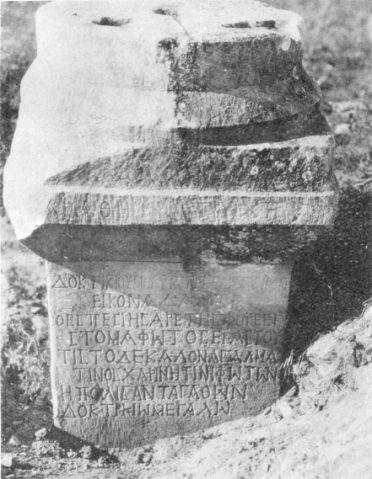
Limestone base with a moulding on all sides at the top; above the upper moulding there is a round plinth worked from the same block, with three dowel holes in its upper face. H 122; W (overall) 80, (shaft) 69; D 83 cm; diameter of plinth 69 cm. Our inscription is carved on the opposite side to another probably late-antique inscription, to a local benefactor (LSA-526; Corsten 1997 no. 52). We are unable to determine which of these two inscriptions is the earlier.
PROVENANCE AND CURRENT LOCATION
The inscription was recorded by Buckler & Calder 1939 in Laodicea (http://www.trismegistos.org/place/5418), but with no more precision than 'among the ruins’. Corsten 1997, 107 assumed from the notes of the 17th-century author Thomas Smith that it was located between the stadium and the agora. No more recent account of its location is known to us.
HONORAND, AWARDER AND DATE
Constantinus, the honorand, is described as consul and praetorian prefect (line 3). He was Flavius Constantinus, praetorian prefect of the East in 447, for the second time in 456, for the third time in 459, and consul in 457 (PLRE II, 317-18, Fl. Constantinus 22). Our inscription was set up in 457, the year of his consulship.
The statue was awarded by the city of Laodicea, in gratitude for benefits it had received (lines 6-7).
FURTHER DISCUSSION
In lines 8-10 of the inscription, Laodicea is styled as the city that 'has learned to serve the uparchoi of Asia, ἣτις ὑποδρήσσει̣ν Ἀσίης δεδάηκεν ὑ̣πάρχων'. Robert 1948, 45-6 pointed out that uparchos, although usually the term for a praetorian prefect, could be used for his subordinate, the vicar (see also Feissel 1998, 92). If so, the 'uparchos of Asia' of our inscription could be the vicar of the diocese of 'Asiana' under whose jurisdiction Laodicea lay. However, we think it is more plausible to read uparchos with its usual meaning of 'prefect', since this would be appropriate in an inscription to a man who was a praetorian prefect rather than a mere vicar; in which case 'Asia' is not a reference to the diocese of Asiana, but simply a poetic way of referring to the East.
Discussion references
- Feissel, D. 'Vicaires et proconsuls d’Asie du IVe au VIe siècle. Remarques sur l’administration du diocèse asianique au Bas-Empire', Antiquité tardive. Revue internationale d’histoire et d’archéologie, 6, Paris 1998
- Martindale, J. R., The Prosopography of the Later Roman Empire. Vol. II A.D. 395-527, Cambridge 1980
- Robert, L., Epigrammes du Bas-Empire (Hellenica IV), Paris 1948, pp. 45-7
Cite: Last Statues of Antiquity, LSA-525 (Ulrich Gehn).