
LSA-526
Base for statue of Docticius, local benefactor. Laodicea ad Lycum (Phrygia Pacatiana). Late third to fifth century.
Record details
Photographs
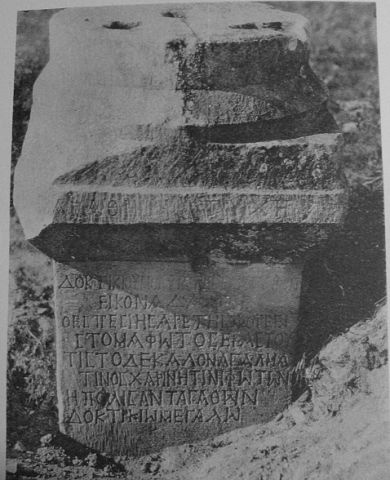
Inscription
ἀγαθῇ τύχῃ. /
(1) Δοκτικίου μορφῆς μὲν ἕχωι τύπον, / εἰκόνα δ’αὗτε / θεσπεσίης ἀρετῆς φορέει /(5) στόμα φῶτος ἑκάστου. /
(2) τίς τόδε καλὸν ἄγαλμα,/ τίνος χάριν ἢ τίνι φωτῶν; / ἡ πόλις ἀντ’ ἀγαθῶν / Δοκτικίῳ μεγάλῳ.
Inscription translation
To Good Fortune.
(1) I have the form of the shape of Docticius; but the mouth of every mortal carries the image of his divine virtue.
(2) Who is this beautiful statue, what is the reason, and for which mortal? The city in return for good deeds [honours] the great Docticius.
Bibliography
- Corsten, T., Die Inschriften von Laodikeia am Lykos. Teil I (Inschriften griechischer Städte aus Kleinasien, Bd. 49) , Bonn 1997, 107-9, no. 52
Discussion
INSCRIPTION
Two verse inscriptions with the standard introductory formula ('To Good Fortune'), laid out in nine lines. The introductory formula is carved on the upper moulding. The first of the two verses is made up of hexameters, laid out in four lines (with each hexameter set over two lines). The second verse is a distich, also laid out in four lines (and again with each line of verse taking up two lines of inscription):
ἀγαθῇ τύχῃ·/
(1) Δοκτικίου μορφῆς μὲν ἕχωι τύπον, / εἰκόνα δ’αὗτε /
θεσπεσίης ἀρετῆς φορέει /(5) στόμα φῶτος ἑκάστου.
(2) τίς τόδε καλὸν ἄγαλμα,/ τίνος χάριν ἢ τίνι φωτῶν; /
ἡ πόλις ἀντ’ ἀγαθῶν / Δοκτικίῳ μεγάλῳ.
'To Good Fortune.
(1) I have the form of the shape of Docticius; but the mouth of every mortal carries the image of his divine virtue.
(2) Who is this beautiful statue, what is the reason, and for which mortal? The city in return for good deeds [honours] the great Docticius.'
Letter height 4 cm.
Verse 1 praises the virtues of Docticius and especially his fine words and eloquence. Verse 2 praises his generosity as a benefactor.
DESCRIPTION (from Buckler & Calder 1939, Corsten 1997, and the published photo)
Limestone base with a moulding on all sides at the top; above the upper moulding there is a round plinth worked from the same block, with three dowel holes in its upper face. H 122; W (overall) 80, (shaft) 69; D 83 cm; diameter of plinth 69 cm. The left corner of the moulding is broken and lost. Our inscription is carved on the opposite side to an inscription to Constantinus, consul in 457 (LSA-525; Corsten 1997 no. 52). We are unable to determine which of these two inscriptions is the earlier.
PROVENANCE AND LOCATION
Buckler and Calder 1939 recorded the base in Laodicea 'among the ruins’. Corsten 1997, 107 from the notes of the 17th-century author Thomas Smith assumes that it was between the stadium and the agora. No more recent account of its present location is known to us.
HONORAND, AWARDER AND DATE
Docticius is honoured as a benefactor; he was presumably a local man, since no reference is made to any imperial offices, and he is known only from this inscription.
The verse form of our inscription is typical of late antique statue bases, but offers no more precise clues for dating. It was dated to the later 3rd century on the basis of its letter forms by Buckler & Calder 1939; while Robert 1969, 339 suggested a broader late antique date, comparing it to two other inscriptions in Laodicea: that to Anicius Asper, probably from the later 3rd / early 4th century (LSA-524), and that to Constantinus (on the opposite side to our inscription) of AD 457 (LSA-525).
Discussion references
- Buckler, W.H. and W.M. Calder (eds.), Monuments and documents from Phrygia and Caria. Monumenta Asiae Minoris antiqua, v. 6
, Manchester 1939, 8-9, no. 14, pl. 4 - Martindale, J. R., The Prosopography of the Later Roman Empire. Vol. II A.D. 395-527, Cambridge 1980
- Robert, L., Les inscriptions, De Gagniers, J., Devambez, P., Kahil, L. & R. Ginouvès, Laodicée du Lycos. Le nymphée. Campagnes 1961-1963, 247-389, Paris 1969, p. 339
Cite: Last Statues of Antiquity, LSA-526 (Ulrich Gehn).