
LSA-527
Plaque from base for statue of Faustinus, former or honorary imperial tribune and notary. Prusa ad Olympum (Bithynia). Late fourth to fifth century.
Record details
Photographs
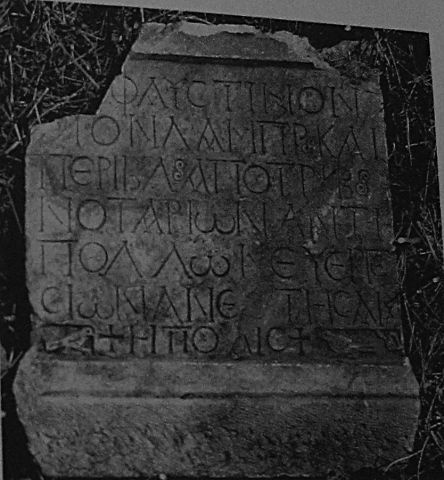
Inscription
[--] Φαυστῖνον, / τὸν λαμπ(ότατον) καὶ / περίβλ(επτον) ἀπὸ τριβ(ούνων) / νοταρίων, ἀντὶ / (5) πολλῶν εὐεργε/σιῶν ἀνέστησαν /(bird and cross) ἡ πόλις. (cross, bird and ivy leaf)
Inscription translation
.. Faustinus, of clarissimus and spectabilis rank, former tribune and notary; the city set [him] up in return for many benefits.
Bibliography
- Corsten, T. (ed.), Die Inschriften von Prusa ad Olympum. Inschriften griechischer Städte aus Kleinasien, Bd. 40, Bonn 1991, p. 181 no. 1095
Discussion
INSCRIPTION
In seven lines:
[--] Φαυστῖνον / τὸν λαμπ(ότατον) καὶ / περίβλ(επτον) ἀπὸ τριβ(ούνων) / νοταρίων, ἀντὶ / (5) πολλῶν εὐεργε/σιῶν ἀνέστησαν /(dove and cross) ἡ πόλις. (cross, dove and ivy leaf)
' .. Faustinus, of clarissimus and spectabilis rank, former tribune and notary; the city set [him] up in return for many benefits.'
Letter height 3.5 cm.
From the way the inscription is laid out, it is clear that one or two letters are missing from the broken beginning of the first line.
DESCRIPTION (from Corsten 1993 and the published photo)
White marble plaque with mouldings at top and bottom: H 69, W 41, D 11 cm. The top left corner is broken and lost. The wording of the inscription, with its statement that Faustinus was here 'set up, ἀνέστησαν' (line 6), shows that it was once fixed to a statue base, presumably built of some less expensive material.
PROVENANCE AND CURRENT LOCATION
The precise provenance of the inscription is unknown. It was first recorded by Corsten 1993 in the Bursa Museum garden, without published inv. no.
HONORAND, AWARDER AND DATE
Faustinus, the honorand, is here rewarded for his benefactions towards the city of Prusa (lines 4-6). He had held the court office of tribune and notary ('ἀπὸ τριβούνων νοταρίων', in lines 3-4, Latin tribunus ac notarius); the qualification of him as a former office holder (ἀπὸ, in line 3) could mean that he held this office only in an honorary capacity. None of the persons of this name listed in PLRE can be associated with our honorand. He was probably a native of Prusa, since his offices would not have involved him specifically with the provincial administration of Bithynia.
The inscription was set up by the city of Prusa, in gratitude for benefits received from Faustinus
Faustinus boasts the rank of a 'vir clarissmus et spectabilis' (λαμπότατον καὶ περίβλεπτον, lines 2-3); these are the two lower of the three senatorial ranks established after the mid-fourth century and codified in a law of 372 (Codex Theodosianus VI 7,1; 9,1; 11,1; 14,1; Chastagnol 1982, 176). A law of 381 (Codex Theodosianus VI, 10,2) established that higher ranking tribuni ac notarii were spectabiles, the grade above clarissimi.
These laws provide the terminus post quem for our inscription, a dating supported by the Christian symbols in the last line of the inscription, which also point to a later 4th-century, or 5th-century date.
Discussion references
- Chastagnol, A., La carrière sénatoriale du Bas-Empire depuis Diocletien, Epigrafia e ordine senatorio, 1. Atti del Colloquio intenazionale AIEGL, Roma 14 - 20 maggio 1981, pp. 167-92, Roma 1982
- Jones, A. H. M. et al., The Prosopography of the Later Roman Empire. Vol. I 260-395, Cambridge et al. 1971 (1975)
- Martindale, J. R., The Prosopography of the Later Roman Empire. Vol. II A.D. 395-527, Cambridge 1980
- Martindale, J. R., The Prosopography of the Later Roman Empire. Volume III A. D. 527-641, Cambridge 1992
Cite: Last Statues of Antiquity, LSA-527 (Ulrich Gehn).