
LSA-528
Base, probably for statue, with dedication to emperors Valentinian II, Theodosius I, and Arcadius. Heraclea Pontica (Bithynia). 383-392.
Record details
Photographs
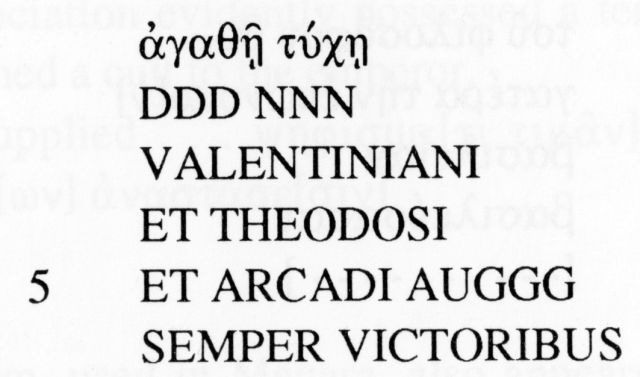
Inscription
Ἀγαθῇ τύχῃ. / Ddd(ominis) nnn(ostris) / [V]alentiniani / et Theodosi / (5) et Arcadi Auggg(ustis), / semper victoribus.
Inscription translation
To Good Fortune. To our lords, Valentinianus, and Theodosius, and Arcadius, the Augusti, always victorious.
Bibliography
- Jonnes, L. (ed.), The inscriptions of Heraclea Pontica. Inschriften griechischer Städte aus Kleinasien, bd. 47, Bonn 1994, no. 6
Discussion
INSCRIPTION
In five lines:
Ἀγαθῇ τύχῃ. / Ddd(ominis) nnn(ostris) / [V]alentiniani / et Theodosi / (5) et Arcadi Auggg(ustis), / semper victoribus.
'To Good Fortune. To our lords, Valentinian, and Theodosius, and Arcadius, the Augusti, always victorious.'
Letter height 2-5 cm.
The names of the honorands in the genitive is unusual for Latin statue base inscriptions, but the closing victoribus is 'correctly' in the dative, so the use of the genitive is probably an error by someone unused to Latin (Jonnes 1986). Also unusual on a statue base is the absence of a named awarder.
DESCRIPTON (from Jonnes 1986 and Jonnes 1994)
White marble block with mouldings at top and bottom: H 150, W 60, D 60 cm. At the bottom right a large portion is broken off and lost. At the front top there is a relief showing a wreath with ribbons flowing to each side. The upper front corners are decorated with acroteria. The first, Greek, line of the inscription is carved on a rim between the shaft and the upper moulding. It belonged to an earlier inscription that was erased to create the epigraphic field for our inscription. There is no published image.
PROVENANCE AND CURRENT LOCATION
The inscription was first recorded in 1977 in Heraclea Pontica by Şahin, and published by Jonnes 1986. It is now in the courtyard of the library/museum in Ereğli, inv. no. 3.
HONORANDS, AWARDER AND DATE
Valentinian II, the first honorand, was Augustus 375-92; Theodosius I, the second honorand, 379-95; his son Arcadius, the third honorand, 383-408. The inscription therefore dates from the common reign of the three emperors, 383-92.
No awarder is named; it is likely to have been the city itself.
FURTHER DISCUSSION
Although the Latin of the inscription is eccentric, and no awarder is named, we think this probably was a statue base (presumably set up by the city itself). In support of this hypothesis are the size and form of the block, its location within the city, and the fact that another very similar inscription, with a dedication to the same emperors, is also known from Heraclea (LSA-529). Our base presumably bore the statue of one of the three emperors, while LSA-529 carried one of his colleagues. Inscriptions of the Theodosian period, with the names of the honorands in the genitive, are also known from Rhodes (LSA-936, LSA-937).
Discussion references
- Jonnes, L., Three inscriptions from Heracleia Pontica, Epigraphica Anatolica 7, 1986, 97-9, p. 97 no. 1
Cite: Last Statues of Antiquity, LSA-528 (Ulrich Gehn).