
LSA-529
Fragmentary inscription, probably from base for statue, with dedication to emperors Valentinian II, Theodosius I, and Arcadius. Heraclea Pontica (Bithynia). 383-392.
Record details
Photographs
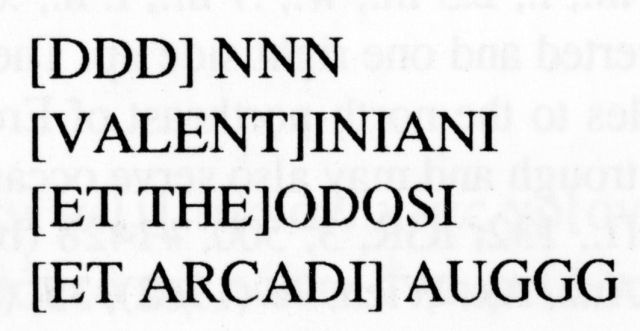
Inscription
[Ddd(ominis)] nnn(ostris) / [Valent]iniani (sic) / [et The]odosi (sic) / [et Arcadi] Auggg(ustis).
Inscription translation
To our lords, Valentinian, and Theodosius, and Arcadius, the Augusti.
Bibliography
- Jonnes, L. (ed.), The inscriptions of Heraclea Pontica. Inschriften griechischer Städte aus Kleinasien, bd. 47, Bonn 1994, p. 34 no. 59
Discussion
INSCRIPTION
In four lines:
[Ddd(ominis)] Nnn(ostris) / [Valent]iniani (sic) / [et The]odosi (sic) / [et Arcadi] Auggg(ustis).
'To our lords, Valentinian, and Theodosius, and Arcadius, the Augusti.'
Letter height not recorded.
The names of the honorands in the genitive is unusual for Latin statue base inscriptions, but may well be an error by someone unused to Latin (Jonnes 1986; and see our discussion of the more complete inscription of LSA-528, also from Laodicea). Also unusual on a statue base is the absence of a named awarder. In this case (a fragmentary inscription), the absence could be explained as an accident of survival (though an awarder is also missing from the closely related, and complete, LSA-528).
DESCRIPTION (from Jonnes 1994)
Fragment of a white marble block, built into the city wall, broken and lost on the left. No measurements are published, and there is no published image.
PROVENANCE AND CURRENT LOCATION
The inscription was first recorded by Jonnes 1994 built into the city wall of Heraclea Pontica 'on the west side of town, some 100 meters along the road above the city market place. It is some ten meters above the roadway'. It is still in situ.
HONORANDS, AWARDER AND DATE
Line 4 indicates that there were three Augusti honoured ('Auggg(ustis)'), the names of two of whom partially survive: Valentinian II, Augustus 375-92, and Theodosius I, Augustus 379-95. The third whose name is lost can only be Arcadius (Augustus 383-408). Gratian (Augustus 367-83), Valentinian II’s brother, who shared a common reign with the two others in 379-83, can be excluded because he would certainly have been named first, as the senior Augustus. Imperial seniority is observed on our inscription (as on its pair from Heraclea Pontica, LSA-528), both naming Valentinian II before Theodosius, although it was Theodosius who was the ruler of the East.
No awarder's name survives; it is likely to have been the city itself.
The inscription dates to the common reigns of Valentinian II, Theodosius I and Arcadius, 383-92.
FURTHER DISCUSSION
Although very little survives of this block, and the use of the genitive in its inscription is anomalous for a statue dedication, we think it probably did serve as a statue base, since its surviving wording is identical to that on another block in Heraclea, which has the shape and size of a statue base (LSA-528). It is likely that that base and ours were part of a set of three, each with the same dedication, and each bearing a statue of one of the commemorated emperors.
Cite: Last Statues of Antiquity, LSA-529 (Ulrich Gehn).