
LSA-530
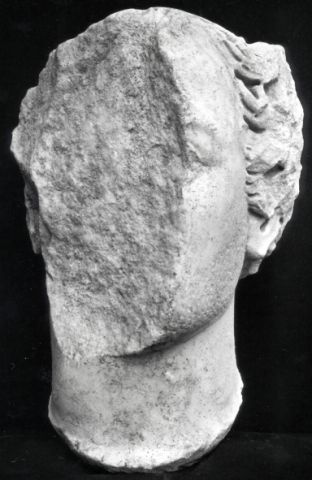
Fragmentary portrait head of man with bald pate and stubble beard. Aphrodisias (Caria). Fifth century.
Record details
Photographs
Bibliography
- Smith, R.R.R., “Archaeological Research at Aphrodisias 1989-1992” Aphrodisias Papers 3. The setting and quarries, mythological and other sculptural decoration, architectural development, Portico of Tiberius and tetrapylon (JRA Supplementary Series 20), Ann Arbor 1996, 18-20, no. 3, fig. 8
Discussion
DESCRIPTION (Object)
Separately worked head. H: 31 cm. White marble.
The head and neck were separately worked. The bottom surface of the neck is only slightly convex. The right side of the face is missing. The hair in front of the ears is worked with a drill in front of the ears; there are small struts or ‘bridges’ over some of the drill channels. Stubble has been picked into the surface of the face with a fine point.
PROVENANCE
Found in 1989 at the western end of the pool in the South Agora. It was found with several other heads in the west end of the pool of the South Agora (for example, LSA-168, LSA-173, LSA-182, and LSA-184) and probably belonged to a statue set up in the west portico of the South Agora or forecourt to the Hadrianic Baths.
DESCRIPTION (Subject)
The fragmentary head shows a man with a bald pate, a tall, thick ‘wreath’ hairstyle, and a stubble beard. The ears are not entirely covered, and the neck is cylindrical.
DATE
The tall ‘wreath’ hairstyle with the stubble place this head best in the fifth century. The closest parallels for this hairstyle at Aphrodisias are , LSA-175, LSA-179, (both fragmentary), and the statue of Pytheas LSA-147 and LSA-148. Pytheas has been placed with good probability in the late fifth century.
Discussion references
- Smith, R.R.R., "Statue life in the Hadrianic Baths at Aphrodisias, AD 100-600: Local context and historical meaning", in F.A. Bauer, C. Witschel (eds.), Statuen und Statuensammlungen in der Spätantike - Funktion und Kontext (Spätantike, Frühes Christentum, Byzanz: Kunst im ersten Jahrtausend), Wiesbaden 2007, 229, no. A 47 (later 5th-6th c.)
Cite: Last Statues of Antiquity, LSA-530 (J. Lenaghan).