
LSA-531
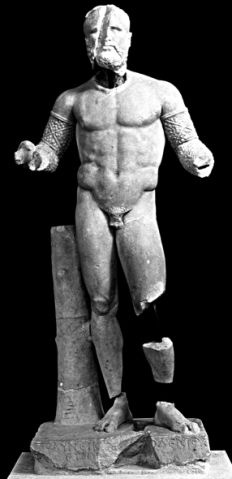
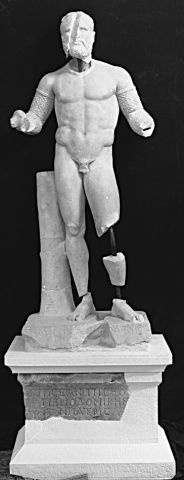
Statue of boxer Piseas (base LSA-532). Aphrodisias (Caria). Late third to early fourth century.
Record details
Photographs
Bibliography
- Smith, R.R.R., S. Dillon, C.H. Hallett, J. Lenaghan, and J. Van Voorhis, Aphrodisias II: Roman Portrait Sculpture at Aphrodisias, Mainz 2006, 145-7, no. 39, pls. 26-7
- Van Voorhis, J. 'Two portrait statues of boxers', Aphrodisias Papers 4. New Research on the City and its Monuments, Portsmouth RI 2008, 235-6, 242-3
Discussion
DESCRIPTION (Object)
Life-size statue. H: 177, W: 71, D: 45 cm, H (of head): 27 cm. Large-grained white marble.
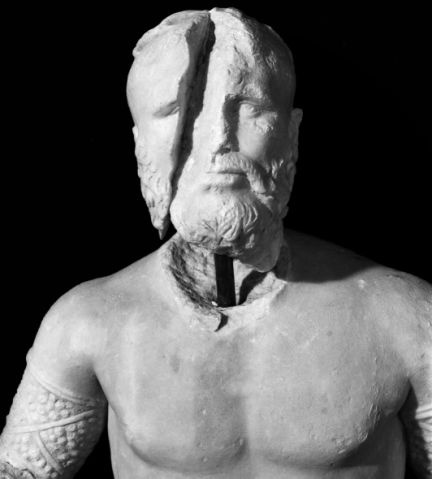
The statue has been recovered from 14 pieces, of which three do not join. The head, now preserved in two fragments, and the left arm were attached by dowels; these represent ancient repairs. The pupils are drilled out in a crescent shape and the irises are engraved. There is also drilling in the beard.
There are three clamps on the plinth, at each side and at the back. There is also a dowel hole between the feet. These connected the statue to its base. Yet there are no cuttings on the base, LSA-532.
PROVENANCE
Most of the fragments of the statue were found in 1970 and 1971 on the stage of the Theatre, north of the south analemma wall. The inscribed base LSA-532 was found also found in the Theatre.
DESCRIPTION (Subject)
The statue shows a naked athlete. He wears a specific athletic hairstyle (cirrus in vertice), a full beard and moustache, and the gloves of a professional boxer. He stands on a tall rectangular plinth which is inscribed Polyneikes of Aphrodisias made this. Both arms are bent and project; the weight rests over the right leg; and a tall tree trunk support, reaching the buttock, supports the figure outside the right leg.
Inscription
The plinth bears the signature of the sculptor in two lines. It seems unusual that this sculptor needs to refer to himself as Aphrodisian within the city.
Πολυνείκ[ης Ἀφρ]οδεισιεὺς
2 vac. ἐποί[ει] vacat
Polyneikes, Aphrodisian, made (this)
DATE
The eye markings, large statue support, and small scale suggest a date no earlier than the late third century and possibly even the fourth century. This is confirmed by the lettering of the base, LSA-532.
The repairs, especially the head, and the clamp cuttings may indicate that the statue and base did not originally belong together and that they were brought together as a single monument at a second moment in the Theatre.
Cite: Last Statues of Antiquity, LSA-531 (J. Lenaghan).