
LSA-532
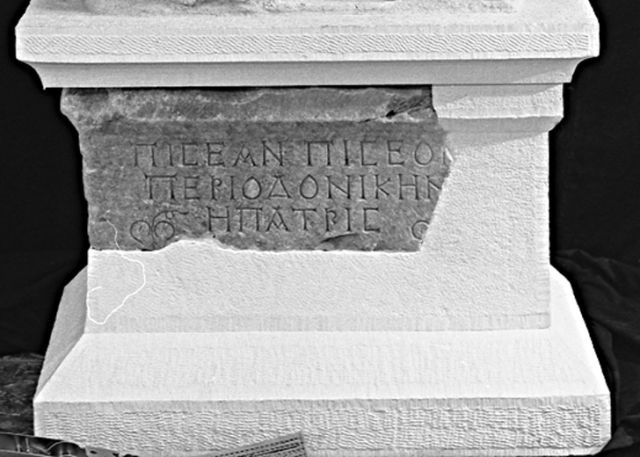
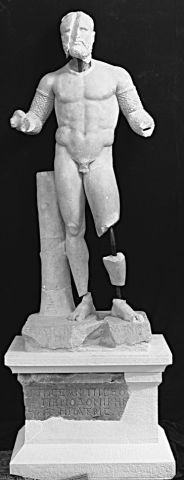
Base for boxer Piseas (statue LSA-532). Aphrodisias. Late third to early fourth century.
Record details
Photographs
Inscription
Πίσεαν Πισέου / περιοδονίκην / leaf ἡ πατρίς leaf /
on statue plinth
Πολυνείκ[ης Ἀφρ]οδεισιεὺς / vac. ἐποί[ει] vacat
Inscription translation
The fatherland (honours) Piseas, son of Piseas, circuit-victor.
on statue plinth
Polyneikes, Aphrodisian, made (this)
Bibliography
- Roueché, C., Performers and partisans at Aphrodisias in the Roman and late Roman periods : a study based on inscriptions from the current excavations at Aphrodisias in Caria , London 1993, 207-208, no. 75, pl. 21
- Van Voorhis, J. 'Two portrait statues of boxers', Aphrodisias Papers 4. New Research on the City and its Monuments, Portsmouth RI 2008, 241-242 (mid third to early fourth c.)
Discussion
INSCRIPTION
In three lines:
Πίσεαν Πισέου / περιοδονίκην / leaf ἡ πατρίς leaf
'The fatherland (honours) Piseas, son of Piseas, circuit-victor.' (Trans. C. Roueché).
Letter height line 1, 3 cm; line 2, 2.5 cm.
DESCRIPTION
Rectangular base with with a simple band of upper moulding. H: 26, W: 59, D: 27 cm. Local blue-grey marble.
The bottom, back, and viewer’s right side are missing. The surface of the extant portion of the left (viewer’s) is worked with a large claw chisel. There are no traces of clamps for the attachment of the statue.
PROVENANCE
The inscribed base was found in 1971 near the central door way of the stage building. The statue, which belonged to the base, LSA-531 was found near the south analemma wall.
HONORAND, AWARDER AND DATE
The pithy inscription gives little information about the honorand. He was a circuit-victor which meant that he was victorious at a series of international contests. His particular sport is unnamed but the statue wears boxing gloves. He was a native of Aphrodisias; the inscription was set up by his hometown.
The lettering and the leaf decoration in the third line suggest a date late in the 3rd century or even the early 4th century.The world of Greek athletics apparently flourished in the mid-third century and early fourth when various emperors (including Constantine) are known to have established new contests.
Discussion references
- Smith, R.R.R., S. Dillon, C.H. Hallett, J. Lenaghan, and J. Van Voorhis, Aphrodisias II: Roman Portrait Sculpture at Aphrodisias, Mainz 2006, 145-7, no. 39
Cite: Last Statues of Antiquity, LSA-532 (J. Lenaghan).