
LSA-538
Base for statue of Celsius or Celseas, military commander. Cibyra (Caria). Later third to mid-fourth century.
Record details
Photographs
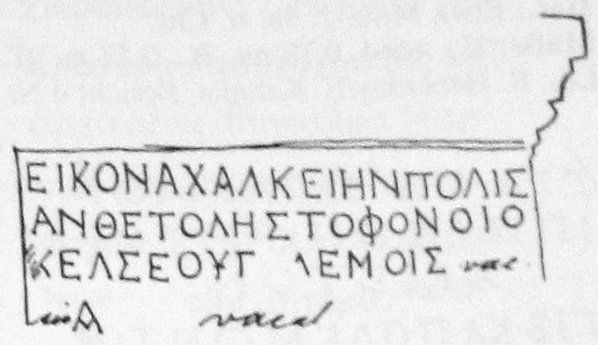
Inscription
Εἰκόνα χαλκείην πόλις / ἄνθετο, λῃστοφόνοιο / Κελσέου π[ο]λέμοις / Α ...
Inscription translation
A bronze statue, the city put up, of Celsius (or Celseas), the robber-slayer in the wars ...
Bibliography
- Corsten, T. (ed.), Die Inschriften von Kibyra. Inschriften griechischer Städte aus Kleinasien, Bd. 60, Bonn 2002, 101, no. 66
Discussion
INSCRIPTION
Verse inscription of one, incomplete, distich laid out in four lines:
Εἰκόνα χαλκείην πόλις / ἄνθετο, λῃστοφόνοιο /
Κελσέου π[ο]λέμοις / Α ...
'A bronze statue, the city put up, of Celsius (or Celseas), the robber-slayer in the wars ...'
Letter height 3 cm.
DESCRIPTION (from Corsten 2002)
Rectangular limestone base with mouldings at top and bottom, worked back at top left and right and at bottom front: H 145, W 49 cm.
PROVENANCE AND CURRENT LOCATION
The inscription was first recorded in 1902 by Heberdey, 'at the entrance of the ruins built into the wall of the entry to the right of the gate'. Corsten 2002, the first scholar to publish the text, quotes Heberdey’s notes without being explicit about the inscription's present location; it is probably still in situ.
HONORAND AND DATE
The honorand, Celsius or Celseas, is otherwise unknown; none of the persons named Celsus listed in PLRE I and PLRE II can be associated with our inscription. His achievements which earned him a bronze statue must have been outstanding; he was therefore almost certainly an imperial military commander rather than a local 'irenarch'. the official responsible for police duties in the city. He is specifically celebrated for slaying 'robbers' (λῃστοφόνοιο, line 2), which was associated with the Isaurian raids of the late 270s by Corsten 2002, who argued that this is supported by the letter forms, and associated the base with specific events in 278. While accepting the link to Isaurian raids, we do not see cogent reasons to be so precise about the date. Violent upheavals in Isauria started in the 3rd century (Christol 1978, 536-7), went on through the 4th century (Matthews 1989, 355-67; Cameron & Garnsey 1998, 452 (B. Isaac)), and erupted again in the late 5th century (Cameron, Ward-Perkins & Whitby 2000, 477 (Whitby)).
The inscription refers to a bronze statue. This required imperial permission from the mid-4th century onwards, which is often mentioned on statue inscriptions (Feissel 1984, 545-58; LSA-1190). The absence of any hint of imperial permission suggests a date for our base before the middle of the 4th century.
Discussion references
- Cameron, Al., Iamblichus at Athens, Athenaeum (nuova serie) 45, 1967, 143-53
- Cameron, Av. & Garnsey, P., The Late Empire, A.D. 337-425 (The Cambridge Ancient History Vol. XIII), Cambridge 1998
- Christol, M. 'Un duc dans une inscription de Termessos (Pisidie). Un témoignage sur les troubles intérieurs en Asie Mineure romaine au temps de la crise de l’empire', Chiron. Mitteilungen der Kommission für Alte Geschichte und Epigraphik des Deutschen Archäologischen Instituts, 8., Munich 1978
- Jones, A. H. M. et al., The Prosopography of the Later Roman Empire. Vol. I 260-395, Cambridge et al. 1971 (1975)
- Martindale, J. R., The Prosopography of the Later Roman Empire. Vol. II A.D. 395-527, Cambridge 1980
- Matthews, J., The Roman Empire of Ammianus, London 1989
Cite: Last Statues of Antiquity, LSA-538 (Ulrich Gehn).