
LSA-539
Lost base for statue of Flavius Annius Chrysobius signo Anatolius; erected by his father. Cibyra (Caria). Fourth century.
Record details
Photographs
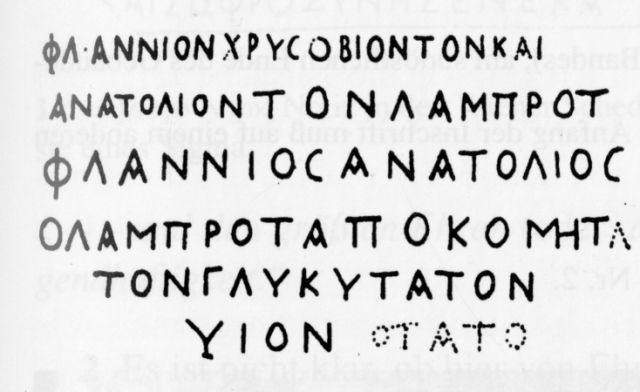
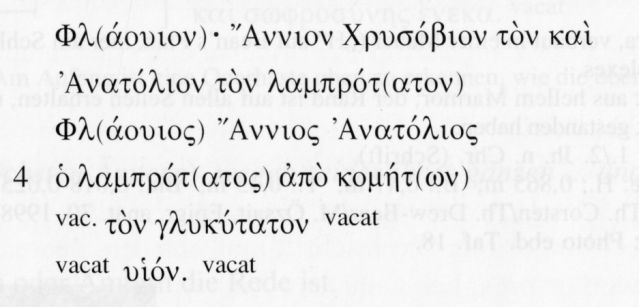
Inscription
Φλ(άουιον)· Ἄννιον Χρυσόβιον, τὸν καὶ / Ἀνατόλιον, τὸν λαμπρότ(ατον), / Φλ(άουιος) Ἄννιος Ἀνατόλιος, /(4) ὁ λαμπρότ(ατος) ἀπὸ κομήτ(ων), / τὸν γλυκύτατον / υἱόν.
Inscription translation
Flavius Annius Chrysobius, also called Anatolius, of clarissimus rank; Flavius Annius Anatolius, of clarissimus rank, former comes, [honours] his sweetest son.
Bibliography
- Corsten, T. (ed.), Die Inschriften von Kibyra. Inschriften griechischer Städte aus Kleinasien, Bd. 60, Bonn 2002, 107-8, no. 74
Discussion
INSCRITION
In six lines:
Φλ(άουιον) Ἄννιον Χρυσόβιον, τὸν καὶ / Ἀνατόλιον, τὸν λαμπρότ(ατον), / Φλ(άουιος) Ἄννιος Ἀνατόλιος, / (4) ὁ λαμπρότ(ατος) ἀπὸ κομήτ(ων), / τὸν γλυκύτατον / υἱόν.
'Flavius Annius Chrysobius, also called Anatolius, of clarissimus rank; Flavius Annius Anatolius, of clarissimus rank, former comes, [honours] his sweetest son.'
Letter height 3-4 cm.
DESCRIPTION (from Corsten 2002)
Limestone base with mouldings at top and bottom: H 116, W 53, D 55 cm. Our inscription is carved over an erased earlier one which was in seven lines.
PROVENANCE AND LOCATION
The inscription was first recorded in 1894/5 by Heberdey and Kalinka 'in the fields' of the village of Yusufça, close to the site of ancient Cibyra (Heberdey & Kalinka 1896). It is today lost.
HONORAND, AWARDER, AND DATE
Flavius Annius Chrysobius signo Anatolius, the honorand, was the son of the awarder Flavius Annius Anatolius (lines 5-6). Both were of senatorial (clarissimus - λαμπρότατος) rank (lines 2 and 4) and therefore members of the highest stratum of the local elite. The father held the rank of ex comitibus, former comes (ἀπὸ κομήτων, line 4). This does not necessarily mean that he served at the imperial court; as Corsten 2002, 108 points out, already in the 4th century the title was bestowed honorifically on people who had never actually served in the imperial comitatus. Both honorand and awarder are without entry in PLRE; and no association can be established with any of the Anatolii listed in PLRE I and PLRE II.
The title of comes, together with the gentilicium Flavius, dates our inscription to the fourth century.
FURTHER DISCUSSION
This is an unusual and interesting dedication. Although statues set up to distinguished family members are common in Rome amongst the senatorial aristocracy (often placed within their rich houses), they are not a feature of the Greek-speaking East, and our inscription anyway differs from the western examples by suggesting affection rather than family pride as its motive.
However, the size and shape of our base, and the wording of its inscription, strongly suggest that it was for a statue. One must wonder what its context was. Was it set up in a public place; but, if so, why does it not refer to any of the public virtues of the honorand? Or was it, like the Roman examples, erected in the father's home, or perhaps even erected in a funerary context (for a possible parallel see LSA-633 at Nicomedia)?
Discussion references
- Heberdey, R. & E. Kalinka, Bericht über zwei Reisen im südwestlichen Kleinasien ausgeführt im Auftrage der kaiserlichen Akademie der Wissenschaften, Wien 1896, p. 2 no. 6, p. 6 no. 2
Cite: Last Statues of Antiquity, LSA-539 (Ulrich Gehn).