
LSA-540
Base for bronze statue of Eulalius, imperial office holder. Sinope (Paphlagonia). Late fourth or fifth century.
Record details
Photographs
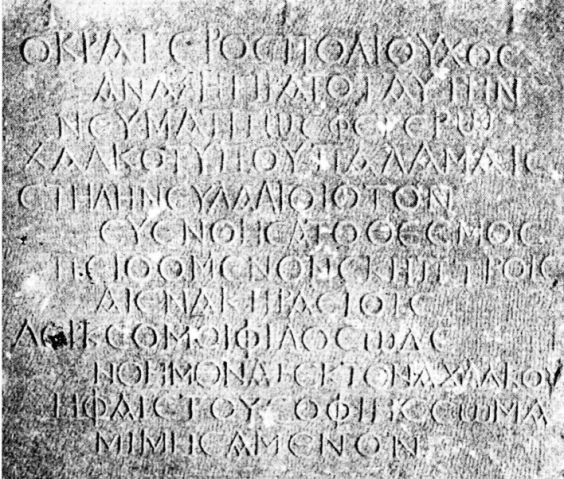
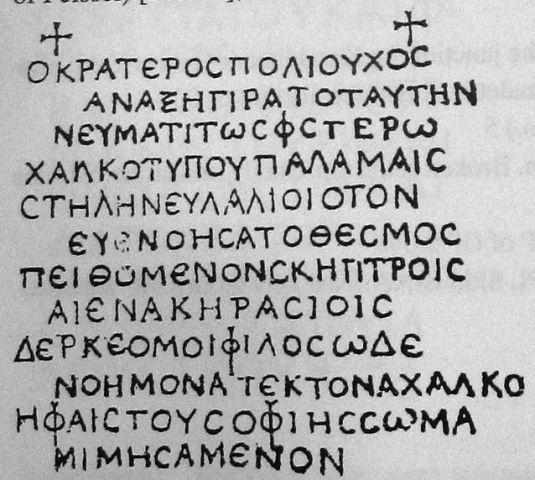
Inscription
(Three crosses)
Ὀ κρατερὸς πολιοῦχος / ἄναξ ἠγίρατο ταύτην, /
νεύματι τῷ σφετέρῳ, / χαλκοτύπου παλάμαις /
(5) στήλην Εὐλαλίοιο, τὸν / εὖ ἐνοήσατο θεσμός /
πειθόμενον σκήπτροις / αἰὲν ἀκηρασοις· /
δέρκεό μοι, φίλος, ὧδε /(10) νοήμονα τέκτονα χαλκοῦ / Ἡφαίστου σοφίῃς σῶμα / μιμησάμενον.
Inscription translation
The mighty warden of the city, the emperor, had this statue of Eulalius set up at his own decree (literally, 'at his own nod'), by the hands of a bronzesmith, whom (= Eulalius), being ever so obedient to undefiled authority (literally, 'to sceptres'), the law (i.e. the emperor) has noticed. Look at me, my friend! [the] craftsman in bronze, thus clever, has imitiated a [living] body with the skill of Hephaistos.
Bibliography
- French, D. (ed.), The inscriptions of Sinope. Inschriften griechischer Städte aus Kleinasien, Bd. 64 , Bonn 2004, 132-3, no. 181
- Merkelbach, R. and J. Stauber (eds.), Steinepigramme aus dem griechischen Osten. Bd. 2. Die Nordküste Kleinasiens (Marmarameer und Pontos), Munich 2001, 332-2, no. 10/06/07
Discussion
INSCRIPTION
Verse inscription of three distichs laid out in twelve lines. Above the inscription three crosses are engraved.
Ὀ κρατερὸς πολιοῦχος / ἄναξ ἠγίρατο ταύτην, /
νεύματι τῷ σφετέρῳ, / χαλκοτύπου παλάμαις /
(5) στήλην Εὐλαλίοιο, τὸν / εὖ ἐνοήσατο θεσμός /
πειθόμενον σκήπτροις / αἰὲν ἀκηρασοις· /
δέρκεό μοι, φίλος, ὧδε /(10) νοήμονα τέκτονα χαλκοῦ /
Ἡφαίστου σοφίῃς σῶμα / μιμησάμενον.
'The mighty warden of the city, the emperor, had this statue of Eulalius set up at his own decree (literally, 'at his own nod'), by the hands of a bronzesmith, whom (= Eulalius), being ever so obedient to undefiled authority (literally, 'to sceptres'), the law (i.e. the emperor) has noticed. Look at me, my friend! [the] craftsman in bronze, thus clever, has imitiated a [living] body with the skill of Hephaistos.'
Letter height 4 cm.
Our translation follows the proposals made by Feissel 1984.
DESCRIPTION (from Robinson 1905 and French 2004, and the published images)
Rectangular block of freestone: H 150, W 86, D 85 cm. The epigraphic field is finished with a claw chisel.
PROVENANCE AND CURRENT LOCATION
The inscription was first recorded in the earlier 19th century built into the north-eastern city wall of Sinope (French 2004, 132, with references). The last scholar who saw it was Robinson in 1903; it has not been found by recent scholars and is possibly lost.
HONORAND, AWARDER AND DATE
The honorand, Eulalius, obeyed the imperial will (lines 6-8), which was noticed by the emperor (ἐνοήσατο, line 6). This possibly alludes to a promotion because of Eulalius' good administration of an office connected with the law (θεσμός, line 6). From the reference to justice and law it is likely that Eulalius was a judge ('iudex'), and therefore either a praetorian prefect or vicar, or, perhaps most likely, a provincial governor of Paphlagonia. His identification with a Eulalius comes domesticorum, proposed by Merkelbach 2001, 333, should therefore be ruled out, since this comes was a military official (PLRE II, 418, Eulalius).
The inscription is expressed as though the statue was ordered by the emperor himself, but this is very unlikely (particularly when no emperor is named). It was probably a civic commission, with the imperial permission that was required to set up a bronze statue being flatteringly expressed as the desire of the emperor himself.
The reference to this imperial permission indicates a date not earlier than the mid-4th century, after which this requirement came into force. The Christian crosses, prominent at the top of the inscription, are likely to be no earlier than the very late 4th.
Discussion references
- Feissel, D. 'Notes d' Épigraphie chrétienne', Bulletin de Correspondance Hellénique 108, 545-579, Paris 1984, pp. 551-2
- Martindale, J. R., The Prosopography of the Later Roman Empire. Vol. II A.D. 395-527, Cambridge 1980
- Robinson, D. M., Greek and Latin Inscriptions from Sinope and Environs, American Journal of Archaeology 9, 1905, 294-333, pp. 310-11 no. 38
Cite: Last Statues of Antiquity, LSA-540 (Ulrich Gehn).