
LSA-541
Base for statue of Maximian, emperor. Docimium (Phrygia Salutaris). 286-305.
Record details
Photographs
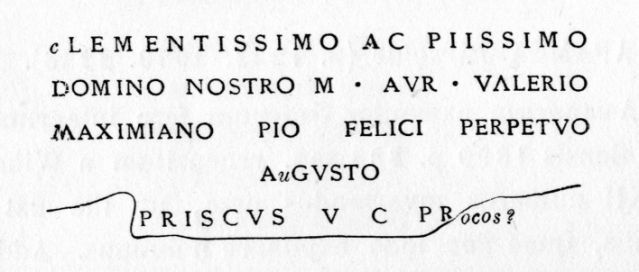
Inscription
Clementissimo ac piissimo / domino nostro, M(arco) Aur(elio) Valerio / Maximiano, pio, felici, perpetuo / Augusto / [---] Priscus, v(ir) c(larissimus), pr[--
Inscription translation
To our most clement and most pious lord, Marcus Aurelius Valerius Maximianus, pious, fortunate, perpetual Augustus ... Priscus, of clarissimus rank, pr... [set this up].
Bibliography
- Corpus Inscriptionum Latinarum; , III 14191
Discussion
INSCRIPTION
In five recorded lines:
Clementissimo ac piissimo / domino nostro, M(arco) Aur(elio) Valerio / Maximiano, pio, felici, perpetuo / Augusto, / [---] Priscus, v(ir) c(larissimus), pr[--
'To our most clement and most pious lord, Marcus Aurelius Valerius Maximianus, pious, fortunate, perpetual Augustus ... Priscus, of clarissimus rank, pr... [set this up].'
Letter height not recorded.
The epigraphic formula, with the honorand in the dative and an awarder in the nominative, is typical of statue bases.
DESCRIPTION
CIL III, the only edition of the inscription, gives no description and no measurements, and there is no published image. The wording of the inscription, however, strongly suggests that it was on a statue base.
PROVENANCE AND CURRENT LOCATION
The inscription was recorded in 1902 (for CIL III) in the village of Gebeciler (Gebadjiler) close to the site of ancient Docimium, built into a wall of a modern house. There is no recent record of its location.
HONORAND, AWARDER AND DATE
Maximian, the honorand, was Augustus 286-305.
The awarder, Priscus, was of clarissimus rank. His rank, and the fact that he dedicated a statue to the emperor, suggest that he was an imperial official of the status of a governor or above. Precisely what office he held is unclear from the two letters ('PR...') that survive of his title. Mommsen, Hirschfeld and Domaszewski (for CIL III in 1902; followed in this by PLRE I, 729, Priscus 1) argued that he was a proconsul of Asia, before the province was divided during the tetrarchic reforms. This is, however, not possible, since Docimium from the mid-3rd century was no longer within Asia, but within the province of Caria et Phrygia, administered no longer by a proconsul, but by a legatus Augusti pro praetore (Roueché 1981, 111; Bowman, Garnsey & Cameron 2005, 709). It is also impossible that Priscus was a praetorian prefect, since at this date these were of perfectissimus, rather than clarissimus, rank. Furthermore, he cannot have been a praeses of the period after the tetrarchic reforms, since these men were also of perfectissimus rank. In the absence of any other possibilities, we believe he is being described as a praeses, but in the informal and unofficial way that the term was used, for all kinds of governors, during the 3rd century. He must have been a legatus Augusti pro praetore of the joint province of Caria et Phrygia before 303 (Roueché 1981, 111).
FURTHER DISCUSSION
It is likely that this statue was accompanied by one to Diocletian, and possibly also by statues to the Caesars of the tetrarchy, Galerius and Constantius I.
Discussion references
- Bowman, A. K., Garnsey, P. & A. Cameron, The Crisis of the Empire A. D. 193-337 (The Cambridge Ancient History. Second Edition. Volume XII), Cambridge 2005
- Jones, A. H. M. et al., The Prosopography of the Later Roman Empire. Vol. I 260-395, Cambridge et al. 1971 (1975)
- Roueché, C., Rome, Asia and Aphrodisias in the third century, Journal of Roman Studies 71, 1981, 103-120
Cite: Last Statues of Antiquity, LSA-541 (Ulrich Gehn).