
LSA-542
Base for statue of Maximian, emperor. Dorylaeum (Phrygia Salutaris). 303-305
Record details
Photographs
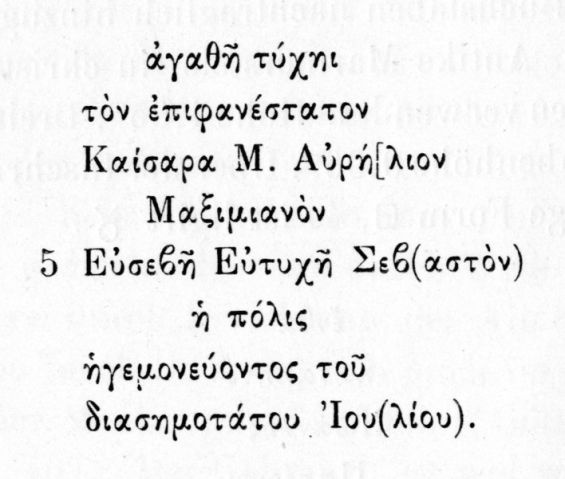
Inscription
Ἀγαθῇ τύχηι. / τὸν ἐπιφανέστατον / Καίσαρα, Μ(ᾶρκον) Αὐρή[λιον] / Μαξιμιανὸν, /(5) εὐσεβῆ, εὐτυχῆ Σεβ(αστὸν), / ἡ πόλις, / ἡγεμονεύοντος τοῦ / διασημοτάτου Ἰου(λίου).
Inscription translation
To Good Fortune. The most noble Caesar, Marcus Aurelius Maximianus, pious, fortunate Augustus; the city [honours him], under the governorship of Julius(?), of perfectissimus rank.
Bibliography
- Cagnat, R. (ed.), Inscriptiones Graecae ad res Romanas pertinentes, Paris 1906-, IV no. 523
Discussion
INSCRIPTION
In eight lines:
Ἀγαθῇ τύχηι. / τὸν ἐπιφανέστατον / Καίσαρα Μ(ᾶρκον) Αὐρή[λιον] / Μαξιμιανὸν, /(5) εὐσεβῆ, εὐτυχῆ Σεβ(αστὸν), / ἡ πόλις, / ἡγεμονεύοντος τοῦ / διασημοτάτου Ἰου(λίου).
'To Good Fortune. The most noble Caesar, Marcus Aurelius Maximianus, pious, fortunate Augustus; the city [honours him], under the governorship of Julius(?), of perfectissimus rank.'
Letter height 5 - 8.5 cm.
Strangely, the name of the governor appears to have been abbreviated to just the first three letters 'Ἰου' (Latin, 'Iu...'). Körte’s assumption, that additional names were carved on the backside of the block, is highly improbable.
DESCRIPTION (from Körte 1900)
Marble base: H 175, W 100, D 70 cm. On the top face there are holes for the fixing of a bronze statue. There is no published image.
PROVENANCE AND CURRENT LOCATION
The inscription was recorded by Körte 1900 on the ruin-hill of Schar-Öjük (Şehir-Öyük) today within the city of Eskişehir; this is the site of ancient Dorylaeum. Körte saw the block built into a wall at the western side of the hill. There is no recent record of its location; it is perhaps still where Körte saw it.
HONORAND, AWARDER AND DATE
The honorand, Maximian (full name Marcus Aurelius Valerianus Maximianus), was Augustus 286-305.
The inscription was set up by the city of Dorylaeum, when the province was administered by a governor (praeses) of equestrian rank (perfectissimus, Greek διασημοτάτος, line 8). This indicates a date after the former province of Caria et Phrygia, administered by a legatus Augusti pro praetore of senatorial rank (clarissimus, Greek λαμπρότατος), was split up into the smaller provinces of Phrygia Salutaris, Phrygia Pacatiana, and Caria, probably in 303 (Roueché 1981, 111). These smaller provinces were administered by praesides of equestrian (perfectissimus) rank, like our Julius, who is known only from this inscription (PLRE I, 467, Iu...).
FURTHER DISCUSSION
This statue to Maximian was probably accompanied by similar ones to his imperial colleagues Diocletian, Constantius I, and Galerius.
Discussion references
- Jones, A. H. M. et al., The Prosopography of the Later Roman Empire. Vol. I 260-395, Cambridge et al. 1971 (1975)
- Körte, A., Kleinasiatische Studien. VI. Inschriften aus Phrygien, Mittheilungen des Kaiserlich Deutschen Archaeologischen Instituts, Athenische Abteilung, 25, 1900, 399-444, pp.426-7 no. 43
- Roueché, C., Rome, Asia and Aphrodisias in the third century, Journal of Roman Studies 71, 1981, 103-120
Cite: Last Statues of Antiquity, LSA-542 (Ulrich Gehn).