
LSA-543
Base for statue of Flavius Optimus, governor of Phrygia Salutaris. Meirus (Phrygia Salutaris). Earlier fourth century.
Record details
Photographs
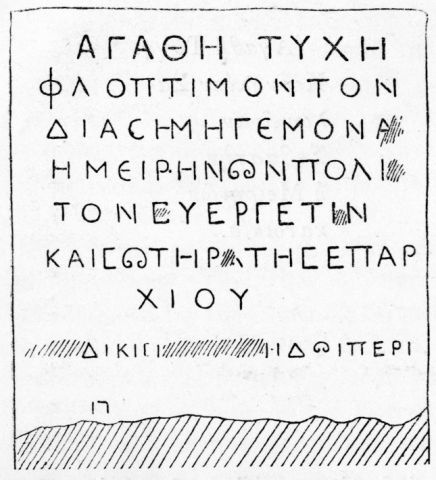
Inscription
Ἀγαθῇ τύχῃ. / Φλ(άουιον)Ὄπτιμον, τὸν / διασημ(ότατον) ἡγεμόνα, / ἡ Μειρηνῶν πόλι[ς / (5) τὸν εὐεργέτην / καὶ σωτῆρ[α] τῆς ἐπαρ/χίου.
Inscription translation
To Good Fortune. Flavius Optimus, governor of perfectissimus rank; the city of Meirus [honours] the benefactor and saviour of the province.
Bibliography
- Anderson, J.G.C. 'A Summer in Phrygia: I', The Journal of Hellenic Studies, London 1897, 423-4, no. 22
Discussion
INSCRIPTION
In seven lines:
Ἀγαθῇ τύχῃ. / Φλ(άουιον)Ὄπτιμον, τὸν / διασημ(ότατον) ἡγεμόνα, / ἡ Μειρηνῶν πόλι[ς] /(5) τὸν εὐεργέτην / καὶ σωτῆρ[α] τῆς ἐπαρ/χίου.
'To Good Fortune. Flavius Optimus, governor of perfectissimus rank; the city of Meirus [honours] the benefactor and saviour of the province.'
Letter height not recorded.
The epigraphic formula, with the honorand in the accusative and the awarder in the nominative, is typical of statue bases.
DESCRIPTION (from Anderson 1897 and the published image)
Rectangular block, seemingly broken and lost at the bottom (no measurements published). Below our inscription, Anderson’s drawing records two very partially preserved lines of text in smaller lettering, perhaps the remains of an earlier inscription.
PROVENANCE AND CURRENT LOCATION
Anderson 1897, 423 recorded the inscription in modern Kümbet, the site of ancient Meirus, 'standing amongst the ruins' (for Meirus/Miros, see Zgusta 1984, 376-77 no. 796;http://www.trismegistos.org/place/36939).
There is no recent record of its location.
HONORAND, AWARDER, AND DATE
Flavius Optimus, the honorand, was a governor (ἡγεμών, Latin praeses) of equestrian rank (διασημότατος, Latin perfectissimus), as stated in line 3 of our inscription (PLRE I, 650, Fl. Optimus 2). This dates his governorship to after the division, probably in 303, of the large province of Phrygia et Caria (governed by a consularis of clarissimus rank) into three smaller provinces governed by praesides (Roueché 1981, 111). The city of Meirus was within Phrygia Salutaris.
The base was set up by the city (polis) of Meirus (line 4). The settlement had apparently acquired city-status not long before our inscription; only a few decades earlier, in an inscription to Salonina Augusta (253-68) it is still being described as a 'kome, village' (Anderson 1897, 422-4).
Roueché 1981, 111-12, on the basis of the very regular lettering of the inscription, argues for an early date, even in the 3rd century.
Discussion references
- Jones, A. H. M. et al., The Prosopography of the Later Roman Empire. Vol. I 260-395, Cambridge et al. 1971 (1975)
- Roueché, C., Rome, Asia and Aphrodisias in the third century, Journal of Roman Studies 71, 1981, 103-120, pp. 111-12
- Zgusta, L., Kleinasiatische Ortsnamen, Heidelberg 1984, pp. 376-7 § 796
Cite: Last Statues of Antiquity, LSA-543 (Ulrich Gehn).