
LSA-544
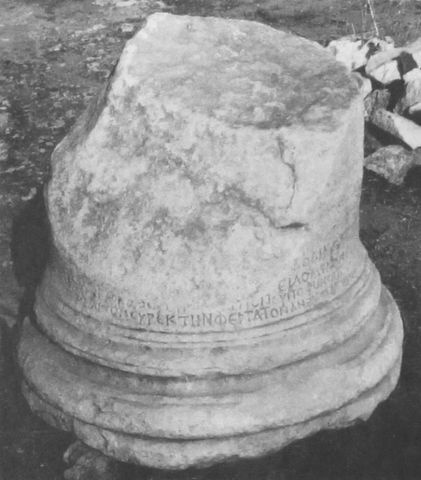
Base for statue of a governor (proconsul) of Asia (?). From Laodicea ad Lycum (Phrygia Pacatiana). Late third to earlier fifth century
Record details
Photographs
Inscription
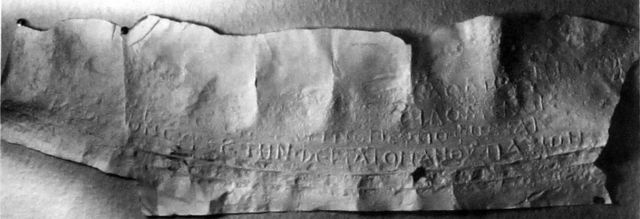
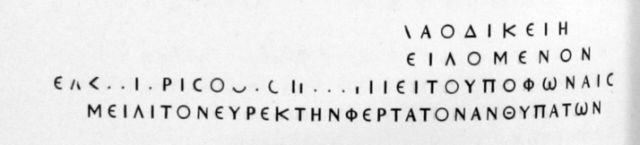
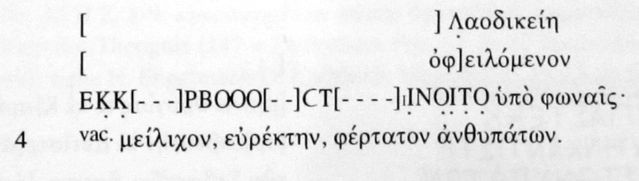
...................................... Λαοδικείη / ................................ εἰλόμενον / ............................ ειτο ὐπὸ φωναῖς / μείλιτον εὐρέκτην φέρτατον ἀνθυπάτων.
Inscription translation
...] Laodicea for [...] by words the sweetest benefactor, the best of proconsuls
Bibliography
- Cagnat, R. (ed.), Inscriptiones Graecae ad res Romanas pertinentes, Paris 1906-, IV, no. 854
- Corsten, T., Die Inschriften von Laodikeia am Lykos. Teil I (Inschriften griechischer Städte aus Kleinasien, Bd. 49) , Bonn 1997, pp. 81-2 no. 38
Discussion
INSCRIPTION
Verse inscription in distichs, two distichs fragmentarily preserved in four lines:
...................................... Λαοδικείη /
................................ εἰλόμενον /
............................ ειτο ὐπὸ φωναῖς /
μείλιτον εὐρέκτην φέρτατον ἀνθυπάτων.
...] Laodicea for [...] by words the sweetest benefactor, the best of proconsuls
Letter height 1.5 – 2.5 cm.
DESCRIPTION (From Corsten 1997 and the published images)
Cylindrical block with mouldings at bottom and broken at top, H 75, diameter 80 cm. Corsten 1997 mentions figural representations on the back side seen by earlier scholars.
PROVENANCE AND CURRENT LOCATION
The inscription was first recorded by Clerc 1887 in Denizli, close to the mosque Çay başı. It was recorded in the garden of the Denizli museum by Corsten 1997, without published inv. no.
HONORAND, AWARDER AND DATE
The inscription was dated to the earlier 3rd century by Corsten 1997 who attributed the title of proconsul (ἀνθυπάτων, line 4) to a proconsul of Asia to which Laodicea belonged until the mid-3rd century. After that date, it belonged to the province of Phrygia and Caria which had been cut out of the larger province of Asia (Roueché 1981, 112); this new province was administered by a legatus Augusti pro praetore (πρεσβευτὴς καὶ ἀντιστράτηγος τῶν Σεβαστῶν). Still later, in the early 4th century, the joint province was split up into two, Phrygia of which Laodicea was the capital, and Caria with the capital Aphrodisias, both administered by a praeses.
We agree to Corsten that the rank of the honorand excludes a governor of the province of Phrygia and Caria, as well as a governor of the later province of Phrygia. We would not exclude, however, that a proconsul of Asia was honored in the capital of the neighbouring province of Phrygia; a similar case is known from Aphrodisias (LSA-153). The verse form of our inscription would be extraordinary in the earlier 3rd century, when verse inscriptions are widely restricted to local and provincial notables. They become common for high imperial office holders only in the late 3rd century and remain in use for these persons through the 4th and 5th centuries. In our view, the verse form speaks strongly in favor of a later date than the one proposed by Corsten 1997.
Discussion references
- Clerc, M., Inscriptions de la vallée du Méandre, Bulletin de Correspondance Hellénique 11, 1887, 346-54, p. 352 no. 8
Cite: Last Statues of Antiquity, LSA-544 (Ulrich Gehn).