
LSA-545
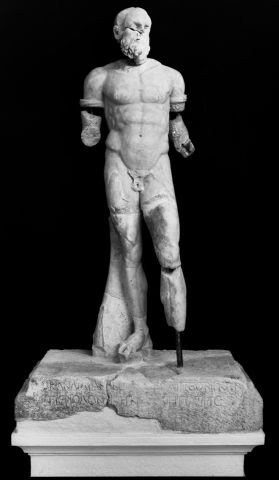
Statue of boxer Candidianus (base LSA-547). Aphrodisias (Caria). Late third to early fourth century.
Record details
Photographs
Bibliography
- Smith, R.R.R., S. Dillon, C.H. Hallett, J. Lenaghan, and J. Van Voorhis, Aphrodisias II: Roman Portrait Sculpture at Aphrodisias, Mainz 2006, 147-9, no. 40, pls. 28-9
- Van Voorhis, J. 'Two portrait statues of boxers', Aphrodisias Papers 4. New Research on the City and its Monuments, Portsmouth RI 2008, 231-5, 236-240
Discussion
DESCRIPTION (Object)
Life-size statue. H: 149, W: 51.5, D: 43 cm. Large-grained white marble with grey streaks.
The statue has been recovered from 14 pieces and there are numerous lacunae. These include the left side of the face; a vertical slice from right side of face; the right side of the neck; section of both arms between the upper biceps and elbow; both lower arms and hands; the left lower leg and foot; almost the entire plinth; a narrow section of the left and right thighs along the break (partly restored with modern fill); and a small section below the left knee.
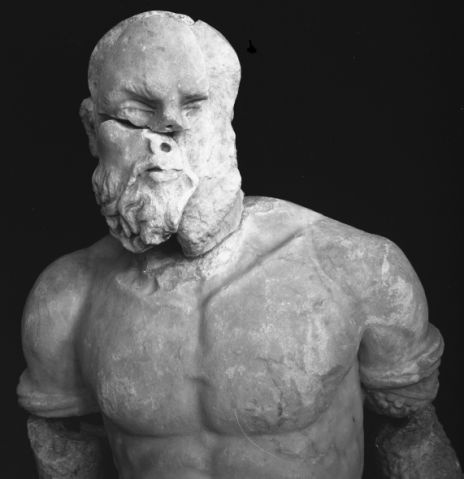
The significant piecing is the result of ancient repair work. The head was doweled into the torso at the base of the neck. About mid-way up the left forearm there is a worked surface with a dowel hole for the addition of the rest of the forearm and hand. The right arm was pieced higher up; a comparable worked surface with dowel hole is found just below the upper end of the glove. Also on the right arm there is a dowel hole running horizontally through the biceps to connect it with the right side of the torso; an iron pin is still visible on the right side of the ribcage. An ancient dowel hole running up through the left leg indicates that it was broken and repaired in antiquity. The end of the nose was replaced, as indicated by two preserved dowel holes: one drilled into the center of the face, one up into the nose itself. The genitals also had to be repaired: they were re-carved and added separately, as indicated by two dowel holes.
In addition, there are two secondary(?) cuttings on the back of the statue (of uncertain purpose), one in the right buttock and another in the top of the tree trunk support, which rises to mid-thigh level on the right side.
The hair on the head is rendered with a flat chisel. The hair of the beard is drilled, and marble ‘bridges’ have been left over some of the channels. In the extant right eye the iris is marked by an engraved lines which forms three-quarters of a circle. The pupil is deeply drilled and almost circular
PROVENANCE
The 14 pieces of the statue were all discovered in the Theatre, between 1967 and 1976. They and the base LSA-547 come mainly from the north side of the stage and orchestra; one fragment of the head came from the dismantling of the mid-byzantine wall behind the stage building. This statue seemed to have formed a pair with the boxer Piseas LSA-531 and LSA-532, respectively on the north and south side of the stage building.
DESCRIPTION (Subject)
The statue shows a naked athlete who turns gently to the left. He wears a specific athletic hairstyle (cirrus in vertice), a full beard and moustache (the beard reaches his chest), and the gloves of a professional boxer. A tall tree-trunk functions as a support for the statue behind the right leg.
The head has cauliflower ears, broad cheekbones, and extremely arched and thick eyebrows. These give the face a distinctive aspect, not traditionally associated with athletes.
The body is lean and long with a torso which is articulated beyond reality. This is especially visible on the outside of the ribcage where the body surface rises and falls in knots or lumps. Also the lower part of the sternum ends in a diamond shape.
DATE
As with the statue of the boxer Piseas from the same context (LSA-531 and LSA-532), the eye markings, large statue support, and small scale suggest a date no earlier than the late third century and possibly even the fourth century. The base, LSA-547, also suggests such a date.
The extensive repairs and unusual fit between statue and base suggest that both elements were used pieces, brought from elsewhere, and combined to form a new (or refurbished) monument in the Theatre at some point in the late third or fourth century.
This statue in particular bears strong technical resemblances to statues found in a sculptor’s workshop at Aphrodisias which was functioning into the late fourth century and probably early fifth century.
Cite: Last Statues of Antiquity, LSA-545 (J. Lenaghan).