
LSA-547
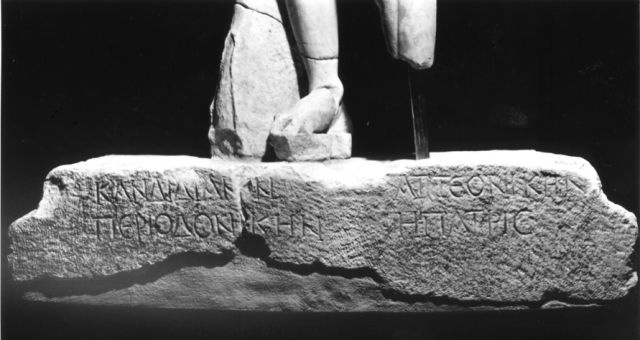
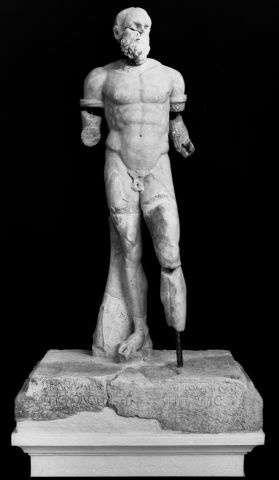
Base for statue of boxer Candidianus (statue LSA-545). Aphrodisias. Late third to early fourth century.
Record details
Photographs
Inscription
Κανδιδιανὸν vac. Ἀ{τ}`κ´τεονίκην / περιοδονίκην vac. ἡ πατρίς
Inscription translation
The fatherland (honours) Kandidianos, victor at Actia, circuit-victor
Bibliography
- Roueché, C., Performers and partisans at Aphrodisias in the Roman and late Roman periods : a study based on inscriptions from the current excavations at Aphrodisias in Caria , London 1993, 207, no. 74, pl. 21
- Van Voorhis, J. 'Two portrait statues of boxers', Aphrodisias Papers 4. New Research on the City and its Monuments, Portsmouth RI 2008, 240-243
Discussion
INSCRIPTION
in two lines with central vacats
Κανδιδιανὸν vac. Ἀ{τ}`κ´τεονίκην
2 περιοδονίκην vac. ἡ πατρίς
The fatherland (honours) Candidianus, victor at Actia, circuit-victor.
Letter Height: line 1, 3.5 cm, line 2, 4 cm.
The tau in line 1 is a spelling error; it should be a kappa.
DESCRIPTION
Low rectangular base. H: 25, W: 112, D: 51 cm. White marble.
The base is broken at the back and at the viewer’s right bottom edge. It is cracked through the centre.
It is a reused architectural element. It is broader at the bottom and preserves mouldings on the sides. The inscription has been carved irregularly into a roughly claw-chiselled surface. The top of the base preserves the impression of a right foot. This has generally been assumed to indicate another use for a bronze statue.
PROVENANCE
The inscribed base was found in 1968 (exc. inv. 68-400) on the north side of the stage near the fragments of the statue LSA-547
HONORAND
The honorand was a circuit-victor just as LSA-532. His particular sport is unnamed but the statue LSA-545wears boxing gloves.
DATE
The lettering suggests a date in the late third or early fourth century (see Van Voorhis, p. 241, fn. 23). Earlier dates were assigned in previous studies because of the statue; the statue (LSA-545) however has been re-used. The world of Greek athletics apparently flourished in the mid-third century and early fourth centuries when various emperors (including Constantine) are known to have established new contests.
The monument was either erected in the earlier fourth century from recycled parts for a new victor, or it honoured an old hero and was repaired as well as moved in refurbishment of the Theatre stage.
Cite: Last Statues of Antiquity, LSA-547 (J. Lenaghan).