
LSA-549
Base for statue of Hesychius, perhaps Hesychius Illustrius, local benefactor. Miletus (Caria). Late fourth to sixth century.
Record details
Photographs
Inscription
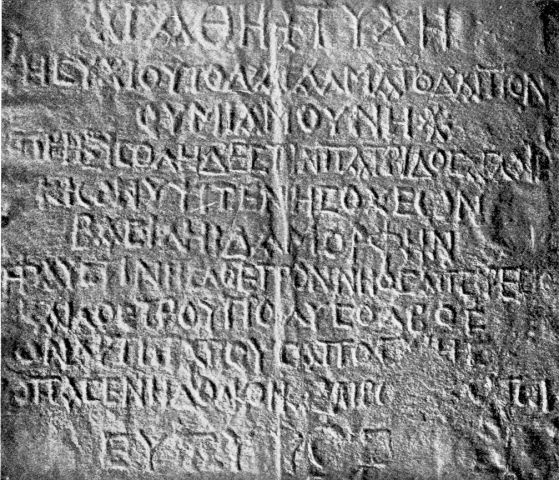
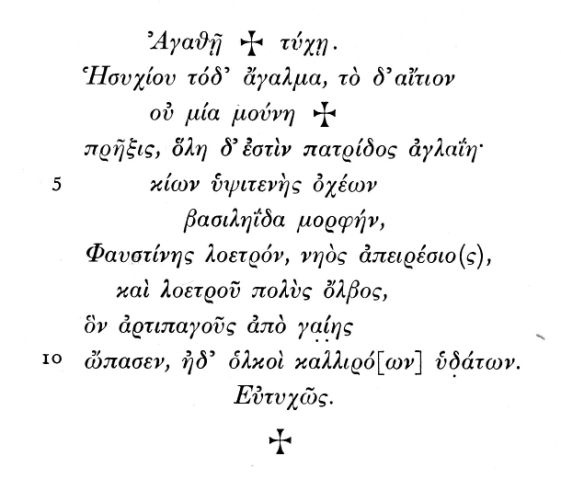
Ἀγαθῇ (cross) τύχῃ. / Ἡσυχίου τόδ’ ἄγαλμα, τὸ δ’ αἴτιον / οὐ μία μούνη (cross) / πρῆξις, ὅλη δ’ἐστὶν πατρίδος ἀγλαΐη· /(5) κιών ὑψιτενὴς ὀχέων / βασιληΐδα μορφήν, / Φαυστίνης λοετρὸν, νηὸς ἀπειρέσιο(ς), / καὶ λοετροῦ πολὺς ὄλβος, / ὅν ἀρτιπαγοῦς ἀπὸ γαίης /(10) ὤπασεν, ἠδ’ ὁλκοὶ καλλιρό[ων] ὑδάτων. / Εὐτυχῶς / (cross)
Inscription translation
To Good Fortune. Of Hesychius this is the likeness, and the reason is not one matter alone, but it is the whole beauty of the fatherland. The lofty column supporting the kingly form; the baths of Faustina, an immense temple; and the great bliss of the baths which he procured from moulded earth, and the haulers of beautiful flowing waters. Good luck.
Bibliography
- Rehm, A., and P. Herrmann, Inschriften von Milet, Teil I (Milet VI, 1), Berlin 1997, VI.1, no. 343
Discussion
INSCRIPTION
Verse inscription of three distichs, with introductory and final formula, laid out in eleven lines:
Ἀγαθῇ (cross) τύχῃ. /
Ἡσυχίου τόδ’ ἄγαλμα, τὸ δ’ αἴτιον / οὐ μία μούνη (cross) /
πρῆξις, ὅλη δ’ἐστὶν πατρίδος ἀγλαΐη· /
(5) κιών ὑψιτενὴς ὀχέων / βασιληΐδα μορφήν, /
Φαυστίνης λοετρὸν, νηὸς ἀπειρέσιο(ς), /
καὶ λοετροῦ πολὺς ὄλβος, / ὅν ἀρτιπαγοῦς ἀπὸ γαίης /
(10) ὤπασεν, ἠδ’ ὁλκοὶ καλλιρό[ων] ὑδάτων. /
Εὐτυχῶς /
(cross)
'To Good Fortune. Of Hesychius this is the likeness, and the reason is not one matter alone, but it is the whole beauty of the fatherland. The lofty column supporting the kingly form; the baths of Faustina, an immense temple; and the great bliss of the baths which he procured from moulded earth, and the haulers of beautiful flowing waters. Good luck.'
Letter height 3-5 cm.
DESCRIPTION (from Rehm and Herrmann 1997)
Column of bluish marble: H 168, diameter 51 cm. The inscription is framed by a double moulding.
PROVENANCE AND CURRENT LOCATION
Found in 1899 ('zu Beginn der Grabung', Rehm and Herrmann 1997, 117) 'at the north-eastern corner of the garden of Ahmed Aga'. It is now standing in the courtyard of the Miletus museum, to the left of the entrance gate, inv. no. 50.
HONORAND, AWARDER AND DATE
Hesychius, the honorand, is celebrated in two further verse inscriptions carved in the baths of Faustina, on the frame of the arched doorway leading from the apodyterium to the tepidarium (Gerkan & Krischen 1928, 59-60; 66 fig. 81; inscriptions: Rehm and Herrmann 1997, nos. 341 and 342). From these we know that he was a native of Miletus, son of another Hesychius, a famous orator at the court of the praetorian prefect or vicar, and for nine years a 'friend' of the emperor; after one hundred years (implicitly, of neglect), he restored the baths of Faustina which were worn down by age (Herrmann and Rehm 1997 nos. 341 and 342). Our inscription refers to the restoration of the baths (line 7), specifying that he provided bricks for it and restored the water supply (lines 8-10). It also records the erection of an imperial statue on a columnar base (lines 5-6; see LSA-548), and of an 'immense temple’ (νηὸς ἀπειρέσιος, in line 7), which could be a church donated by Hesychius (unless it is just a poetic description of the baths).
The awarder, though not mentioned in our inscription, was presumably the grateful city of Miletus.
PLRE I dates our Hesychius very broadly, to the 4th/5th century (PLRE I, 429, Hesychius 3). Herrmann and Rehm 1997, however, suggested identifying him with the Milesian historian Hesychius Illustrius of the 6th century, whose death occurred sometime after 582 (PLRE II, 555, Hesychius 'Illustrius’ 14; Schultz 1913, 1323). This Hesychius, like our man, was both a native of Miletus and the son of another Hesychius. Also in favour of a late date, not before the end of the 4th century, is the prominence of crosses set within the inscription (there are three of them). The fact that, before Hesychius' repair, the baths of Faustina had not been repaired for one hundred years initially might suggest a late date, but such claims can be found even in the earlier 4th century.
However, we should also note that Hesychius is not a rare name (and is one that appears to have been used by a noble family of Miletus across the generations), that the description of our Hesychius as an orator does not perfectly fit Hesychius the historian, and that the later 6th century would be very late indeed for a statue to a local benefactor. We have therefore given the possible date-range for our statue as the late 4th to 6th centuries; but are dubious about a date in the second half of the 6th century (which it would have to be, if our man was Hesychius Illustrius).
Discussion references
- Gerkan, A. v. & F. Krischen, Thermen und Paläste (Milet I, 9), Berlin 1928
- Jones, A. H. M. et al., The Prosopography of the Later Roman Empire. Vol. I 260-395, Cambridge et al. 1971 (1975)
- Martindale, J. R., The Prosopography of the Later Roman Empire. Vol. II A.D. 395-527, Cambridge 1980
- Schultz, H., Hesychios Illustrios, Paulys Realenzyklopädie der Altertumswissenschaften Vol. VIII, 1322-7, Stuttgart 1913
Cite: Last Statues of Antiquity, LSA-549 (Ulrich Gehn).