
LSA-550
Lost base for statue of Julian, emperor. Miletus (Caria). 361-363
Record details
Photographs
Inscription
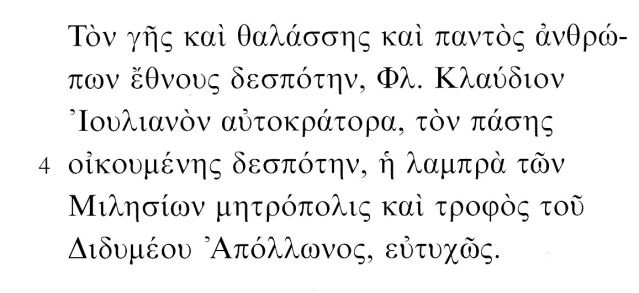
ὸν γῆς καὶ θαλάσσης καὶ παντὸς ἀνθρώ/πων ἔθνους δεσπότην, Φλ(άβουιον) Κλαύδιον / Ἰουλιανὸν αὐτοκράτορα, τὸν πάσης / οἰκουμένης δεσπότην, ἡ λαμπρὰ τῶν /(5) Μιλησίων μητρόπολις καὶ τροφὸς τοῦ / Διδυμέου Ἀπόλλωνος, εὐτυχως.
Inscription translation
The ruler of the earth and the sea and of all races of men, Flavius Claudius Iulianus, emperor, the ruler of the entire civilised world; the shining metropolis of the Miletians and the nurse of Didymean Apollo [honours him]. With good luck.
Bibliography
- Herrmann, P., Günther, W., and N. Erhardt, Inschriften von Milet, Teil 3 (Milet VI, 3), Berlin 2006, p. 72 no. 1112
Discussion
INSCRIPTION
In six lines:
Τὸν γῆς καὶ θαλάσσης καὶ παντὸς ἀνθρώ/πων ἔθνους δεσπότην, Φλ(άβουιον) Κλαύδιον / Ἰουλιανὸν αὐτοκράτορα, τὸν πάσης / οἰκουμένης δεσπότην, ἡ λαμπρὰ τῶν /(5) Μιλησίων μητρόπολις καὶ τροφὸς τοῦ / Διδυμέου Ἀπόλλωνος, εὐτυχως.
'The ruler of the earth and the sea and of all races of men, Flavius Claudius Iulianus, emperor, the ruler of the entire civilised world; the shining metropolis of the Miletians and the nurse of Didymean Apollo [honours him]. With good fortune.'
Letter height not recorded.
The Greek epigraphic formula, with the honorand in the accusative and an awarder in the nominative, is typical of a statue base.
DESCRIPTION (from Cyriac of Ancona, as cited by Riemann 1877, and Herrmann, Günther, and Erhardt 2006)
Columnar marble base. No measurements were published, and there is no published image.
PROVENANCE AND CURRENT LOCATION
The inscription was recorded by Cyriac of Ancona in 1446 in Miletus 'in a garden close to a marble temple (in orto prope marmoream aedem)’, quoted by Riemann 1877). It is known only from Cyriac’s account and is now lost.
HONORAND AND DATE
Julian, the honorand (full name Flavius Claudius Iulianus, as in our inscription) was Caesar 355-60 and Augustus 360-3. Although his Augustus-title does not appear in our inscription, the strongly pagan allusion in lines 5-6 makes it certain that this was set up after Julian became sole emperor, following his cousin Constantius II’s death in 361.
The statue was set up by the city of Miletus, styled 'shining metropolis’ (lines 4-5) and 'nurse of Didymean Apollo’ (lines 5-6); the latter refers to the oracle at Didyma of which Julian himself was prophet (Herrmann, Günther, and Erhardt 2006, 72).
Discussion references
- Riemann, O., Inscriptions Grecques provenant du recueil de Cyriaque d'Ancone., Bulletin de Correspondance Hellénique 1, 1877, 286-94, p. 288 no. 65
Cite: Last Statues of Antiquity, LSA-550 (Ulrich Gehn).