
LSA-552
Base for repaired statue of Neileus, mythical founder of the city. Miletus (Caria). Fourth to sixth century.
Record details
Photographs
Inscription
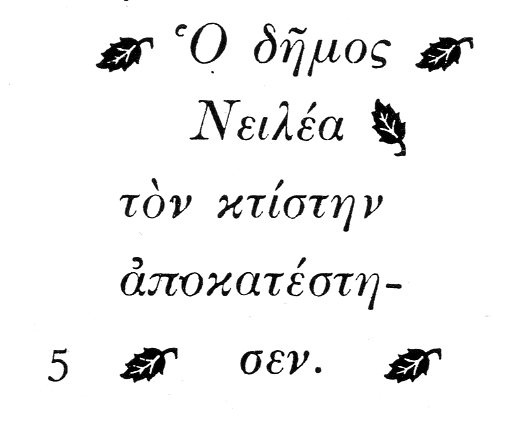
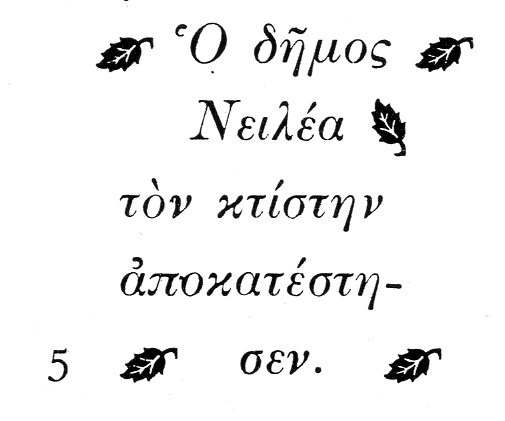
(leaf) Ὁ δῆμος (leaf) / Νειλέα (leaf) / τὸν κτίστην / ἀποκατέστη-/(leaf)-σεν. (leaf)
Inscription translation
The people (demos) have restored [the statue] of Neileus the founder.
Bibliography
- Rehm, A., and P. Herrmann, Inschriften von Milet, Teil I (Milet VI, 1), Berlin 1997, p. 72 no. 269
Discussion
INSCRIPTION
In five lines. The first and last lines are flanked by leaves, and after the honorand’s name in line two a fifth leaf is engraved:
(leaf) Ὁ δῆμος (leaf) / Νειλέα (leaf / τὸν κτίστην /(4) ἀποκατέστη-/(leaf])-σεν. (leaf)
'The people (demos) have restored [the statue of] Neileus the founder.'
Letter height 5.8 - 7.5 cm.
DESCRIPTION (from Rehm and Herrmann 1997)
Columnar base of grey-streaked white marble, with moulding at bottom: H (including base) 166, diameter (at bottom) 102, (at top) 70 cm. Our columnar block stands on a moulded round base (H 40 cm), and is set on a plinth made up of re-used marble plaques.
PROVENANCE AND CURRENT LOCATION
The base was found in 1906 in situ in the area between the Nymphaeum and the 'Ionic Hall’, at the north-western corner of the entrance to the Hellenistic gymnasium (for map see Bendt 1968, 'Nordblatt',). It remains there, standing in situ, Museum inv. no. 1000.
HONORAND AND DATE
Neileus, the honorand, was the mythical founder-hero of Miletus (Hanslik 1935). His statue was re-erected by the people of Miletus (lines 1, 4).
According to Herrmann and Rehm 1997, the letter forms suggest a late-antique date for the inscription, an idea supported by the use of re-used material in the plinth.
FURTHER DISCUSSION
This inscription testifies to the late antique repair of a statue in Miletus. Such repair inscriptions are common in Italy (above all Rome) and North Africa, but rare in the East.
Discussion references
- Bendt, W., Topographische Karte von Milet (Milet II, 4), Berlin 1968, Nordblatt
- Hanslik, R., Neileos, Paulys Real-Encyclopädie der Classischen Altertumswissenschaft, Band 16, 2183-4, Stuttgart 1935
Cite: Last Statues of Antiquity, LSA-552 (Ulrich Gehn).