
LSA-554
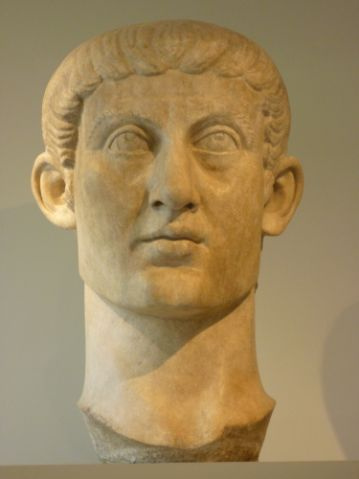
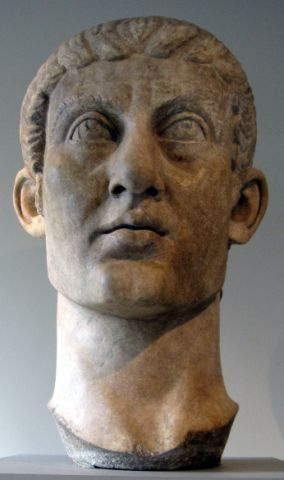
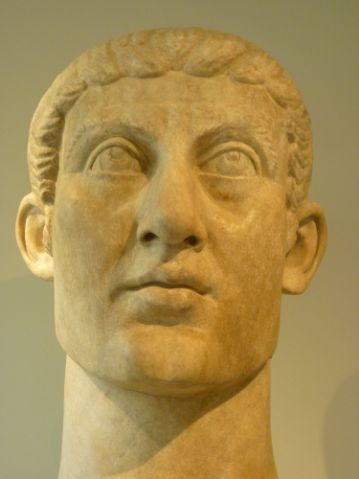
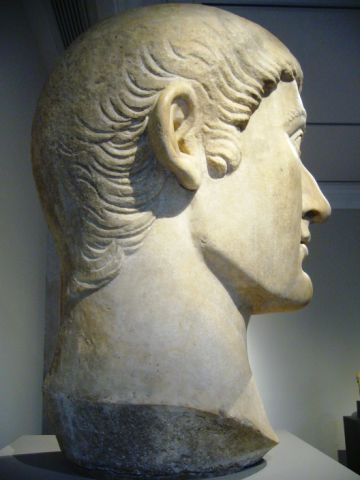
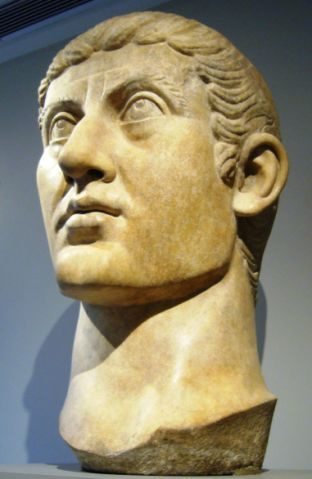
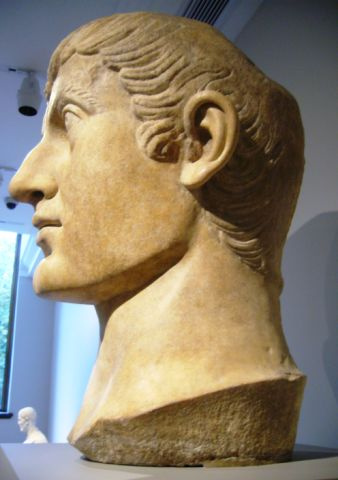
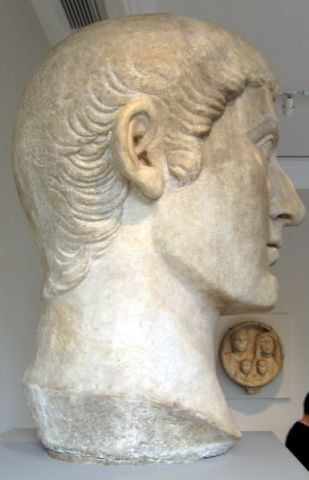
Colossal portrait head of Constantine. From area of Rome. 311-337.
Record details
Photographs
Bibliography
- Schäfer, T. 'Felicior Augusto, melior Traiano! Das Bildnis des Konstantin in New York', Antike Porträts. Zum Gedächtnis von Helga von Heintze, Bibliopolis 1999, 295-302, pl. 69.1-3
Discussion
DESCRIPTION (Object)
Colossal head, worked separately. H: 95.25 cm. H (chin to crown): 51 cm. W: 58.4, D: 67.3 cm. Carrara marble
The nose, mouth, chin, and outer ears have been restored. The left part of the upper head is restored in plaster. The lower part of the plug has perhaps been shortened for aesthetic reasons.
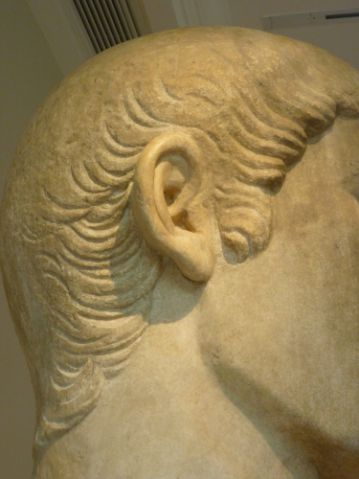
The head is not fully finished at the back; there is a 20 cm wide area of picked surface. The hair has not been fully worked out at the top and back of the head. The pupils and irises are defined by concentric engraved lines which are about three- quarters of a circle.
There is a contrast between the thick clumsy locks of the brow which sit at a deeper level and the finer longer locks behind and above the ears which are engraved on a higher surface (Schäfer). This is probably evidence that the head has been re-cut.
PROVENANCE
The head was acquired by the Metropolitan Museum of Art in 1923. It was first published in the Giustiniani collection in 1631. That collection was mainly acquired by Marchese Vincenzo Giustiniani (1564-1637). It probably comes from Rome.
DESCRIPTION (Subject)
The head belonged to a statue that was about 5 m tall. The tight cut around the neck suggests that this may have been cuirassed statue. The head probably turned to its left. There is no positive evidence of a crown.
The face is broad across the brow which has a single deep furrow. The broad cheekbones make the eyes seem close-set. They are framed by protruding and arching eyebrows of engraved hair. The jawline is strong and angular. The mouth and chin are restored.
The hair is short and falls over the brow in the thick locks which gently curve inward. Over the nose, at the point of convergence, there is a straight, recessed lock. In front of each ear is a sideburn, and behind and above the ears the brushed forward curl forward.
DATE
The physiognomy and fundamental arrangement of the brow hair correspond to those of Constantine’s main, Quinquennalia, type: see LSA-558 or LSA-834. Thus, the portrait dates after 311 and before 337.
There is scholarly debate as to when within that period the head dates: see Schäfer p. 297 fn. 10 for list of opinions. Schäfer notes clearly that a later date based on the length of hair at the nape (Delbrueck) is untenable since the head has been re-cut and the nape hair depends on the original portrait, probably of Trajan (see Schäfer, p. 298, for comparison to Trajan’s Paris 1250-Mariemont type).
Discussion references
- Delbrueck, R., Spätantike Kaiserporträts. Von Constantinus Magnus bis zum Ende des Westreichs , Leipzig 1933, 112-13, pl. 28
- Fittschen, K. and P. Zanker, Katalog der Porträts in den Capitolischen Museen und den anderen kommunalen Sammlungen der Stadt Rom, Band I, Mainz 1985, (2)1994, 150, no. B 8 (Zanker: new interpretation of main type)
- L'Orange, H. P., Das spätantike Herrscherbild von Diokletian bis zu den Konstantin-Söhnen, 284-361 n. Chr. Das Römische Herrscherbild. III. Abteilung ; Bd. 4 , Berlin 1984, 123, pl. 48d
Cite: Last Statues of Antiquity, LSA-554 (J. Lenaghan).