
LSA-555
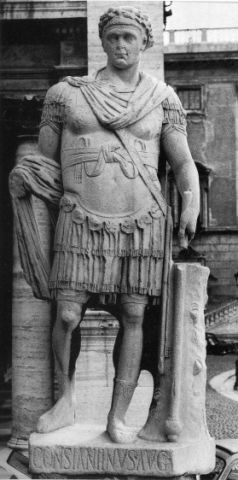
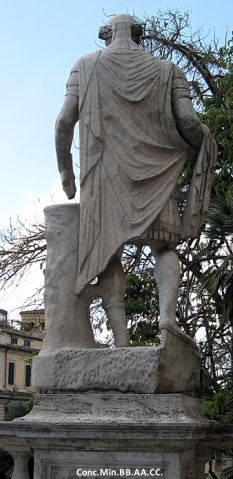
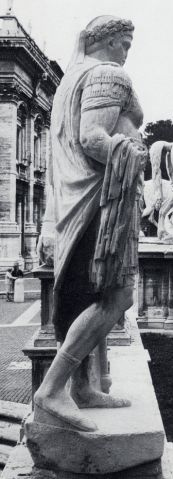
Inscribed portrait statue of Constantine I in armour. Rome. 317-337.
Record details
Photographs
Bibliography
- Corpus Inscriptionum Latinarum; , VI, no. 1149
- Fittschen, K. and P. Zanker, Katalog der Porträts in den Capitolischen Museen und den anderen kommunalen Sammlungen der Stadt Rom, Band I, Mainz 1985, 144-5, no. 120, pls. 149-50
Discussion
DESCRIPTION (Object)
Over life-size statue. H (without plinth): 275 cm. H (chin to crown): 30 cm. H (chin to hairline): 25 cm. Lttr H: 12-13 cm Marble
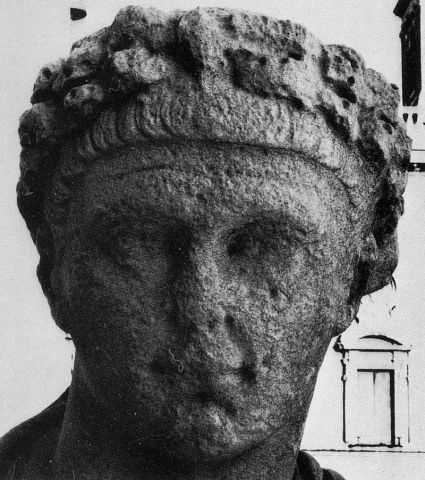
The right hand, a small part of the staff in the left hand, the nose, and a projecting element on the left side of the crown are missing. Perhaps the central jewel of the crown has also broken off. The surface is generally worn, and this has mainly occurred in the last fifty years due to combined exposure to the elements and modern traffic.
The statue stands on a thick plinth, which has been re-shaped. The front proper left is cut diagonally back, and the proper left edge of the back has been angled slightly to meet this cut. The proper right edge has been similarly cut back in two diagonal slices which meet outside the right foot.
The statue is supported by a large tree trunk on the outside of the left leg. A large strut extends between the left thigh and the tree trunk. The raised right foot is supported by a large wedge of marble. The ties of the crown are left summarily rendered en bloc to create essentially a neck pillar.
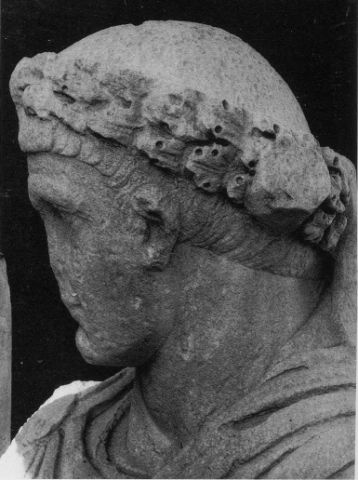
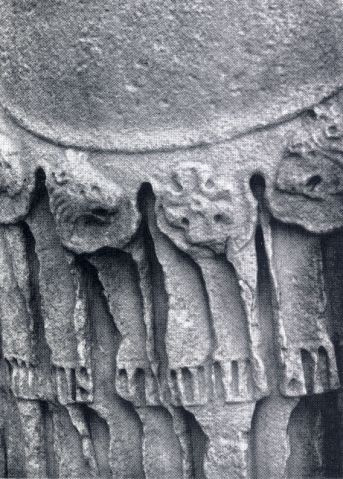
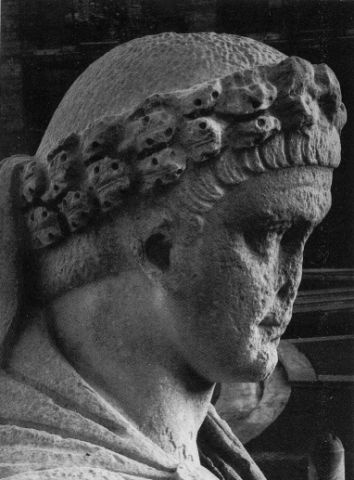
The portrait head has been re-worked from an earlier portrait. The present hair is rendered with a flat chisel below the crown and above the crown all of the original hair has been removed leaving a dome shape with large point marks on the surface. The crown has considerable amount of drilling and mainly seems to belong to the first use; however, its upper edge has been sharply cut. The eyeballs are too damaged to assess. The deep crease in the brow and the line defining the upper limit of the chin belong to the second use. The fine and detailed engraving on the body, especially on the cuirass, belongs to the first use.
PROVENANCE
The head was found on the Quirinal Hill in the 15th century with three other statues, one of which is lost (see, LSA-556 , LSA-559, LSA-2302). Probably they were part of the decoration of the Baths of Constantine on the Quirinal which was dedicated in c. 315. The larger size of LSA-556 may indicate that all four were not part of one contemporary honorific monument. Between 1536 and 1544 there is discussion only about three statues. In 1653, this statue and LSA-559 were mounted in their current location.
INSCRIPTION
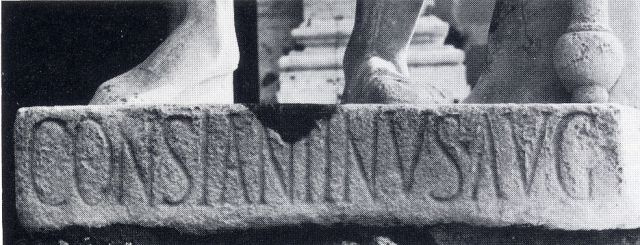
Constantinus • Aug(ustus) •
Constantine Augustus …
DESCRIPTION (Subject)
The statue is identified as Constantine by its plinth. It shows the Emperor dressed in military armour, wearing a corona civica, and holding a staff. The body is large in comparison to the head which represents a mature man with short hair that is combed forward on to the brow.
The weight of the statue is over the left leg. The heel of the right foot is raised. Both arms are lowered; the right arm bends more than the left. The head looks to its right.
The dress consists of a cloak fastened on the right shoulder by a round fibula; the metal breast plate with the leather shoulder flaps and skirt; a short tunic; a broad belt across the waist; a sword strap and scabbard (along the straight left leg); and tall closed boots. The left hand holds a marble rod with a round lower terminus. This might be a sceptre, a lance, or a vexillum. The right hand, if it held anything, had a small object; a globe, for instance, would be possible. On the head is a crown of oak leaves.
The face is broad across the brow but tapers downwards. The brow has a deep furrow. The eyes are small and close-set. The mouth is short but with folds at the outer corners. The roundness of the chin is emphasized by a semi-circular arc that defines its upper border.
The hair is short and arches over the brow in the gently bending locks which curve inward. The area where they would converge is heavily weathered. A small lock comes forward over the ear.
DATE
Because the portrait head has been re-cut from an earlier one, it does not follow a type exactly. The inscriptions on the plinths of the pendant statues (this and LSA-559) are for Constantine as Augustus and Constantine as Caesar. They most easily refer to Constantine and his son Constantine who was made Caesar virtually at birth in 317. Since they were erected together and one is called Caesar as opposed to Augustus, they were probably erected during the reign of Constantine I. They thus date between 317, birth of Constantine II, and 337, death of Constantine I.
Zanker in his discussion of the pendant statue, (see bibliography of LSA-559), imagines that both statues originally represented members of the family of Maxentius and were then changed to represent members of the family of Constantine. He believes that they might even have been changed more than once; that is, from Maximian and Maxentius or Romulus and Maxentius to Crispus and Constantine and then to Constantine II and Constantine. He notes that the plinths have been re-shaped and that the letter forms are not the same. This solution is hypothetical.
COMMENT ON THE INSCRIPTION
There is an interpunct after the abbreviation AUG. This suggests that on the now missing proper left corner there was another word. It could not have been longer than three or four letters and was certainly an epithet; possibly INV(ictus), AET(ernus), FEL(IX) or PIUS.
The removal, however, of the corner would seem most likely to have been dictated by the position in which it was re-used since it hardly changes the meaning of the statue. Moreover, both this edge and the back left and back right are finely smoothed which contrast markedly to the unfinished original back edge of the plinth. Thus, this author believes that the inscription, if really altered, was done without any change in meaning and so that it could fit into a new setting.
Discussion references
- Delbrueck, R., Spätantike Kaiserporträts. Von Constantinus Magnus bis zum Ende des Westreichs , Leipzig 1933, 113-18, pl. 30-32
- Heintze, H. von. "Statuae quattuor marmoreae pedestres quarum basibus Constantini nomen inscriptum est", Mitteilungen des Deutschen Archäologischen Instituts, Römische Abteilung 86, Mainz 1979, 399-407, 417-37, pls. 129.2, 130, 132.1, 133.1, 134.1, 135.1, 136.2, 137.1 (especially for history and plinths)
- L'Orange, H. P., Das spätantike Herrscherbild von Diokletian bis zu den Konstantin-Söhnen, 284-361 n. Chr. Das Römische Herrscherbild. III. Abteilung ; Bd. 4 , Berlin 1984, 126, pls. 40, 42a, and 42d
Cite: Last Statues of Antiquity, LSA-555 (J. Lenaghan).