
LSA-556
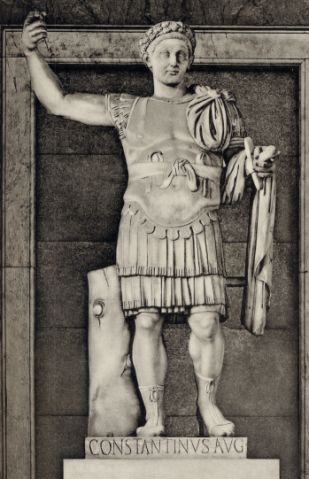
Portrait statue of Constantine or son (?) in armour. Rome. 312-340.
Record details
Photographs
Bibliography
- Heintze, H. von. 'Statuae quattuor marmoreae pedestres quarum basibus Constantini nomen inscriptum est', Mitteilungen des Deutschen Archäologischen Instituts, Römische Abteilung 86, Mainz 1979, 399-417, 426-37, pls. 118-129.1, fig. 1
Discussion
DESCRIPTION (Object)
Upper body of over life-size statue. H (of restored statue without plinth): 322, H (of ancient fragment): 197 cm. H (chin to tip of jewel on crown): 47 cm. Marble
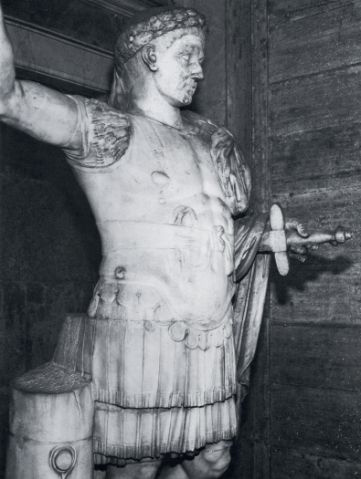
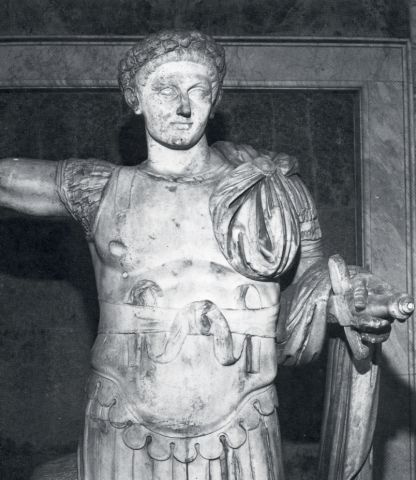
The head was originally worked in one piece with the body, the back side of which was finished. The ties of the crown are left summarily rendered en bloc to create essentially a neck pillar. The body is preserved until the end of the first row of leather flaps on the on the left side and to just under the hip on the right side. The current legs, right arm, left wrist with some of the forearm and the hilt of the sword, statue support, and plinth are not ancient. The ancient inscription, LSA-2302 is attached to the modern plinth which is made from the same block of marble as the legs and statue support. It is impossible to ascertain whether it belonged to this statue. The restored lower section is about 30 cm deeper than the ancient upper body.
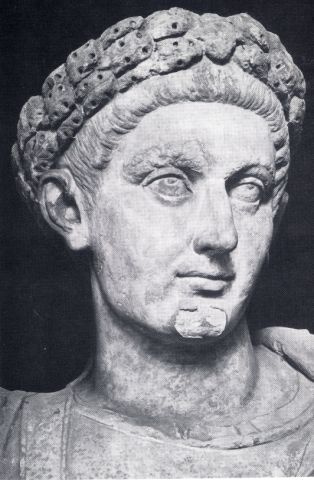
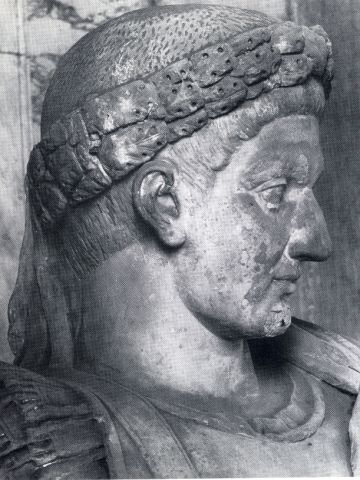
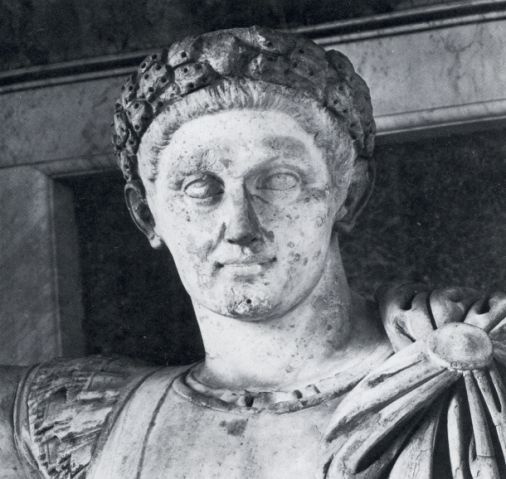
On the ancient upper body: the jewel of the crown is broken; the nose is restored in marble; the right ear is plaster; the chin has some rust and a hole for a pin which held a plaster restoration; other plaster restoration can be found in the brow and right eye. Some folds of the bunched cloak on the left shoulder have been restored; there is a chip in the right breast. On the head behind the right ear, Heintze reports a perpendicular channel in the crown with a metal pin. On the right hip is a plastered over rectangular chip below and forward of which is a depression. At the right hip this seems to be a strut for the spear; the other cutting may also have been related to the spear.
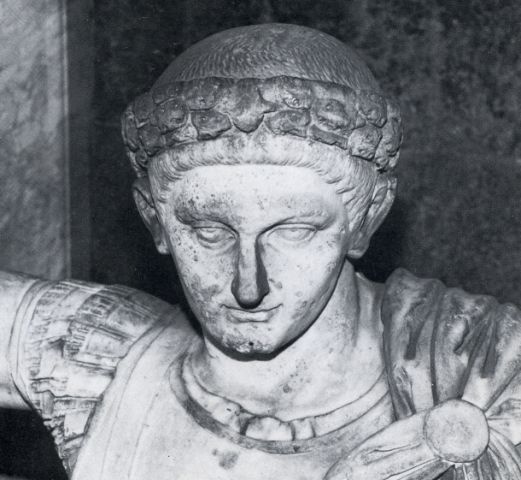
The portrait head has been re-worked from an earlier portrait. The present hair above the wreath and behind the ears sits tightly to the skull and has little to no representational detail. The hair over the brow is rendered (with a flat chisel) in a series of locks which curve inwards. The face lacks depth, and the loss of the ear (here right) is typical in portraits which once had fuller hair that may once have touched or covered the ears. The pupil, preserved only on the left side, is marked by a large drill hole. The drill holes in the oak leaves of the crown belong to the first use of the portrait.
PROVENANCE
This statue was found on the Quirinal Hill in the 15th century with three other statues. The four statues are recorded in different sources between 1445-1463. One of the statues, reportedly inscribed CONSTANTINUS AUG, is lost; the other two are LSA-555 and LSA-559. For more on this, see below and LSA-2302. Probably all of the statues were part of the decoration of the Baths of Constantine on the Quirinal which was dedicated in c. 315. This statue is larger than the other two extant ones and was probably not from the same monument.
LOCATION
Betwen 1536 and 1544 the statues found on the Quirinal were brought to the area of the Capitoline. This statue was moved in 1737 by Clement XII to the new front hall of the Lateran.
INSCRIPTION
Constantinus Aug(ustus)
Constantine Augustus
DESCRIPTION (Subject)
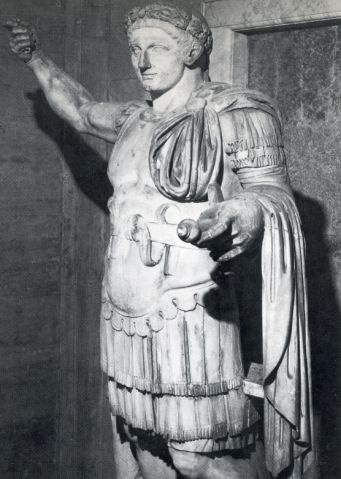
The statue shows an Emperor dressed in military armour and wearing a corona civica with a central jewel. The head, which turns to its left, shows a man with short hair that is combed forward.
The weight of the statue was over the right leg. The left arm was lowered and bent so that drapery fell over the forearm. The right arm was raised. He holds a sword in his left and would have held a staff or sceptre in his right hand.
The dress consists of a cloak fastened on the left shoulder by a round fibula; an undecorated metal breast plate with the leather shoulder flaps and skirt; a short tunic; and a broad belt across the waist. The metal breast plate features no ornamental detail. On the head is a crown of oak leaves.
The ends of the hair form a regular arch over the brow. At the temples the regularity of the arch is broken by longer hair which is unevenly cut.
The oval face is broad across the brow and between the cheekbones. The brow is unmarked and tall. The bridge of the nose indents significantly which suggests a hooked nose. The eyes are large, and the hollows beneath them are indicated. There are creases at the corners of the nose, which suggest that it had an extended point, and at the corners of the up-turned mouth. Beneath the lower lip is an indentation which defines the upper border of the chin.
DATE
It is impossible to determine the relationship between the ancient inscribed plinth and the statue. The statue has been identified as Constantine on the basis of the portrait. Zanker considered the head possibly a variation of Constantine’s main type (see LSA-558). Von Heintze believes that it is Constantine I and that on the basis of stylistic criteria and the young face considers it to pre-date LSA-555 and LSA-559 by a quarter of a century.
Zanker, however, also suggests that this statue may represent the same prince as LSA-559 and LSA-1064. Since the inscription does not necessarily belong to this statue and since this head is youthful and the face a round oval, this hypothesis has immediate appeal.
Whether the portrait is that of Constantine or his son Constantine II, it should date between 312 (Constantine’s defeat of Maxentius) and 340, the death of Constantine II.
COMMENT
H. von Heintze (pp. 407-408) attributes the restoration of this statue in 1594 to Ruggiero Bescapè. Presicce Parisi, see LSA-558, thinks that this is a reference to the colossal Constantine. Probably this statue was restored earlier since early references speak of three statues of Constantine.
It seems to this author that there may be a simple solution for the discrepancy between three and four statues. In 1445-6 F. Blondo speaks of four statues on whose bases the name Constantine is inscribed; Signorelli at the beginning of the 1400s speaks of three bases; a codex of inscriptions by Felicianus in 1463 was emended to add a fourth statue for CONSTANTINUS AUG; Fulvius in 1513 and 1527 notes three statues (for references, see Heintze, pp. 400-401). Could it not simply be that there were originally two well-preserved statues LSA-555 and LSA-559, an upper body LSA-556, and a plinth (perhaps even with some fragment of a statue) inscribed Constantinus Augustus. They were condensed into three by the combination of the upper body and plinth, probably when they were moved to the Capitoline.
Discussion references
- Delbrueck, R., Spätantike Kaiserporträts. Von Constantinus Magnus bis zum Ende des Westreichs , Leipzig 1933, 118-19, pls. 33-5
- Fittschen, K. and P. Zanker, Katalog der Porträts in den Capitolischen Museen und den anderen kommunalen Sammlungen der Stadt Rom, Band I, Mainz 1985, (2)1994, 147, 151 no. 13 (Zanker: perhaps loose version of Constantine but probably son)
- L'Orange, H. P., Das spätantike Herrscherbild von Diokletian bis zu den Konstantin-Söhnen, 284-361 n. Chr. Das Römische Herrscherbild. III. Abteilung ; Bd. 4 , Berlin 1984, 126-7, pls. 42e, 43, and 44
Cite: Last Statues of Antiquity, LSA-556.