
LSA-557
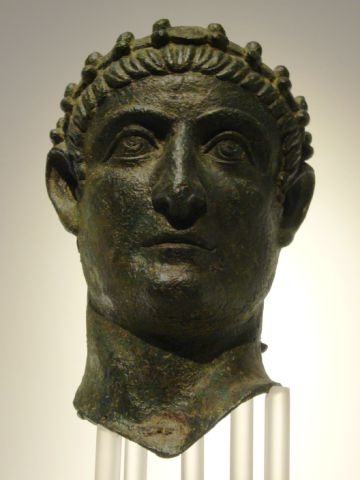
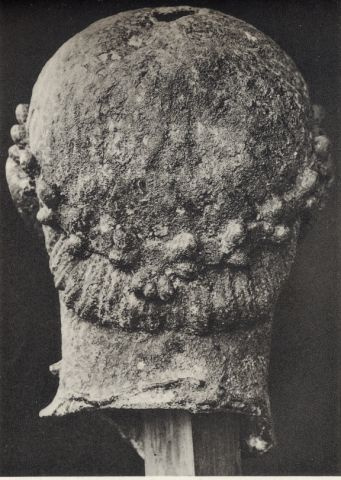
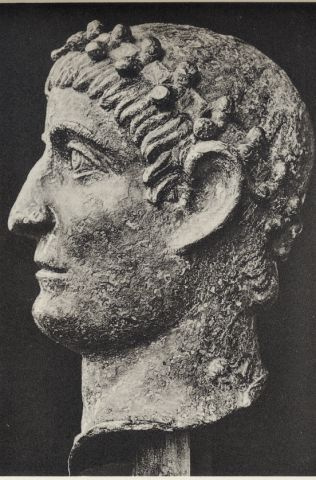
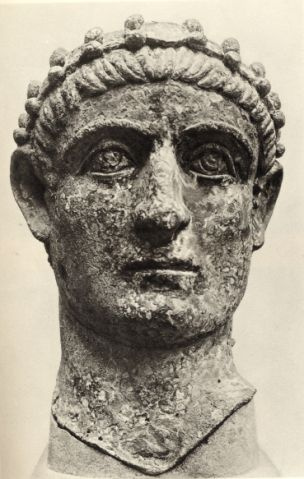
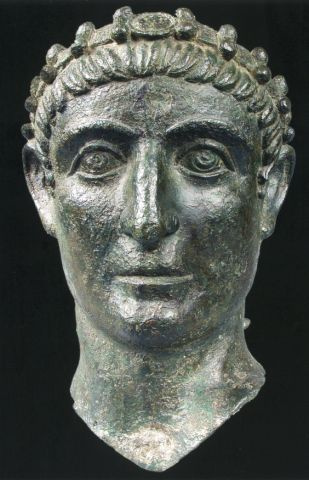
Gilded bronze portrait head of Constantine I. Naissus (Dacia Mediterranea). 325-330
Record details
Photographs
Bibliography
- Delbrueck, R., Spätantike Kaiserporträts. Von Constantinus Magnus bis zum Ende des Westreichs , Leipzig 1933, 119-21, pls. 35-6
- L'Orange, H. P., Das spätantike Herrscherbild von Diokletian bis zu den Konstantin-Söhnen, 284-361 n. Chr. Das Römische Herrscherbild. III. Abteilung ; Bd. 4 , Berlin 1984, 120, pl. 48a-b.
Discussion
DESCRIPTION (Object)
Male portrait head with neck, H (total) 36, (face) 24 cm. The boarders of the neck are smooth; the head was cast separately to be combined with a statue body. At the left side of the neck there is a small protuberance, probably to fix an attire. There are two irregular holes on the apex. There are traces of gilding on the ears and eyes.
The hair is made of long parallel strands combed forward from the centre of the crest. It is treated summarily on the apex; below the diadem it forms into single compartments.
The iris is circumscribed by an engraved line. The pupils were attached separately (Delbrueck 1933, 120). The eybrows are marked by short incised parallel lines.
The cheekbones and chin are prominent, the areas in between scarsly modelled.
PROVENANCE AND CURRENT LOCATION
The head was found in 1900 during construction work of a bridge in central Niš (Vasić 1901, 47). It is today in the Belgrade National Museum, inv. no. 79.
DESCRIPTION (Subject)
Portrait of a clean shaven male with lank hair, wearing a diadem. The diadem has a medallion above the centre of the brow and is made up of rectangular plaques connected by pearls or jewels (see below, 'Honorand and Date'). The compartments of hair below the diadem are arranged towards the centre above the brow and turn towards the ears above the temples. The eyes are large, with arching eybrows; the prominent chin suggests energy.
HONORAND AND DATE
The diadem makes sure that the portrayed is an emperor, as does the hair arranged into the 'imperial pattern' (σχῆμα βασιλικόν) introduced into imperial representation by Constantine I. The diadem provides a terminus post quem of 325, the year of Constantine’s vicennalia, when he was first represented with this attribute.
Vasić 1901, the first publisher of the portrait, suggested the portrait to represent Constantine I; this has been unchallenged since. The arrangement of the hair above the brow which is similar on the head of Constantine from his arch in Rome (Delbrueck 1933 pl. 27) and on the colossal head in the Palazzo dei Conservatori (LSA-558) affirm this ascription. The form of the diadem (Kettendiadem, ’chain diadem', Delbrueck 1933, 60) is not testified to after 330 (Delbrueck, l. c.).
Discussion references
- Calza, R., Iconografia Romana Imperiale. Da Carausio a Giuliano (287-363 d. C.), Rome 1972, 227-8, no. 141, pl. 78, 275-6 (Constantine, post 324)
- Demandt, A. and J. Engemann, (eds.), Konstantin der Grosse, Mainz 2007
, no. I.8.3 (J. Rankov Kondić) - Donati, A. and G. Gentili, Costantino il Grande. La civiltà antica al bivio tra Occidente e Oriente, Milan 2005, 213, no. 9
- Fittschen, K. and P. Zanker, Katalog der Porträts in den Capitolischen Museen und den anderen kommunalen Sammlungen der Stadt Rom, Band I, Mainz 1985, (2)1994, 150, no. B 9 (Zanker: new interpretation of main type)
- L'Orange, H. P., Das spätantike Herrscherbild von Diokletian bis zu den Konstantin-Söhnen, 284-361 n. Chr. Das Römische Herrscherbild. III. Abteilung ; Bd. 4 , Berlin 1984, 119 (late portrait of Constantine)
- Vasić, M. M., Fund von Nisch, Mitteilungen des Kaiserlich Deutschen Archäologischen Instituts, Römische Abteilung 16, 1901, 47-56
Cite: Last Statues of Antiquity, LSA-557 (Ulrich Gehn).