
LSA-558
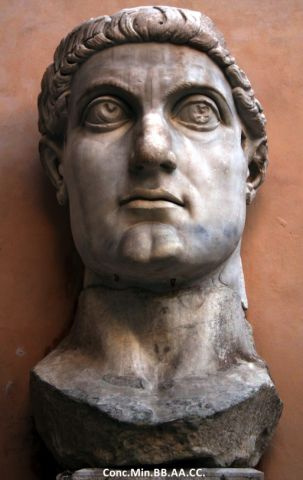
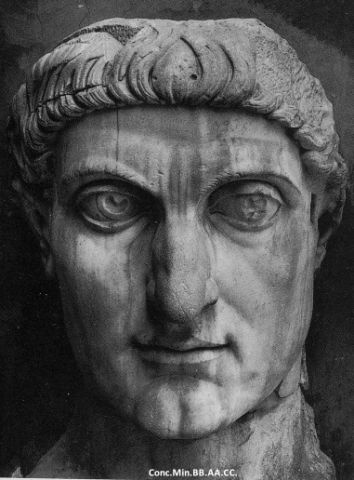
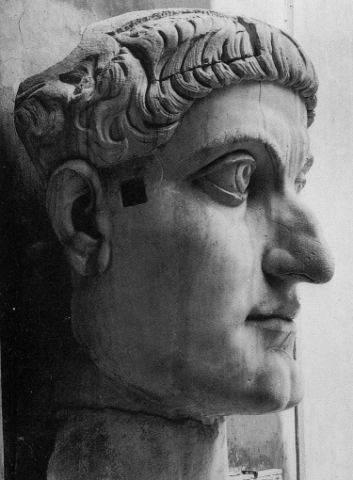
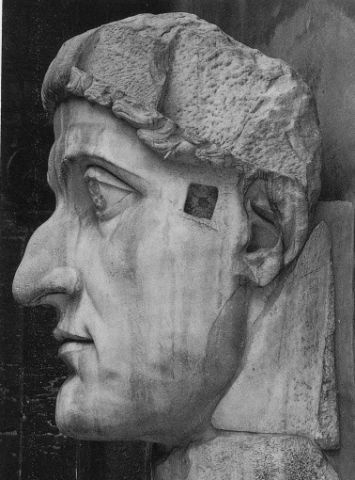
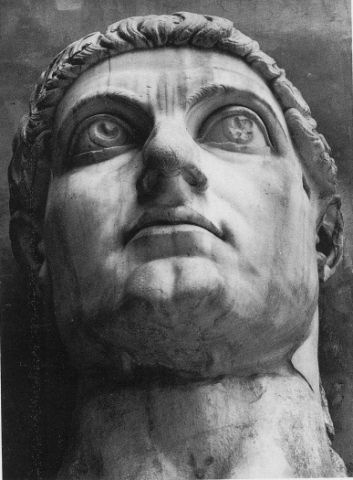
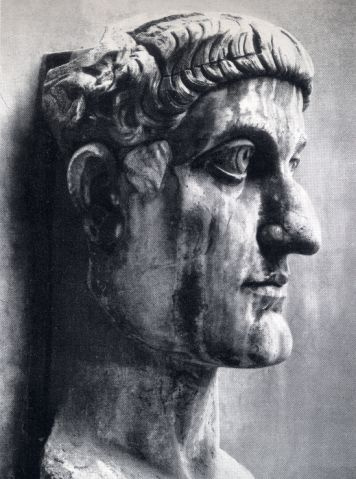
Colossal acrolithic portrait statue of Constantine. Rome. 312-337
Record details
Photographs
Bibliography
- Fittschen, K. and P. Zanker, Katalog der Porträts in den Capitolischen Museen und den anderen kommunalen Sammlungen der Stadt Rom, Band I, Mainz 1985, 146-52, no. 122, pls. 151-2
- Parisi Presicce, C. 'Konstantin als Iuppiter. Die Kolossalstatue des Kaisers aus der Basilika an der via Sacra', Konstantin der Grosse (A. Demandt and J. Engemann, eds.), Mainz 2007, 117-31
Discussion
DESCRIPTION (Object)
Colossal head, worked separately, with body fragments. H (of head and Renaissance neck): 297 cm. H (of chin to crown): 174 cm. Estimated Height of Total Statue: 10 m. Parian marble.
The head and the neck with its adjacent chest, though broken, were thought to be ancient and belong together. In 2007 Parisi Presicce argues that early 16th century drawings show no neck and that archival material shows payment to the sculptor Ruggero Bescapè for the purchase of marble and salary. The neck is furthermore of Cararra marble, and the rest of the statue of Parian.
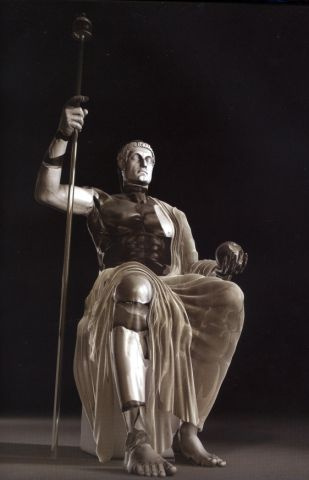
There are ten further fragments of the statue preserved: (1) The left foot (inv. no. 798) which was worked in two pieces. The repairs of the second and third toes seem to be ancient. The heel was raised, and the upper edge was attached to an area of clothing. (2)-(5) The right foot, the right shin (inv. no. 785), a slice of the right upper calf (inv. no. 793) which fits against the back of the knee, and the right knee worked for drapery to hang off both sides. (6) The right upper arm, elbow, and some of the lower arm. (7) A small fragment of the lower arm, which was found in the 20th century (MC dep. 12). (8) The right hand which is broken directly below the thumb (inv. no. 789) and which held a staff-like object for which there is a depression in the upper side of the hand. (9) Part of the left breast, which was found in 1951 and is currently in the Antiquario del Foro Romano. Its proper left edge seems to have been covered with drapery. (10) A fragment of the separately-worked, right sideburn which was published still on the head by Kähler (fig. 16) in 1952.
CONDITION OF HEAD
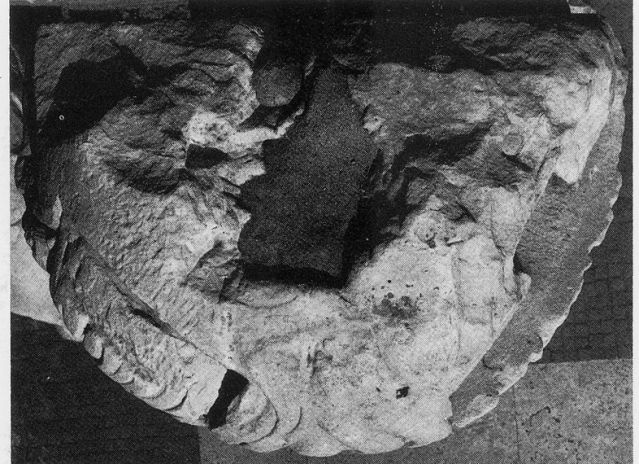
The back of the head has been removed to lessen the weight and to allow for trusses and clamps. The surface has been regularly worked. No longer attached to the head are the separately worked sideburns, the right of which is preserved (see above). There are square dowel holes in front of both ears for their attachment.
The areas of hair around the temple were also worked separately. On the left side this area, which includes also the upper edge of the ear, is missing. The top of the head preserves a large lewis hole for lifting it from the quarry. Over the centre of the brow in the hair are two circular holes. There are two iron clamps protruding beneath the chin. They are presumably modern and belong with the Renaissance restoration.
The hair is rendered with mainly flat chisel work; there are however also drill channels. The perimeter line of the irises and edge of the right inner canthus are engraved. The pupils are large drilled out U-shapes. The line between the lips is also drilled out.
The portrait has been re-worked out of an earlier head, possibly an imperial portrait or a divinity, which wore a beard. The evidence for this includes: the recessed brow, the cut back surface in front of both ears, the uneven surface under the jaw on the throat, the separately-worked areas of hair, and the remnants of previous hair, especially around the right ear and on the top of the head, which do not follow the Constantine portrait type. The large eyes and eyebrows belong to the original portrait.
PROVENANCE
The head and body parts were found by Pope Innocent VIII in the west aspe of the Basilica of Maxentius in 1486. The drawing made by eye-witness Giorgio Martini also shows two large rectangular bases or plinths.
Kähler asserted that, because the west apse had a lower or cellar level , it could not have been intended as the original location for a 10 m statue in marble. Throughout the 20th century it was believed that the building plan was changed after completion to accommodate a southern entrance on the Via Sacra and a new northern apse across from that entrance; at which point it was imagined that the statue was moved to the west aspe. Yet the most recent research suggests that the porch and apse were contemporary additions to the plan.
CURRENT LOCATION
The fragments were brought to the Capitoline. In 1594 the head was incorporated in a fountain in the area of the Palazzo Nuovo. At this point Parisi Presicce argues that it acquired its neck. C. 1636 the hand and left foot were set in the courtyard. In c. 1642 the right hand was restored. In 1672, when the upper part of the fountain was destroyed, the head was also brought to the courtyard. Between 1767 and 1804 the left foot was restored with its heel. The hand was removed from the shared base and put on another base in the left part of the Courtyard. All other fragments were by that time there. In 1829 a second colossal right hand was acquired which was moved between 1834-7 on to a base inscribed Divus Constantinus. It was thereafter mistakenly associated with the colossal statue.
DESCRIPTION (Subject)
The head and body fragments belonged to a seated acrolithic statue of c. 10 m; the exposed body parts were in marble and the drapery perhaps in bronze. The statue showed the Emperor Constantine, seated in the guise of Jupiter. He wore a cloak around his waist and had an end of it set on this left shoulder. He held a sceptre in his right hand.
The head combines a specific physiognomy on a colossal scale with unusually large and stiffly rendered eyes. The face is long with protruding cheekbones and a prominent chin with a cleft. The brow swells beneath a single furrow. The eyebrows arch symmetrically and the eyes, immediately beneath them, are large and look to the left. The nose is markedly hooked and pointy. The mouth is small with creases at the corners. The sterno-mastoids are defined on the front of the neck. Asymmetries in the facial structure suggest that the head turned to its right.
The hair is brushed forward onto the brow; the ends turn inwards and converge centrally over the nose. The hair at the temples is longer and comes farther forward. On the right side large S-shaped locks are preserved around the ears.
IDENTIFICATION
The portrait represents Constantine whose distinctive physiognomy is readily recognizable. This statue may even be that described by Eusebius (Hist. eccl. 9.9.10-11). Eusebius spoke of a cross held in the Emperor’s right hand. This literary reference and the confusion over which colossal hand in the Capitoline collection belonged to the statue have given rise to misleading arguments.
DATE
Three portrait types for Constantine have been identified from coinage. The first type was created for him as Caesar in 306. A second type, apparently commemorating his five-year anniversary and new status after the defeat of Maxentius, appears in 311. This portrait appears to correspond to this main portrait type of which there are c. 15 versions. Although a new image featuring a crown was created probably c. 325, the main type could still have been used until Constantine’s death.
This has led to scholarly debate as to whether this head belongs immediately after 310 or later in the 330s. Context and arguments positing a crown have been used as evidence for early and late dates.
Stylistic arguments also abound. Zanker, following Bergmann, for example, considers the stylistic details of the head closer to the tradition of the Tetrarchs (especially of the so-called Maxentius type LSA-895,LSA-896, and LSA-897 ) than to later works such as the bronze Constantinian Emperor in the Conservatori LSA-562 and Dogmatius, LSA-903. This is the most accepted argument.
RE-USE
Twentieth century scholarship proposed various hypotheses for the original head. Many of these were misled by the neck and wrong hand fragment which made the statue seem to be made of a variety of different marbles.
Most assumed that the statues was already in the Basilica and therefore previously represented Maxentius (Cecchelli, Jucker, Coarelli, Varner, Giuliani, Zanker). Zanker proposes that before it represented Maxentius, it was the statue of a god. Evers suggested that it was a re-worked Hadrian. La Rocca proposed that it was a composite of numerous acroliths. L’Orange suggested that it was Constantine and the re-worked to include his diadem and cross.
Most recently, Parisi Presicce notes that, since it is made of Parian marble, it probably does not date after the Hadrianic period.
Discussion references
- Delbrueck, R., Spätantike Kaiserporträts. Von Constantinus Magnus bis zum Ende des Westreichs , Leipzig 1933, 121-30, pls. 37-44
- Kähler, H. 'Konstantin 313', Mitteilungen des Deutschen Archäologischen Instituts, Römische Abteilung 67, Berlin 1952, 1-30, figs. 7-9, 16-17
- L'Orange, H. P., Das spätantike Herrscherbild von Diokletian bis zu den Konstantin-Söhnen, 284-361 n. Chr. Das Römische Herrscherbild. III. Abteilung ; Bd. 4 , Berlin 1984, 125, pls. 50-52, 53a-b, 54
Cite: Last Statues of Antiquity, LSA-558 (J. Lenaghan).