
LSA-559
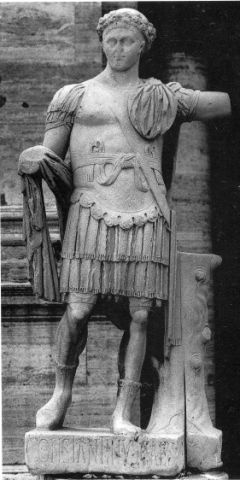
Inscribed portrait statue of Constantine II in armour. Rome. 317-337.
Record details
Photographs
Bibliography
- Corpus Inscriptionum Latinarum; , VI, no. 1150
- Fittschen, K. and P. Zanker, Katalog der Porträts in den Capitolischen Museen und den anderen kommunalen Sammlungen der Stadt Rom, Band I, Mainz 1985, 145-47, no. 121, pls. 149-50
Discussion
DESCRIPTION (Object)
Over life-size statue. H (without plinth): 282 cm. H (chin to crown): 37cm. Lttr H: 14-15 cm. Marble
The right hand and left forearm are missing. The nose is missing. The surface is generally worn.
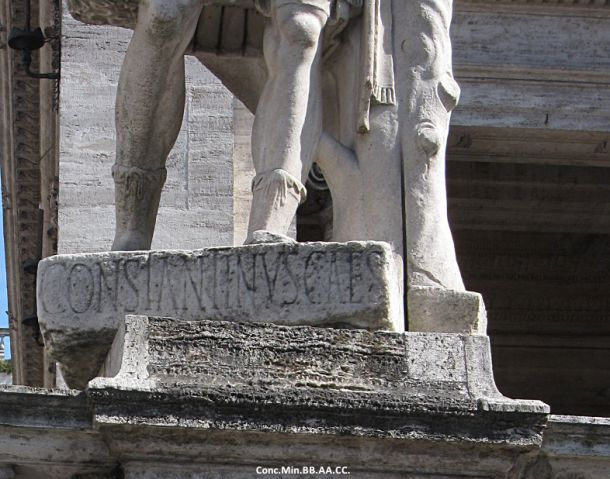
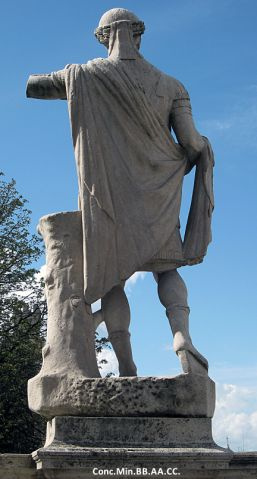
The statue stands on a thick plinth which has been re-shaped. A quadrant of the front left corner of the plinth has been carefully cut away. The line of the cut continues vertically and evenly upwards through the tree-trunk statue support. The back corners have both been cut diagonally back and finished smoothly; in contrast to the rest of the back surface which is only roughly picked.
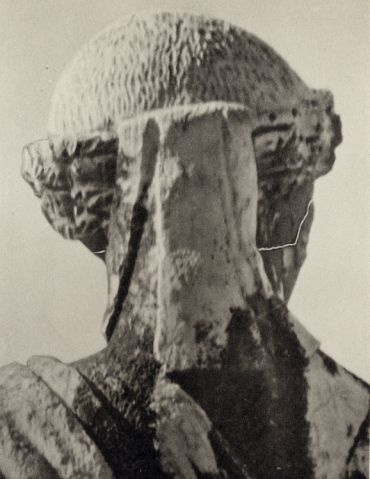
The statue is supported by a large tree trunk on the outside of the left leg. A strut, in form of a branch, extends between the left calf and the tree trunk. The raised right foot is supported by a large wedge of marble. The ties of the crown are left summarily rendered en bloc to create essentially a neck pillar.
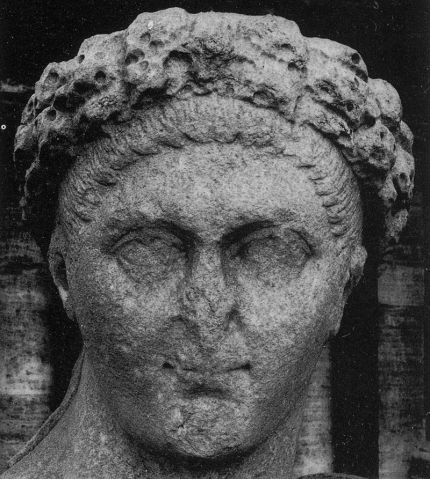
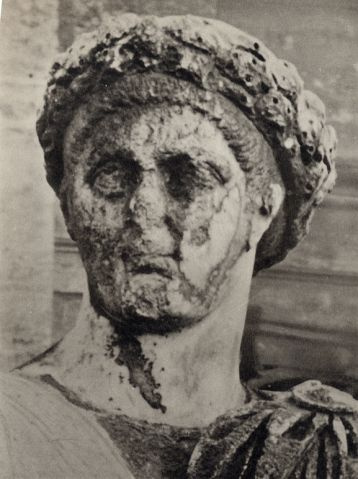
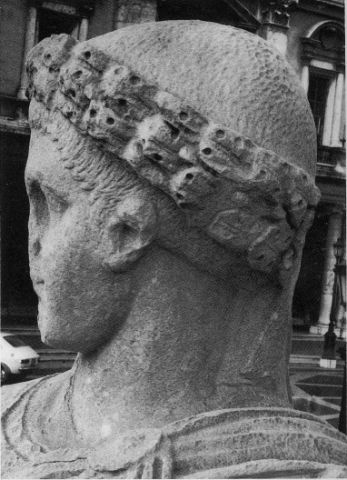
The portrait head has been re-worked from an earlier portrait. The face is too small for the body and lacks depth; this is especially evident in the right profile. The present hair is rendered with a flat chisel below the crown and above the crown all of the original hair has been removed and the surface of the resultant dome shape has been worked over with a combination of point and flat chisel. The leaves of the crown are defined by drilling, and the crown belongs the first use; however, its upper edge has been sharply cut.
The eyeballs have marked pupils and drill points in the inner corners. The crease in the brow, the drill points at the corners of the mouth, and the short indentation defining the upper limit of the chin belong to the second use.
PROVENANCE
The statue was found on the Quirinal Hill in the 15th century with three other statues, one of which is lost (see, LSA-555, LSA-556, LSA-2302). Probably they were part of the decoration of the Baths of Constantine on the Quirinal in c. 315. The larger size of LSA-556 may indicate that all four were not part of one contemporary honorific monument. Between 1536 and 1544 there is discussion only about three statues. In 1653, this statue and LSA-555 were mounted in their current location.
INSCRIPTION
Constantinus Caes(ar)
Constantine Caesar …
DESCRIPTION (Subject)
The statue is identified as Constantine II by its plinth and was conceived as a pendant statue to one of Constantine LSA-555. The two statues are similar in dress, attributes, and even facial representation. The differences are only the position of the left arm and the placement of the cloak.
Here again the weight of the statue is over the left leg, and the heel of the right foot is raised. The head looks to its right. Again the cloak is wound around a bent right arm. The left arm extends away from the body and the upper arm remains at shoulder level. The forearm was presumably raised above the head and held again a staff.
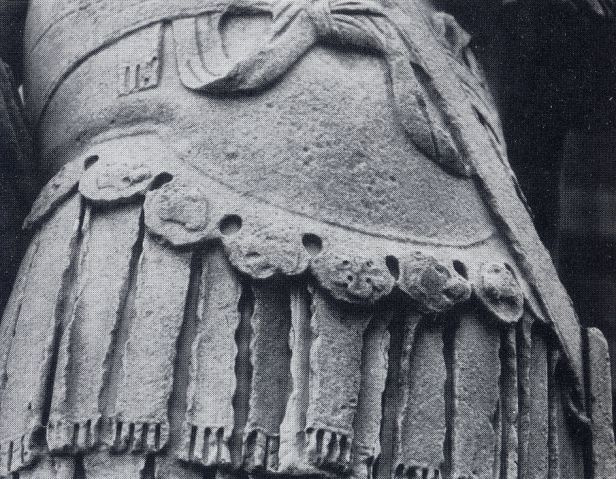
The prince wears a cloak held together by a round fibula on the left shoulder; a metal breast plate with the leather shoulder flaps and skirt of two tiers of flaps; a short tunic; a broad belt across the waist; a sword strap and scabbard (along the straight left leg); and tall closed boots. On the head is a crown of oak leaves.
The face is oval, and this is accentuated by the arch of the fringe over the brow. The brow has one furrow. The eyes are large and close-set. The nose is short with a horizontal crease at the bridge and broad nostrils. The mouth is small but smiling. The projection of the chin is rendered by a crease under the lower lip.
The hair is short and combed forward. Over the brow, the hair ends in pointed locks, all of which turn inwards. They converge over the inner corner of the right eye. Behind the ears the hair is cut short.
THE PORTRAIT TYPE
Zanker notes differences between this portrait, which he considers younger, and that of LSA-555. The crease on the brow is less deep. The arch of hair over the brow rises higher and ends in points. The cheekbones are less pronounced. Thus, the portrait statues, which were put up presumably at the same because of their technical similarities, were intended to represent different individuals.
Zanker considers this statue to represent the same prince as l>556">LSA-556 and l>1064">LSA-1064.
DATE
The statue is a pendant to LSA-555. The two were probably erected between 317, when Constantine II became Caesar, and 337, when Constantine I died. Although Zanker sees no difficulty in the use of an adult statue for a child, it seems perhaps easier to imagine that the group was set up c. 335.
COMMENT ON THE INSCRIPTION AND PLINTH
The plinth has certainly been re-shaped. Zanker imagines that it might have had an original use and then a second use, for example, Crispus, and then was taken back for Constantine II and the corner removed.
It seems to this author that orthogonal cuttings on a plinth are more likely to be the result of fitting statues into spaces for which they were not originally designed. Since the pendant statue, l>555">LSA-555, has suffered similar alteration, I suggest that this has to do with secondary placement rather than name-changing.
Discussion references
- Delbrueck, R., Spätantike Kaiserporträts. Von Constantinus Magnus bis zum Ende des Westreichs , Leipzig 1933, 135-6, pls. 46-8
- Heintze, H. von. "Statuae quattuor marmoreae pedestres quarum basibus Constantini nomen inscriptum est", Mitteilungen des Deutschen Archäologischen Instituts, Römische Abteilung 86, Mainz 1979, 399-407, 417-37, pls. 129.3, 131, 132.2, 133.2, 134.2, 135.2, 137.2 (especially for history and plinths)
- L'Orange, H. P., Das spätantike Herrscherbild von Diokletian bis zu den Konstantin-Söhnen, 284-361 n. Chr. Das Römische Herrscherbild. III. Abteilung ; Bd. 4 , Berlin 1984, 137-8, pls. 41, 42b, and 42c
Cite: Last Statues of Antiquity, LSA-559.