
LSA-56
Base for statue of Plutarchus, governor of Achaea. From Megara (Achaea). 326-360.
Record details
Photographs
Inscription
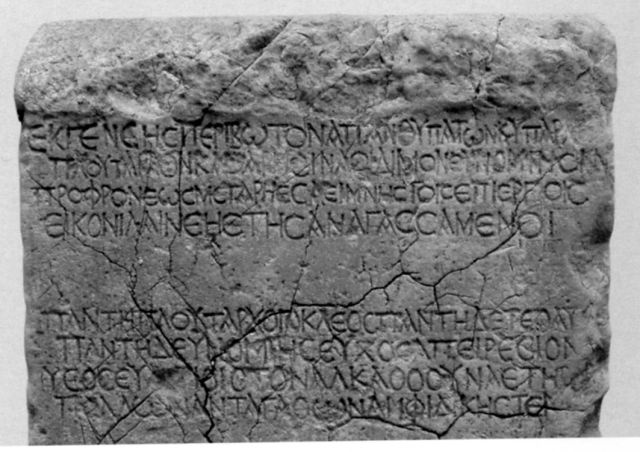
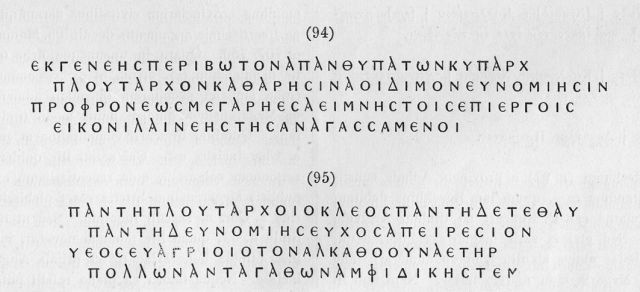
ἐκ γενεῆς περίβωτον ἀπ’ ἀνθυπάτων καὶ ὑπάρχων
Πλουτάρχον, καθαρῇσιν ἀοίδιμον εὐνομίῃσιν,
προφρονέως Μεγαρῆες ἀειμνήστοις ἐπὶ ἔργοις
εἰκόνι λαϊνέῃ στῆσαν ἀγασσάμενοι.
Πάντῃ Πλουτάρχοιο κλέος, πάντῃ δέ τε θαῦμα,
πάντῃ δ’ εὐνομίης εὖχος ἀπειρέσιον,
υἱέος Εὐαγρίοιο, τὸν Ἀλκαθόου ναετῆρες
πολλῶν ἀντ’ ἀγαθῶν ἀμφὶ Δίκης τεμένει.
Inscription translation
The people of Megara willingly set up the widely famous Plutarchus in this marble statue, from a family of proconsuls and prefects, laudible for his purity and justice, deeply rejoicing in his unforgettable works.
Everywhere the fame of Plutarchus, everywhere astonishment, everywhere immense praise of the justice of the son of Euagrius; the inhabitants of Megara [set this up to] him at the sanctuary of Dike for his many good deeds.
Bibliography
- Inscriptiones Graecae, IV(2) 1129
- Inscriptiones Graecae, VII 94, 95
Discussion
INSCRIPTION
Eight lines of verse, consisting of two four-line epigrams separated by a clear space:
ἐκ γενεῆς περίβωτον ἀπ’ ἀνθυπάτων καὶ ὑπάρχων
Πλουτάρχον, καθαρῇσιν ἀοίδιμον εὐνομίῃσιν,
προφρονέως Μεγαρῆες ἀειμνήστοις ἐπὶ ἔργοις
εἰκόνι λαϊνέῃ στῆσαν ἀγασσάμενοι.
Πάντῃ Πλουτάρχοιο κλέος, πάντῃ δέ τε θαῦμ̣[α],
πάντῃ δ’ εὐνομίης εὖχος ἀπειρέσιον,
υἱέος Εὐα̣[γ]ρ̣ίοιο, τὸν Ἀλκαθόου ναετῆρ[ες]
πολλῶν ἀντ’ ἀγαθῶν ἀμφὶ Δίκης τεμένη.
'The people of Megara willingly set up the widely famous Plutarchus in this marble statue, from a family of proconsuls and prefects, laudible for his purity and justice, deeply rejoicing in his unforgettable works.
Everywhere the fame of Plutarchus, everywhere astonishment, everywhere immense praise of the justice of the son of Euagrius; the inhabitants of Megara [set this up to] him at the sanctuary of Dike for his many good deeds.'
The two epigrams are each made up of two elegiac distichs. We are following the edition of the text in IG IV (2). Letters underlined are those recorded by earlier editors, but no longer legible for this, the most recent, edition.
DESCRIPTION (from IG IV (2) and the published photo)
Rectangular base of grey marble, once with mouldings at top and bottom; the upper moulding has been roughly cut back. The epigraphic field is smoothly finished, and extends over the whole width of the base. According to IG, on the top surface there are 'two smaller holes and two bigger ones with cast channels'. The right edge of the front face is chipped, causing damage to the ends of several lines of the inscription. Thin cracks spread over the whole surface; and there is a small area of deeper damage in line 3 of the second epigram. The base was re-used later in the 4th century for the statue of Phosphorius (LSA-57).
PROVENANCE AND CURRENT LOCATION
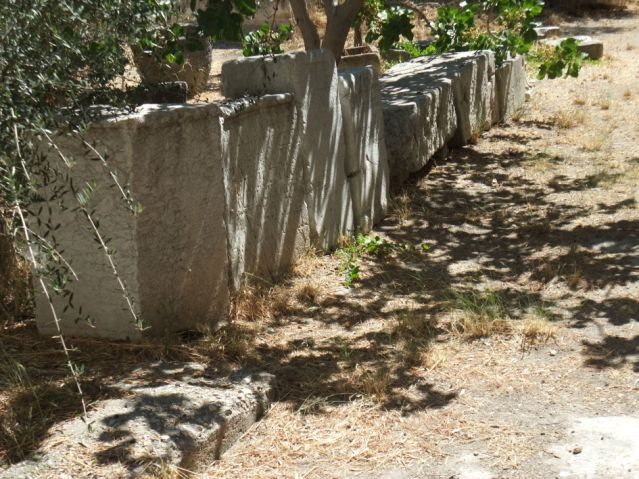
In 1828 the base was recorded built into a wall of the Venetian castle of Nisaia, the port of Megara, by the Corpus Inscriptionum Graecarum ('Nisaeae in pariete Castelli'). According to IG VII, it was 'later brought to Aegina (postea translata Aeginam)'. Transfers of antiquities to Aegina took place after the city became the first capital of an independent Greece in 1828, and here Greece's first archaeological museum was set up and opened in 1829. Our base for Plutarchus (later re-used for Phosphorius, LSA-57) is one of those today standing in front of the old Archaeological Museum in Aegina (and inacessible to the public).
Its original location 'at the sanctuary of Dike (ἀμφὶ Δίκης τεμένη)' (line 8) - referring to Dike, a goddess of Justice - is almost certainly not a reference to a real temple, but to the law-courts of the city, where Dike, and the values she represented, were honoured.
HONORAND, AWARDER AND DATE
L. Robert has pointed out that the virtues lauded in this inscription (Justice and Purity), and the praise for the honorand's office-holding ancestors, strongly suggest that the honorand too was a governor, presumably of Achaea (Robert 1948; PLRE I, 707-8 Plutarchus 3).
He is styled 'son of Euagrius' in the second epigram (line 3), referring probably to Constantine I's praetorian prefect of the East (Robert 1948, 101 with n. 3; PLRE I, 284-5 Evagrius 2). He was also probably the father of another Plutarchus, governor (praeses) of the Islands under Julian (Robert 1948, 101-2; PLRE I 708 Plutarchus 4). These indicators strongly suggest a date in the first half of the 4th century for our man. As a terminus post quem we have suggested the date of his father's first praetorian prefecture in 326, and as a terminus ante quem his son's governorship in the 360s.
This Plutarchus is not the same man as his namesake, the sophist Plutarchus in Athens (PLRE II, 893-4 Plutarchus 2, cf. LSA-134, LSA-136, and LSA-137), as IG VII had suggested (followed by Real-Encyclopädie VI).
The people of Megara are styled 'inhabitants of Alcathous' (Ἀλκαθόου ναετῆρες) in the second epigram, alluding to the eponymous hero of the western Acropolis of Megara (Real-Encyclopädie I).
Discussion references
- Corpus Inscriptionum Graecarum; , Vol. I no. 1080
- Jones, A. H. M. et al., The Prosopography of the Later Roman Empire. Vol. I 260-395, Cambridge et al. 1971 (1975)
- Martindale, J. R., The Prosopography of the Later Roman Empire. Vol. II A.D. 395-527, Cambridge 1980
- Robert, L., Epigrammes du Bas-Empire (Hellenica IV), Paris 1948, 94-102
- Wissowa, G. (ed.), Paulys Realencyclopädie der classischen Altertumswissenschat, Stuttgart, 1894-, I, 1894, 1510-11 Alkathoos 1 (Knaack)
- Wissowa, G. (ed.), Paulys Realencyclopädie der classischen Altertumswissenschat, Stuttgart, 1894-, VI, 1909,830 Euagrius 2 (Seeck)
Cite: Last Statues of Antiquity, LSA-56 (Ulrich Gehn).